
FAQs
How to Fit 8WTC Around a Demanding Job
The 8 Week Transformation Challenge adapts to unpredictable work schedules through home workouts, flexible macro targets, and weekly consistency tracking. This guide shows how to fit four weekly workouts around chaotic hours without rigid timetables.

Yes. The 8 Week Transformation Challenge works around unpredictable work schedules. Home workouts, flexible macro targets, and the ability to log meals whenever you eat mean you can train and fuel on your terms, not a rigid timetable. The programme measures consistency as a weekly average, not daily perfection. Even when work throws unexpected demands your way, the app's tools and the structure itself let you adapt without falling off track.
This piece addresses real friction points that fence-sitters raise: time, cost, beginner readiness, gym access, and whether the results last. It draws on the programme's design and verified policies.
Key takeaways: Managing 8WTC around unpredictable work
You don't need a fixed schedule. Home workouts, flexible meal timing, and macro-based tracking eliminate rigid gym slots or preset eating windows.
Consistency is measured over the full eight weeks, not day-to-day. One missed session or imperfect meal doesn't derail progress. Meal prep on quieter days and anchor workouts at times you can protect. That approach makes the challenge sustainable even during demanding weeks. Over 10,000 documented transformations prove the structure works across different lifestyles; the app carries a 4.9 rating from member reviews, reflecting real user experience with the tracking tools.
The programme is designed around life happening.
What it means: Fitting a fitness plan into a chaotic schedule
Unpredictable work schedules, shift patterns, irregular calls, travel, or last-minute demands, make traditional fitness plans feel impossible. You can't block 06:00 for the gym three days a week if you don't know when you'll finish work. You can't meal-prep Sunday if you're on-call that day.
The 8WTC model removes these barriers.
Home workouts need only bodyweight, resistance bands, dumbbells, or a kettlebell. Flexible dieting lets you eat different foods on different days and still hit your calorie and macro targets. The app's barcode scanning and meal-logging tools work whenever you have five minutes to log, not at a preset meal time. This flexibility isn't laziness, it's realism built into the programme design.
Workouts stay at four per week. That's the prescribed structure. But you choose when in the week those four happen. Finish late on Monday? Shift your workout to Wednesday. Travel unexpectedly? Use the hotel gym or a bodyweight session in your room. This distinction between when you train and how many times you train matters: you're not changing the programme, you're fitting it around real life.
Why it matters: Consistency is measured over eight weeks, not day-to-day
Most fitness guidance assumes predictability. Meal plans assume you'll eat at the same times. Training splits assume you'll be in the gym on set days. That framework fails the moment work disrupts it.
The 8WTC approach flips this.
You're not chasing perfection on a Tuesday or a Thursday. You're aiming for a weekly average that holds across the full eight weeks. If you miss a workout because work ran over, you reschedule it for another day that week. If you can't log your food at lunch, you log it at dinner. If a meal-prep plan fails because of travel, you adjust your food choices but keep hitting your macro targets. The app lets you do this without penalty. The programme's structure expects it.
This matters because it's the difference between a plan that works for Instagram-famous people with controlled schedules and a plan that works for people with real jobs and real constraints.
How it works: Structure for unpredictable schedules
The 8WTC challenge runs for eight weeks. You complete four workouts per week, each lasting 45-60 minutes. You log your diet macros and weekly check-ins. Those components are fixed. Everything else flexes.
Assessing your baseline
Before starting, map your typical work pattern: peak times, travel frequency, common late finishes. Identify windows where you can realistically fit training and meal prep. This isn't about being perfect. It's about knowing what you're working with.
If you work shifts, identify your quietest days. If you travel, check whether your destinations have gym access or if you'll be training at home. If you have unpredictable calls, think about whether early morning, lunchtime, or evening works best when that disruption hits.
This upfront thinking prevents the "I'll just wing it" approach that leads to missed sessions.
Choosing home or gym
8WTC workouts can happen at home or in a gym. Equipment needs range from bodyweight only to barbells and machines, depending on your phase. If your schedule is unpredictable, home workouts offer a safety net: no travel time, no access barriers, no waiting for equipment.
If you travel frequently, pack resistance bands or a jump rope. Hotel gyms often have enough to run a solid workout. Many members combine home and gym sessions depending on where they are that week.
Home Workouts vs Gym: Which Fits Your 8-Week Challenge? covers this decision in depth.
Strategic scheduling of workouts
You have seven days to fit four workouts. This gives you flexibility that a fixed three-day-a-week plan doesn't have.
If you know Monday is always hectic, don't plan a workout there. If Wednesday is usually light, anchor a session on Wednesday. If Thursday and Friday are chaotic but Saturday mornings are sacred, run two workouts on Saturday and Sunday instead.
The point is protecting time you can defend, not fighting your schedule.
Optimising nutrition
Flexible macro tracking means you're hitting protein, carb, and fat targets, not following a fixed meal plan.
On quieter days (often Sunday), prepare components: cooked chicken, rice, pre-chopped vegetables, portioned carbs. During busy work days, combine these quickly into meals. This isn't gourmet cooking. It's strategic assembly.
Keep portable snacks on hand: nuts, protein bars, fruit, yogurt. When meal times are chaotic, hitting your targets gets harder if you're scavenging. Having snacks available buffers the gaps.
The 8WTC app's barcode scanning feature lets you log meals on the go. Scan a shop-bought salad, a restaurant meal, or a packaged snack right after eating. No need to log at a preset time.
Managing disruptions
Work throws curveballs. The table below shows how the 8WTC structure handles common ones:
| Disruption | Strategy |
|---|---|
| Unplanned late finish | Shift your planned workout to the next available window. Run it late that night, early the next morning, or combine it with another session day if feasible within the four-per-week structure. Home workouts keep you from losing access entirely. |
| Last-minute business travel | Use hotel gyms or bodyweight workouts in your room. Pack resistance bands or a jump rope. Pre-log meals using the app's database for restaurant options or plan for easily accessible healthy choices. |
| Back-to-back meetings | Use breaks for quick, prepared snacks to hit macro targets. If a workout slot is lost, reschedule for a later time in the week. |
| Energy depletion | Listen to your body. On days of extreme fatigue, opt for a shorter, less intense version of your workout if the programme allows, or focus on active recovery and ensure adequate nutrition and sleep. |
The pattern is the same: use the flexibility to adapt, not to skip entirely.
Example or scenario: A typical week with unpredictable work
This example shows how four workouts fit into a week when work is chaotic. Names and results are illustrative; this demonstrates the scheduling logic, not guaranteed outcomes.
Monday: Work late, no workout.
Tuesday: Early start, finish on time. Complete Workout 1 (45-60 minutes) at home before dinner. Log macros.
Wednesday: Travel day, limited time. Complete Workout 2 (45-60 minutes) in the hotel gym after checking in. Pack a prepared meal and log it from your phone.
Thursday: Demanding day, no workout.
Friday: Back home, finish work on time. Complete Workout 3 (45-60 minutes) immediately after work. Log macros. Use prepared meal components to hit your targets.
Saturday: Dedicated time. Complete Workout 4 (45-60 minutes) in the morning. Meal prep for Sunday and Monday.
Sunday: Rest and recovery. Light walking if energy allows. Prepare meal components for the week ahead.
All four workouts fit within the week. None happened on a fixed schedule. The member adjusted to their work reality instead of abandoning the challenge because Tuesday didn't go to plan.
This flexibility is baked into the programme design.
Common mistakes or risks: What derails members with chaotic schedules
The all-or-nothing trap
A missed workout or an imperfect meal often triggers the thought: "I've failed, so I might as well quit." This mentality is the biggest saboteur.
The 8WTC measures progress across eight weeks, not individual days. Miss one session? You still have three more chances that week to hit your four workouts. Eat over your macro targets one day? You have six more days to average it out.
Treat each week as a unit, not each day as a pass-or-fail.
Inconsistent tracking
Unpredictable hours make consistent macro tracking harder. Skipping logging happens when you're exhausted or busy. Skipping logging leads to inaccurate nutritional intake and hinders results.
The app's barcode scanner removes friction. Five seconds to scan and log beats ten minutes of manual entry. When you're tired, the lower barrier matters.
Commit to logging immediately after eating, even if it's late at night or during a break. Five seconds now beats guessing later.
Relying too heavily on flexibility
The programme is flexible, but flexibility without structure collapses. If you don't identify any protected workout time, not even one reliable slot per week, you'll lose sessions to work urgency.
Before starting, identify at least one or two times per week when you can almost always train. Build the other two workouts around that anchor.
Burnout from fitting it all in
Constantly squeezing training into tight windows or sacrificing sleep to train late every night burns you out. Training tired and sleep-deprived slows recovery and increases injury risk.
Prioritise rest as part of the programme. If a week is brutal and sleep is low, run a lighter version of your workouts rather than pushing hard and crashing.
The goal is eight weeks of consistency, not eight weeks of running on empty.
How to choose or what to do next: Suitability checklist
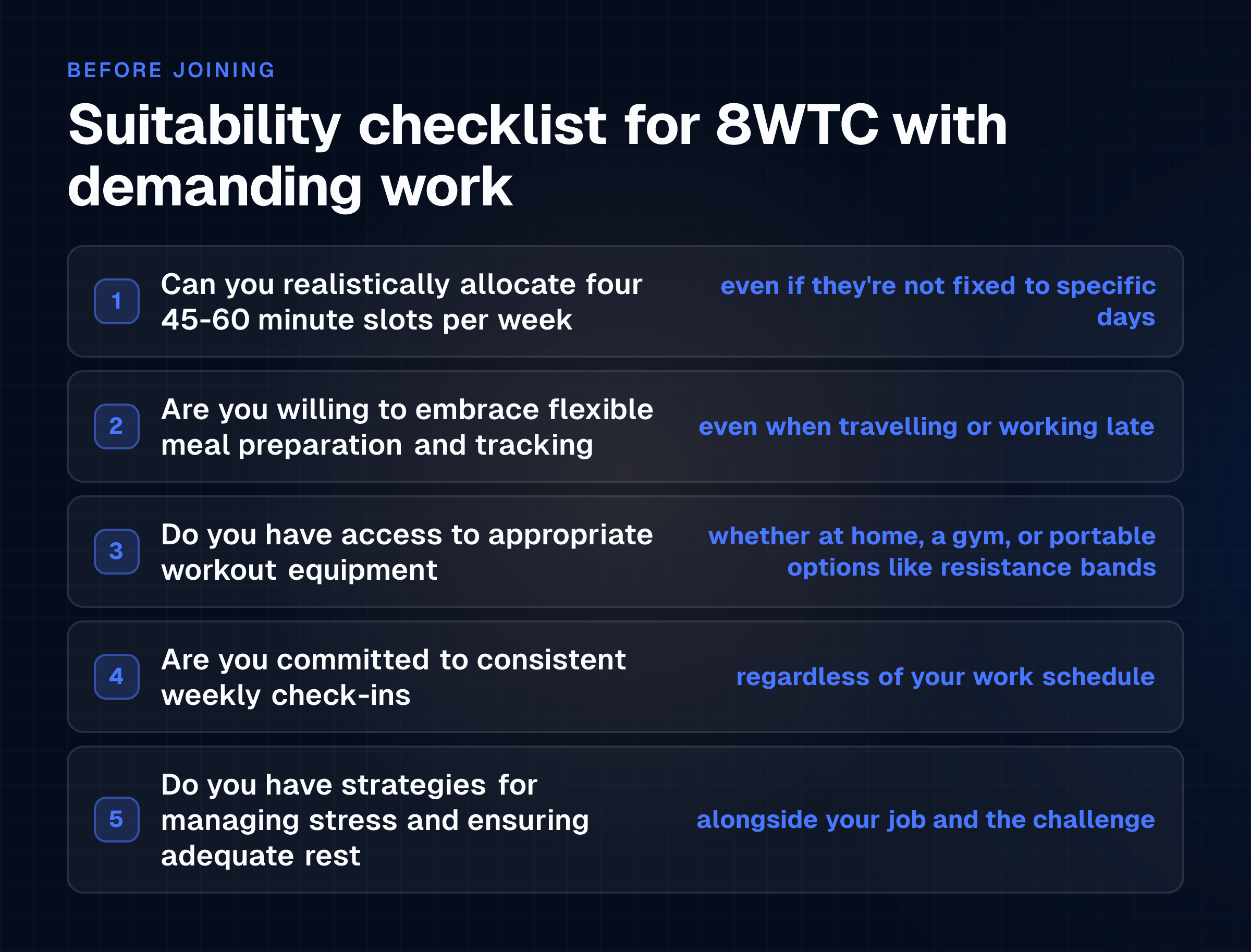
Before joining 8WTC with a demanding job, ask yourself these questions honestly:
Can you realistically allocate four 45-60 minute slots per week, even if they're not fixed to specific days? If your schedule makes four sessions impossible, the programme isn't a fit right now.
Are you willing to embrace flexible meal preparation and tracking, even when travelling or working late? If rigid meal plans and set meal times are non-negotiable, another approach may suit you better.
Do you have access to appropriate workout equipment, whether at home, a gym, or portable options like resistance bands? 8WTC works across all three, but you need something.
Are you committed to consistent weekly check-ins, regardless of your work schedule? The programme requires logging diet macros and weekly progress for the full eight weeks.
Do you have strategies for managing stress and ensuring adequate rest alongside your job and the challenge? If you're already burned out, adding structure might push you over the edge. Address that first.
If you answered yes to all five, the programme is designed to fit your life. If you're unsure, 8WTC Objections: Time Investment & Realism digs deeper into whether the time commitment is realistic for your situation.
Beginners often ask if 8WTC suits them. The answer is yes. Beginner's First 8 Weeks: One Member's Journey walks through how newcomers approach the first week.
FAQs
How much time does 8WTC actually take each week?
The programme itself requires four 45-60 minute workouts per week, plus 10-20 minutes for meal logging and weekly check-ins. That's 3-4 hours per week for training, plus time for meal prep on your quieter days. Meal prep varies: 30 minutes if you're assembling pre-made components, up to 2 hours if you're cooking from scratch. The app is designed to fit around your schedule, not replace it.
Do I need a gym to do 8WTC?
No. Workouts use bodyweight, resistance bands, dumbbells, or kettlebells. Many members train entirely from home. If you travel, pack bands or use hotel gym facilities. The programme adapts to what you have access to. 8WTC Without a Gym: Full Home Workouts details this fully.
Is the money-back guarantee real?
The challenge carries a money-back guarantee tied to completion and participation requirements. The brand's website lists specific conditions; check the current terms before joining, as details vary across published materials.
Can beginners do 8WTC with a chaotic work schedule?
Yes. Beginners often thrive on structure, and 8WTC's flexibility works well for people managing other demands. The app guides you through each workout and nutrition logging. Start by reading the beginner's guide to understand what to expect in week one.
Will I regain the weight after the challenge ends?
The 8WTC teaches you how to eat and train over eight weeks. What happens after depends on what you do next. If you return to old habits, weight regain is common with any programme. If you maintain the habits you've built, the results stick. Regain Prevention After 8WTC: Keep Results covers how members sustain their changes long-term.
What if I miss a workout or fall behind on logging?
One missed session or one day of inconsistent logging doesn't disqualify you. The programme measures consistency over eight weeks as a whole. Adapt, reschedule your workout for another day that week, and keep logging. The flexibility is there for exactly this reason.
General guidance from the 8WTC team, not medical advice. Individual results vary. Always consult your doctor before starting a weight-loss or exercise programme.