
Success Stories
Beginner's First 8 Weeks: One Member's Journey
What actually happens when a complete beginner joins an 8-week structured fitness challenge? This guide walks through the real preparation, early obstacles, and practical strategies that work when you have no fitness background.

When you have no fitness background, starting an 8-week structured challenge can feel uncertain. What actually happens in those first eight weeks? What obstacles will you hit, and how do beginners solve them when they come up?
This guide walks through the real preparation, early setbacks, and practical strategies that beginners encounter when joining the 8 Week Transformation Challenge as complete newcomers to structured fitness. It covers what to expect before day one, how to handle the physical and logistical demands of the first weeks, and the tools available to keep you moving forward when motivation dips.
The Starting Point: Committing to Change
For someone with no regular exercise history, the decision to join comes down to commitment.
Paying the £149.99 entry fee acts as a genuine trigger. It moves fitness from a vague intention into something concrete, with real money on the line. The cost creates accountability that "maybe I'll start next month" never does.
Before starting, two decisions shape the entire eight weeks: equipment and your baseline.
Choosing your environment. Home or gym determines which exercises become available. Home workouts use bodyweight, resistance bands, dumbbells, kettlebells, and a yoga mat, all affordable and flexible around a schedule that doesn't allow for travel time or gym hours. Gym workouts access barbells, squat racks, benches, leg press machines, cable machines, leg curl and extension machines, plus cardio equipment if you want it. Neither is inherently better. The choice depends on what fits your life and what you'll actually use five days a week.
Taking baseline photos and measurements. This feels uncomfortable. Do it anyway. It gives you a reference point to track change, and without it you're guessing whether anything's shifted by week eight. The app guides you through this step, so you're not figuring out angles or which measurements matter.
Learning the app. The 8WTC app delivers workouts, nutrition guidance, and weekly check-ins through your phone or web browser. Spending 15 minutes exploring the navigation, finding workout sections, understanding how to log food using barcode scanning, and seeing how your flexible calorie and macro targets display, removes friction on day one when you're already managing enough new information.
The Challenge: What Beginners Face in the First Weeks
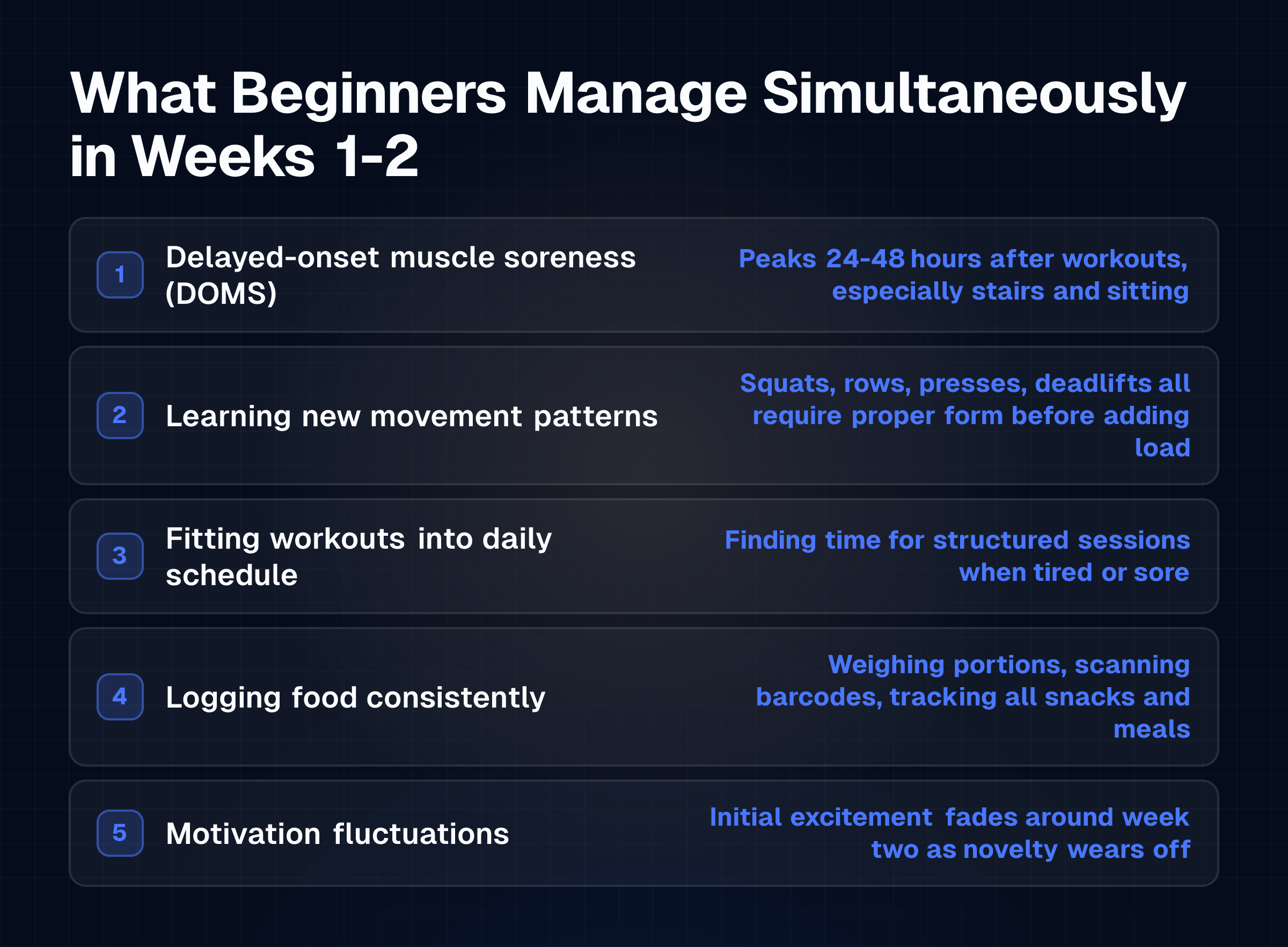
The first week often brings delayed-onset muscle soreness (DOMS).
Physical discomfort peaks 24-48 hours after new exercise. Stairs become painful. This is normal and temporary, but it collides with three other demands all happening at once.
Learning new movements. Each exercise is new. Squats, rows, presses, and deadlifts require understanding proper form before adding weight or speed, and moving carefully takes time you might not feel you have. Rushing to keep up with the workout duration or match someone else's weight risks injury and wastes the session because sloppy form doesn't build strength, it builds compensations.
Fitting structured workouts into your day. Working out isn't optional now. It's in your schedule. Finding space for this, especially when you're tired or sore or both, tests motivation early, often before you've seen any physical change to remind you why you started.
Logging food consistently. Hitting flexible calorie and macro targets means weighing portions, scanning barcodes to log meals, and tracking snacks that used to be mindless. For someone who's never done this, it feels like a second job. Missing logs or rough estimates mean missing your nutrition targets, and missing a core component of the programme that determines whether the workouts translate into visible results.
Motivation fluctuations. The initial excitement from signing up wears off around week two. The reality of daily workouts and detailed food tracking becomes harder, not easier, as novelty fades. The soreness lingers. Some people find this moment makes or breaks their eight weeks.
What Was Done: Practical Approaches Beginners Use

Success in the early weeks relies on specific, repeatable strategies. Not willpower.
Managing soreness. Beginners often fear DOMS means they've done something wrong or that continuing will make it worse. Understanding that soreness is a normal response to new stimulus, not a sign of injury, removes the panic and the temptation to skip the next session. Continuing to move, light walking, stretching, staying hydrated, typically reduces discomfort faster than complete rest, though it won't feel that way in the moment.
Prioritising form over weight or speed. Using lighter weights and slower tempos allows you to feel the movement, learn the pattern, and build confidence without the fear that you're about to drop something or pull a muscle. This foundation pays dividends in weeks 3-8 when progressive overload becomes easier because the movement is already solid and you're not relearning it under heavier load.
Time management for workouts and prep. Beginners who succeed either batch-cook meals on weekends, keep meal logging simple by repeating the same breakfasts and snacks, or build workouts into an existing routine, before work, during lunch, after dinner, so they're not hunting for time every single day. The key is removing decision fatigue, not finding extra hours that don't exist.
Consistent tracking, even imperfectly. Skipping a meal log or a check-in seems minor. It compounds. Beginners who log even roughly stay on track better than those who skip logs when they miss their targets or eat something they can't be bothered to weigh. The 8WTC app's barcode scanning feature cuts logging time significantly compared to manual entry, which matters when you're already managing new workouts and soreness.
Using weekly check-ins. The app prompts you to reflect on the week: what went well, what was hard, what needs adjustment. Beginners who treat these check-ins as genuine progress reviews, not just a box to tick, spot patterns early. One person might realise they need to prep meals differently to hit protein targets; another might find they're trying too many new exercises at once instead of mastering the basics.
Leaning on community. 8WTC offers a supportive community where beginners see others facing the same obstacles. Knowing you're not alone in struggling with food logging or finding motivation around week three makes the challenge feel less isolating, and sometimes that's the difference between quitting and showing up for the next workout.
Results: What Shifts Over Eight Weeks
The 8 Week Transformation Challenge has documented over 10,000 transformations since 2020.
The programme is designed around eight weeks as a contained sprint, long enough to build momentum, short enough to stay focused without burnout.
Results vary widely. Individual factors, starting point, consistency with logging and check-ins, sleep, stress, genetics, all shape outcomes in ways no programme can control or predict.
For beginners, the most consistent shifts are in confidence and routine. By week five or six, the workouts feel less foreign. Logging food becomes habitual rather than a chore that requires conscious effort every single meal. The soreness is gone. The mental fog many beginners experience in weeks one and two, where everything feels hard and unfamiliar, lifts. Whether or not the scale moves, most people report feeling stronger and more in control of their choices, which matters more than it sounds like it will at the start.
Beginners who hit their macro targets consistently and complete all workouts tend to see the most visible change by week eight. Those who miss check-ins or inconsistently log food often see minimal physical change, which is why consistency, not intensity, not perfect adherence, predicts outcomes better than any other factor.
Lessons Learned: What Beginners Wish They'd Known
Soreness is not failure. Inconsistency is.
Physical discomfort passes within days. Skipping workouts or logs sets you back further than pushing through soreness ever will.
Form beats ego. Using the weight you can actually lift with clean form teaches your body the movement and builds strength that lasts. Heavy weight with poor form teaches poor patterns, risks injury, and stalls progress the moment you try to add more load. Beginners see faster progress long-term by starting conservative, even when it feels too easy.
Tracking imperfectly beats not tracking. Rough estimates of portion sizes and rough logs are infinitely better than perfect tracking on four days and zero logs for three. The app's barcode scanner removes much of the friction that stops people from logging, so use it.
You can't out-train inconsistent eating. Eight weeks is short. If you're logging food three days a week and skipping workouts when you're tired, the programme won't deliver results, not because it doesn't work, but because you're not following it. Beginners who succeed treat the nutrition side as seriously as the workouts.
Weekly check-ins aren't optional admin. They're where you catch problems early, before a small slip becomes a larger pattern. Missing a check-in means missing a chance to adjust your approach when adjustment is still easy.
Home and gym workouts work equally well. The equipment difference matters less than showing up and following the plan. Beginners often worry they'll get worse results at home; in practice, consistency beats location every time.
For beginners wondering whether eight weeks from zero is realistic, the answer is yes, if you prepare beforehand, treat the first two weeks as a learning sprint rather than a performance test, and lean on the app's structure and community when motivation dips. Learn more about how an 8-week body transformation challenge works, or explore real results from actual members.
General guidance from the 8WTC team, not medical advice. Individual results vary. Always consult your doctor before starting a weight-loss or exercise programme.