
FAQs
Home Workouts vs Gym: Which Fits Your 8-Week Challenge?
Both home and gym environments enable real transformation in 8 weeks if you follow a structured programme with progressive overload and consistent nutrition.
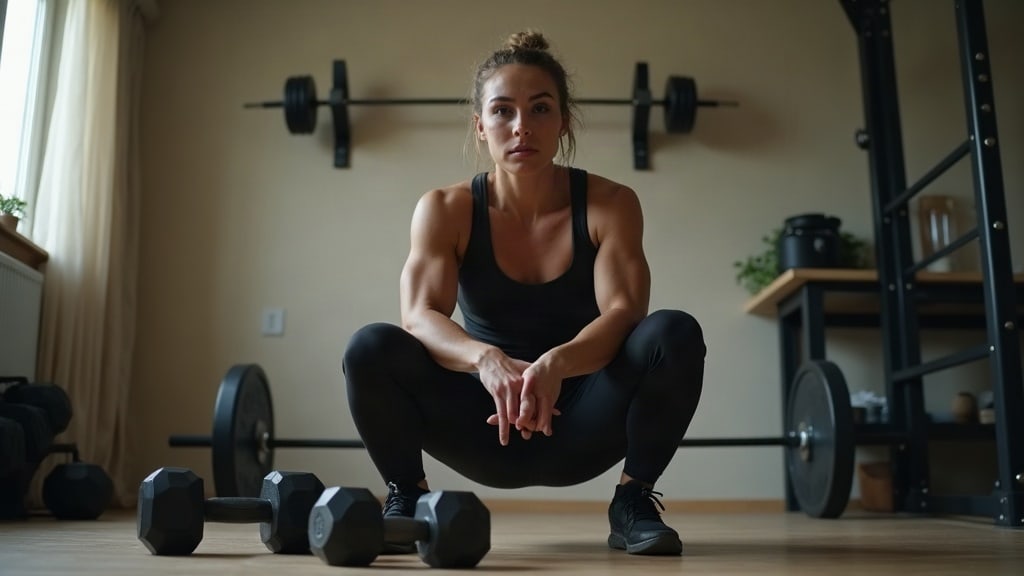
Yes, you can transform your body at home or in a gym within 8 weeks. Location isn't the deciding factor. It's whether you can apply progressive overload (gradually increasing the challenge to your muscles), follow a structured plan, and stick to consistent nutrition. Home workouts suit people with limited time or budget; gyms offer heavier weights and more equipment variety. Both settings have produced documented transformations across more than 10,000 member journeys when paired with macro and calorie targets, weekly check-ins, and adherence to a progressive programme.
This guide addresses the real concerns: cost, time commitment, equipment needs, beginner readiness, and whether results are genuinely possible without a gym membership.
Key takeaways: Home versus gym in 8 weeks
- Both home and gym environments enable real transformation if you follow a structured programme with progressive overload and consistent nutrition; location matters less than effort and adherence.
- Home workouts work best with bodyweight progressions, dumbbells, and resistance bands; they suit people prioritising convenience and lower cost.
- Gym workouts provide heavier weights and specialised machines, making progressive overload easier for advanced strength training; they require travel time and ongoing membership fees.
- Progressive overload is non-negotiable in both settings, you must gradually increase reps, sets, weight, or intensity, or progress stalls.
- Nutrition is equally critical; exercise alone won't transform your body without macro and calorie targets tracked consistently.
- Entry costs £149.99 as a one-off payment per challenge, not a recurring monthly fee.
What it means: Body transformation in two environments
Body transformation is a measurable shift in body composition, reduced body fat paired with maintained or increased muscle, visible within 8 weeks. Progressive overload means gradually increasing the stress on your muscles: more reps, more sets, heavier weight, shorter rest, or harder bodyweight variations. Consistency means showing up to your workouts and logging your nutrition targets every week without significant gaps. Macro and calorie targets are the deliberate tracking of your dietary intake to support your specific goal, whether that's fat loss, muscle gain, or both.
Both home and gym settings can deliver results because transformation hinges on these four elements, not on where you exercise. What changes is convenience, equipment access, and the type of progressive overload you can realistically achieve.
Why it matters: Removing the barrier between you and starting
Many people delay joining a transformation challenge because they assume they need a gym membership, fancy equipment, or hours of free time. The reality is simpler. 8WTC offers home or gym workouts, personalised to the equipment you have available. No equipment? Bodyweight progression is a valid path. Got dumbbells and resistance bands? You can build serious strength. Already have a gym membership? You can exploit heavier loads and machines.
The cost concern is often overstated. Entry is £149.99, a one-off payment per challenge, not a monthly subscription. That's lower than most gym memberships (which typically charge £20, £50+ per month).
Time is real. But real members report that workouts fit their week rather than the other way around. Sessions are structured, not endless. Many fit within 30-60 minutes, 3-5 times per week.
How it works: Equipment, progressive overload, and structure
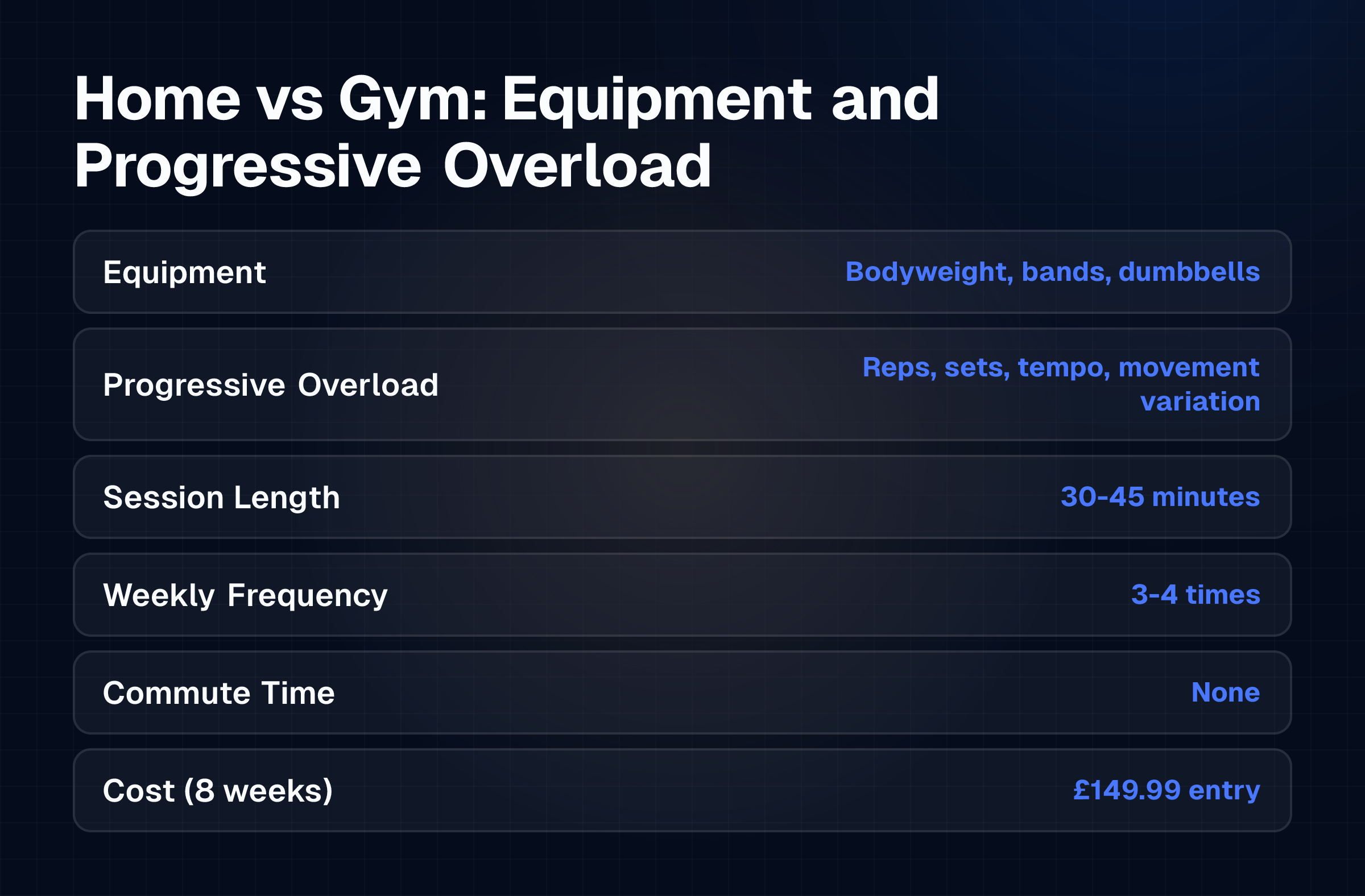
Home workouts: Convenience, creativity, and bodyweight progression
Equipment available:
- Bodyweight (squats, push-ups, lunges, planks)
- Resistance bands (glutes, back, arms, chest)
- Dumbbells or kettlebells (if purchased)
- A yoga mat (optional, useful for floor work)
Progressive overload strategies:
- Increase reps (e.g., 8 push-ups → 12 push-ups)
- Increase sets (e.g., 3 sets → 4 sets)
- Decrease rest time (e.g., 60 seconds between sets → 45 seconds)
- Advance the movement (e.g., standard push-up → archer push-up)
- Add tempo changes (e.g., 2-second lowering phase instead of 1 second)
Time and structure:
Typical sessions run 30-45 minutes, 3-4 times per week. No commute time. Workouts fit into your home schedule. Self-discipline is required; there's no external environment pushing you forward.
Real-world constraint: Heavy barbell lifting is challenging without a dedicated home gym. Progressive overload relies on creativity and volume rather than absolute strength measures. For many people, this is sufficient; for advanced strength athletes, it may feel limiting.
Gym workouts: Heavier loads, more variety, and external motivation
Equipment available:
- Barbells, dumbbells (full range of weights)
- Squat racks, benches, leg press machines
- Cable machines, leg curl/extension machines
- Cardio equipment (treadmills, rowing machines, bikes)
Progressive overload strategies:
- Increase weight (most straightforward method)
- Increase reps or sets
- Decrease rest time
- Add advanced variations or machine exercises
- Reduce rest between sessions (higher weekly volume)
Time and structure:
Typical sessions run 45-60 minutes, 3-5 times per week. Travel time required; adherence depends on commute convenience. External environment and other members can be motivating. Structured routine reduces decision fatigue.
Real-world constraint: Requires a gym membership, which costs money and ties you to gym operating hours. Peak hours can mean equipment queues. Some beginners feel self-conscious in a new gym environment.
Example or scenario: Two practical approaches
Scenario 1: Home-based beginner with no equipment
Goal: Fat loss, basic strength, 8-week challenge.
Equipment: Bodyweight, resistance bands (£15-30), yoga mat.
Weekly structure:
- Monday: Upper body (push-ups, band rows, pike push-ups, 35 minutes)
- Wednesday: Lower body (squats, lunges, glute bridges, banded walks, 35 minutes)
- Friday: Full body circuit (burpees, mountain climbers, band pull-aparts, jumping jacks, 30 minutes)
- Saturday: Active recovery walk or light stretching (15 minutes)
Progressive overload: Week 1: 3 sets of 8 push-ups. Week 2: 3 sets of 10. Week 4: 4 sets of 10. Week 6: 4 sets of 12 with slower lowering. Week 8: 4 sets of 15 with 40-second rest (versus 60 seconds at start).
Nutrition: 1,800-2,000 calories daily, 120g protein, tracked via app barcode scanning. Weekly check-ins on Wednesday.
Why this schedule works: Low barrier to entry (home, minimal cost), time-efficient (sessions fit lunchtimes or evenings), progressive (volume increases each week), structured (same days every week reduce decision fatigue).
Scenario 2: Gym-based intermediate with prior training experience
Goal: Muscle gain and fat loss simultaneously (recomposition), 8-week challenge.
Equipment: Full gym access (dumbbells, barbells, machines).
Weekly structure:
- Monday: Upper body push (barbell bench, incline dumbbell press, cable flyes, 50 minutes)
- Tuesday: Lower body (barbell squat, Romanian deadlift, leg press, 55 minutes)
- Thursday: Upper body pull (bent-over barbell row, lat pulldown, barbell curls, 45 minutes)
- Saturday: Lower body accessories (leg curl, calf raise, sled push, 45 minutes)
Progressive overload: Week 1: Bench press 60kg × 5 reps × 3 sets. Week 2: Same weight, 5 × 4 sets. Week 4: 65kg × 5 × 3. Week 6: 65kg × 5 × 4. Week 8: 70kg × 5 × 3 (or 65kg × 8 × 3 if strength stalls).
Nutrition: 2,200-2,400 calories daily, 160g protein, tracked via app. Weekly check-ins on Wednesday evening.
Why this schedule works: Heavy resistance enables clear, measurable progression. Gym environment provides structure and social motivation. Variety of machines and free weights allows multiple progression levers. Time investment is slightly higher but offset by faster strength gains.
Common mistakes or risks: What derails both approaches
Progressive overload absent or ignored: The single most common mistake is doing the same workout every week. Perform 3 sets of 10 push-ups every session for 8 weeks? You'll adapt within 2-3 weeks and stall. Progressive overload is non-negotiable. Track reps, sets, weight, or rest time and increase something every 1-2 weeks.
Nutrition not tracked: Exercise alone doesn't transform your body. You must track macro and calorie targets consistently. Many people guess their intake and hit a plateau because they're eating more than they think. Use the app's barcode scanning or log manually; consistency matters more than precision.
Inconsistency or missed weeks: Missing workouts breaks momentum and reduces weekly volume. Life happens, but aim for 80%+ adherence over the full 8 weeks. One skipped week is recoverable. Three is not.
Poor form prioritising weight over technique: In both settings, especially at home without supervision, form breakdown under heavy load or fatigue can lead to injury. Prioritise controlled movement over ego lifts. A perfect rep beats a sloppy one every time.
Comparing your journey to others: Social media and gym comparisons create false expectations. Your baseline, genetics, sleep, and consistency are unique. Track your own progress (photos, measurements, strength gains) and ignore the highlight reel.
Ignoring recovery and sleep: Progressive overload stresses your muscles, but adaptation happens during rest. Aim for 7-9 hours of sleep per night. Poor recovery will cap your results regardless of workout intensity.
How to choose or what to do next: A decision framework
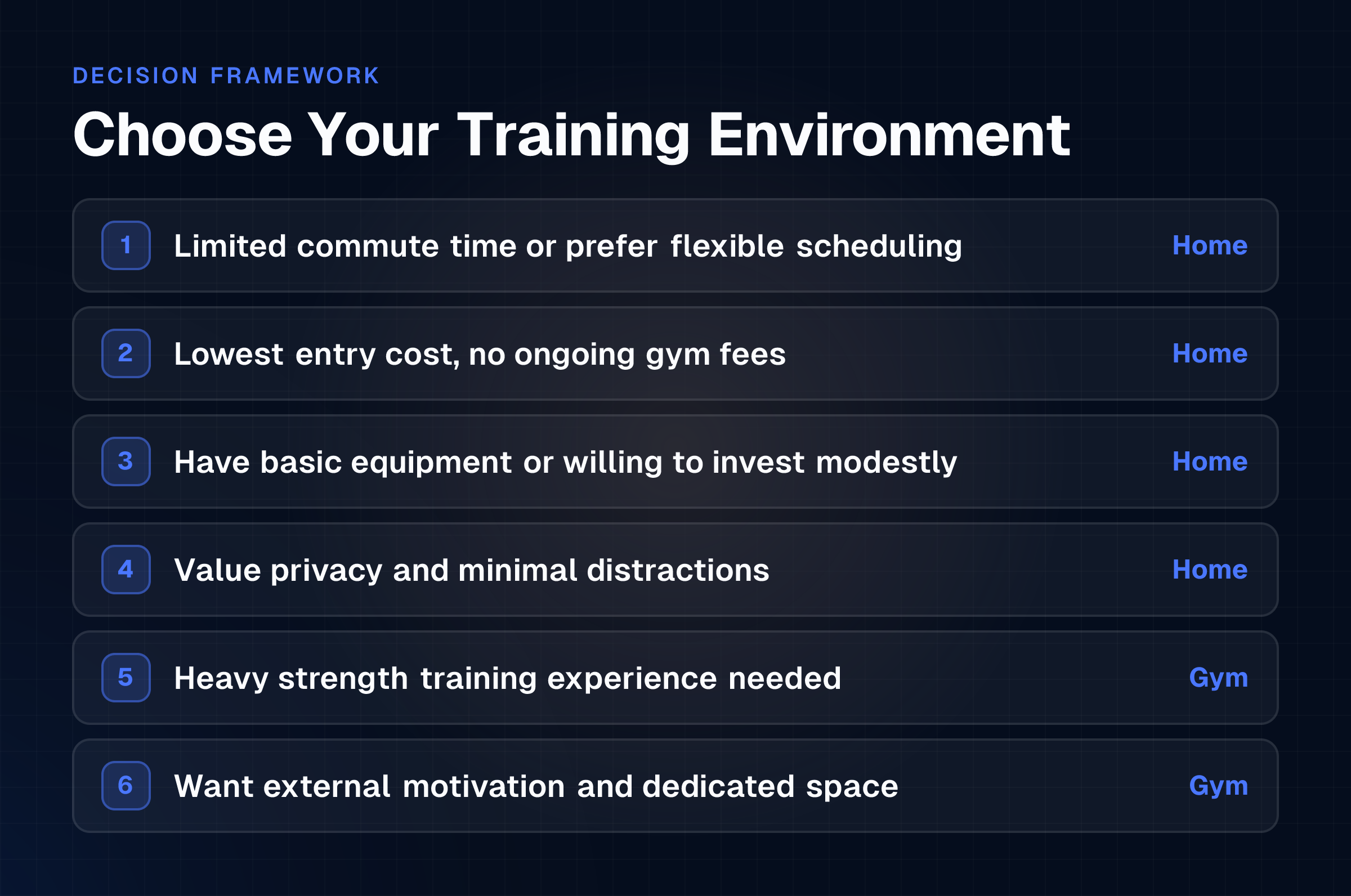
Choose home workouts if:
- You have limited time for commuting or prefer flexible scheduling.
- You want the lowest entry cost and no ongoing gym fees.
- You have basic equipment (dumbbells, bands) or are willing to invest modestly.
- You value privacy and minimal distractions.
- You're a beginner concerned about gym intimidation.
Choose gym workouts if:
- You have heavy strength training experience and need access to barbells and plates.
- You want external motivation and a dedicated workout space.
- You live near a quality gym with peak-hour equipment availability.
- You enjoy the social aspect of a gym environment.
- Progressive overload via heavier absolute weight is your priority.
The hybrid approach: Many successful challengers train at home 2-3 times per week and use a gym 1-2 times per week, or start at home and transition to a gym mid-challenge. The 8WTC app lets you swap between home and gym workouts at any point. Flexibility is built in.
Next step: Review how an 8-week transformation challenge works to understand the full programme structure, workouts, nutrition logging, check-ins, and community support. Then decide whether home or gym (or both) fits your life, and start your entry week.
FAQs
Is £149.99 actually worth it?
Entry costs £149.99 for 8 weeks of personalised workouts (home or gym), nutrition guidance with macro and calorie targets, and weekly check-ins. That's roughly £19 per week, lower than most gym memberships. The programme structure reduces guesswork and provides accountability, which informal training often lacks.
Do I really need a gym?
No. You can transform your body at home with bodyweight and resistance bands. Progressive overload is possible through higher reps, slower tempos, shorter rest periods, and harder movement variations. A gym offers convenience and heavier weights, but it's not mandatory. Choose based on your equipment access, schedule, and preference. Both paths work.
How much time does it actually take?
Sessions typically run 30-45 minutes at home, or 45-60 minutes in a gym. Most challengers train 3-5 times per week, so 1.5-5 hours per week. That's comparable to or lower than a typical gym routine. Real members report that the 8WTC structure fits around their week, not the other way around.
Can beginners actually do this?
Yes. The 8WTC app personalises workouts to your fitness level and available equipment. Beginners start with bodyweight or light dumbbells and progress gradually. Many transformation challengers report that they'd never trained before and still achieved significant results. If you're new to fitness, read the beginner's guide and first-week tips to understand what to expect.
Will I regain the weight after 8 weeks?
Weight regain depends on what happens after the challenge. Stop training and return to old eating habits? Yes, some regain is normal. Maintain exercise and reasonable nutrition? You keep most results. The 8 weeks builds habits and momentum, not permanent immunity.
General guidance from the 8WTC team, not medical advice. Individual results vary. Always consult your doctor before starting a weight-loss or exercise programme.