FAQs
10-Week Body Transformation: Plan Beyond an 8-Week Challenge
Extending your 8-week fitness challenge to 10 weeks gives your body more time to shed fat, build muscle definition, and cement new habits.

Extending your 8-week fitness challenge to 10 weeks gives your body more time to shed fat, build muscle definition, and cement new habits. Eight weeks establishes the foundation, participants in the 8 Week Transformation Challenge have lost up to 13.5kg in that span, but weeks 9 and 10 matter if you're still chasing specific goals, haven't yet built strong consistency, or need recovery time. The key is assessing your progress at week 8 and tailoring those final two weeks to your actual state, not pushing blindly. This guide walks you through a realistic progress check, three distinct paths forward depending on where you stand, and what happens after the challenge ends.
Key takeaways: extending beyond eight weeks
Progress assessment matters. Before extending into weeks 9-10, review your consistency, recovery quality, physical changes (photos and measurements), and whether healthy habits feel automatic yet.
One path doesn't fit all. Your next steps depend entirely on where you stand: steady progress means maintaining intensity, patchy consistency calls for simplification, and persistent fatigue demands recovery time.
Weeks 9-10 are refinement, not miracles. Two extra weeks are valuable for cementing habits and pursuing remaining goals, but they follow the same principles as weeks 1-8: consistent workouts, flexible nutrition tracking, and adequate rest.
Home workouts count. You don't need a gym to complete an eight-week challenge or extend it; 8WTC without a gym uses full home workouts alongside or instead of gym sessions.
Post-challenge options exist. After your 10 weeks, you can continue with structured support, maintain independently, or shift focus to new goals.
What it means: body recomposition beyond the initial phase
Body transformation combines fat loss, muscle preservation or gain, and improved fitness performance. It's rarely linear.
The first 4 weeks of any challenge are largely habit-building. Much of the initial weight drop is water loss as your body adjusts to calorie deficit and increased activity. By weeks 5-8, the body has adapted to consistent training and nutrition patterns, and fat loss typically accelerates. The visible effects, muscle separation, shape, definition, often emerge more noticeably in weeks 5-12 of a sustained effort.
A 10-week timeline captures more of this window than eight weeks alone. But "more time" only multiplies results if consistency and recovery remain in place. Pushing hard without addressing fatigue or skipping workouts will stall progress. That's why the week 8 assessment determines what weeks 9-10 actually look like for you.
Why it matters: realistic expectations for the final two weeks
Two extra weeks aren't a second transformation.
They extend and consolidate what you've already built. Metabolic adaptation happens gradually. Your body adjusts to a calorie deficit and increased activity slowly; an extended timeline allows that adaptation to continue maturing. If your goal is significant fat loss or muscle definition, you've likely made visible progress by week 8, but remaining changes often require the consistency that weeks 9-10 reinforce.
Habit durability improves on longer timelines. Tracking macros, meal prep, and regular workouts become less daunting and more automatic after 10 weeks than after 8. When you've built consistent habits over 10 weeks, maintaining them after the challenge tends to be easier.
This matters especially if you're a beginner or have struggled with consistency before. Beginners can complete 8WTC, and extending two weeks gives you extra runway to cement the skills and confidence you've gained. It's not a shortcut. It's a buffer for real-world adherence.
How it works: assessing week 8 and planning weeks 9-10
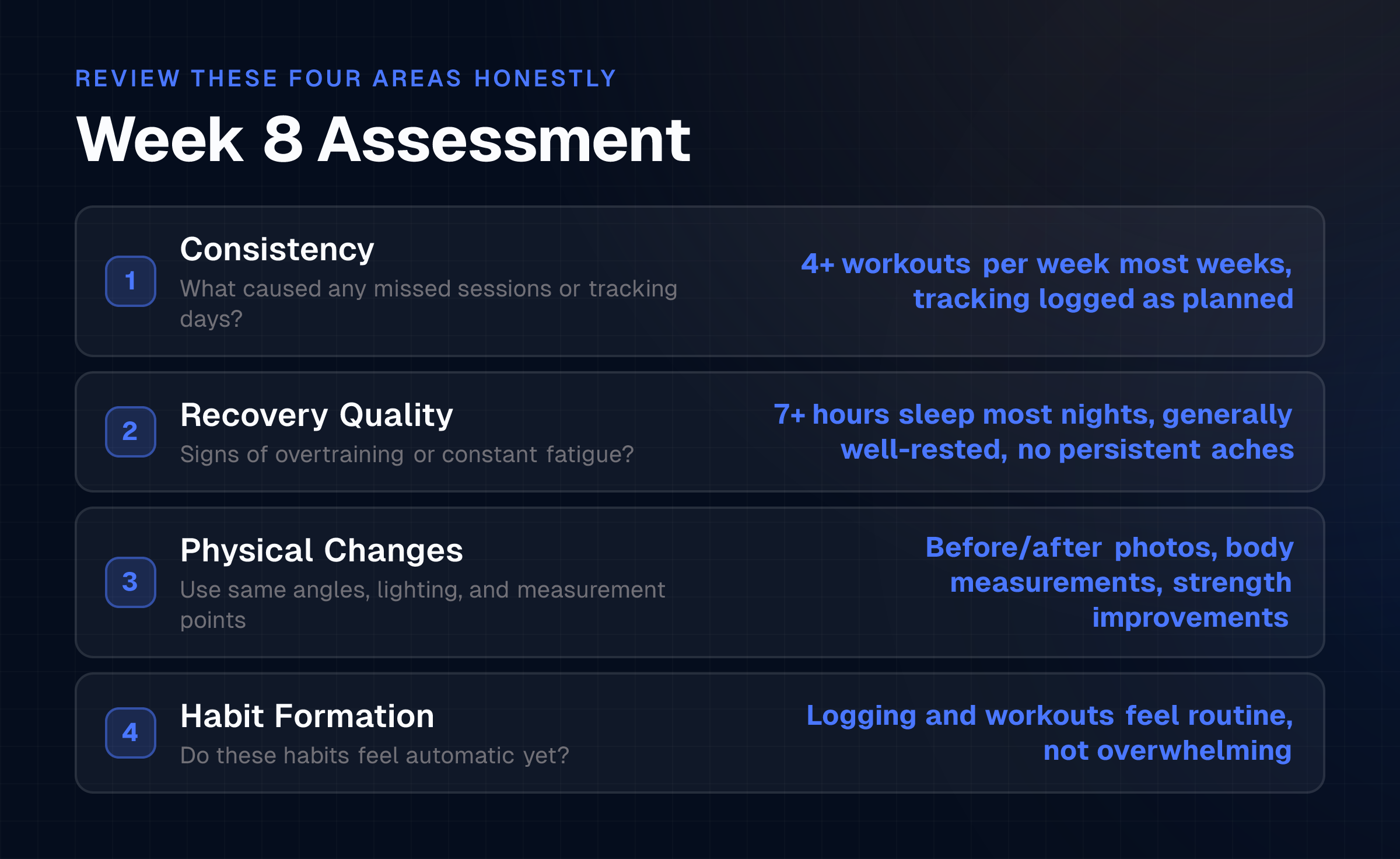
At the end of week 8, pause and honestly review four things: consistency, recovery, physical changes, and habit formation.
Consistency check
Did you complete at least 4 workouts per week, most weeks? Did you log your diet macros and weekly check-ins as planned? If you missed sessions or tracking days, what caused them, time, motivation, life events, unclear plan?
Recovery quality
Are you sleeping 7+ hours most nights? Do you feel constantly fatigued, or generally well-rested? Have you experienced any aches, pains, or signs of overtraining?
Physical changes
Review your before (week 1) and current (week 8) photos from the same angles and lighting. Take fresh body measurements, chest, waist, hips, arms, legs, and compare them. Note any strength improvements: can you lift heavier, do more reps, or move with better form?
Habit formation
Does logging food and checking macros feel easier than week 1? Are workouts becoming part of your routine, or do they still feel like a chore? Can you prepare meals or plan nutrition without the app feeling overwhelming?
Use these answers to place yourself in one of three scenarios below. Be honest; this assessment determines whether weeks 9-10 amplify your results or risk burnout.
Example or scenario: three paths forward
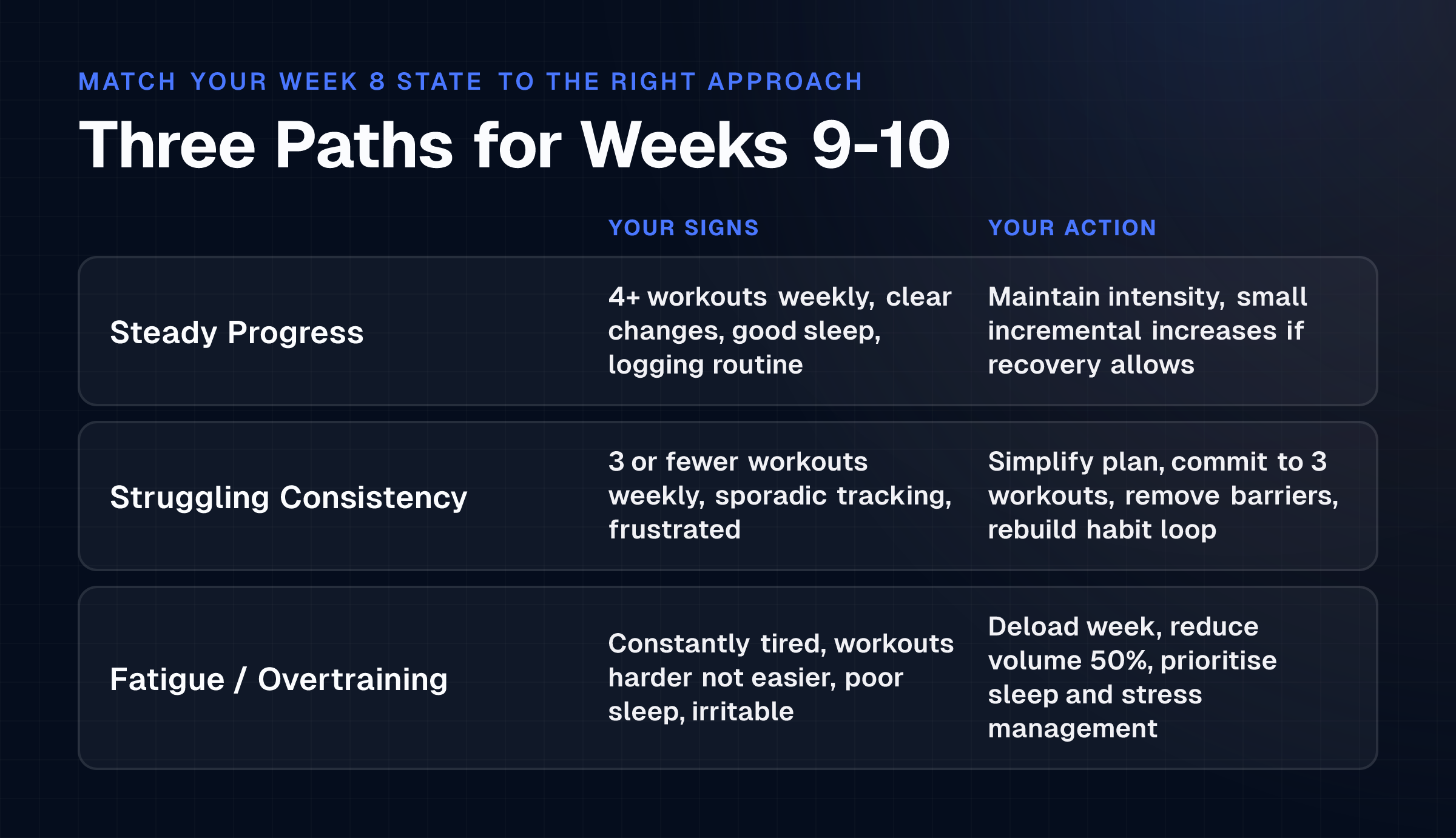
Scenario 1: Steady Progress & Strong Consistency
Your signs: You've hit 4+ workouts per week consistently. Photos and measurements show clear changes. You're sleeping well and feel energised. Logging food is routine now.
Your action: Keep training intensity and nutrition approach steady. If recovery feels good, consider small, incremental increases, add one extra set to a key lift, or extend cardio duration by 5 minutes. Focus on progressive overload rather than drastic change.
Weeks 9-10 (illustrative timeline):
Week 9: Stick with your current workout split and caloric intake. Aim for one small progression per session (e.g., 5kg heavier on squats, or one extra pull-up).
Week 10: Maintain consistent training and nutrition. Re-evaluate your goals for the period after week 10, do you want to continue with a post-challenge membership, shift to maintenance, or pursue new targets?
Scenario 2: Struggling with Consistency
Your signs: You've hit 3 or fewer workouts per week on average. Nutrition tracking has been sporadic. You're frustrated because you know you can do better, but life or motivation has gotten in the way.
Your action: Simplify your plan rather than extend it with more intensity. Remove friction: commit to 3 achievable workouts per week (not 5). Plan meals 3-4 days in advance so logging feels less overwhelming. Re-establish the habit loop before pushing harder.
Weeks 9-10 (illustrative timeline):
Week 9: Review the past 8 weeks for consistency patterns. What specific barriers kept you from workouts or tracking? (E.g., gym timings, app use, meal prep time.) Fix one barrier. Commit to 3 workouts and daily nutrition logging.
Week 10: Gradually increase consistency. Aim for 4 workouts this week and maintain daily nutrition tracking. If that feels sustainable, you're ready to continue post-challenge with greater confidence.
Scenario 3: Fatigue or Signs of Overtraining
Your signs: You feel constantly tired. Workouts have become harder, not easier, over weeks 6-8. Sleep is poor despite trying. Performance has plateaued or declined. You're irritable or unmotivated.
Your action: Implement a deload week, reduce training volume and intensity significantly, or take 2-3 active recovery days (walking, stretching, yoga). Ensure 7-9 hours of sleep and manage stress. This prevents burnout and sets you up for sustainable results post-challenge.
Weeks 9-10 (illustrative timeline):
Week 9: Implement a deload. Reduce all workout sets and reps by 50%, or replace 2-3 gym sessions with active recovery (walking, stretching, mobility work). Prioritise sleep and hydration. Continue light nutrition tracking, don't add mental load.
Week 10: If fatigue has lifted, gradually reintroduce intensity (add sets or weight back in slowly). If fatigue persists, continue a lighter schedule. Recovery now prevents injuries and burnout later.
Common mistakes or risks: what derails weeks 9-10
Pushing too hard without recovery. The temptation to "make up" for weeks 1-8 by hammering weeks 9-10 often backfires. Injury and burnout spike when intensity rises without adequate sleep and stress management.
Skipping the assessment. Continuing your current plan without reviewing progress can lead to stagnation if the plan no longer fits your needs, or injury if you're already fatigued.
Unrealistic expectations about results. Two weeks is valuable but not transformative on its own. Progress compounds over time; extra weeks extend that window but don't double results.
Abandoning structure. If weeks 9-10 feel ad-hoc, no plan, no tracking, no accountability, momentum often fades. Having a clear focus, even a simple one, keeps you on track.
Ignoring recovery signals. Persistent fatigue, poor sleep, and stagnant performance are your body's signals to slow down, not push harder. Listening to them now prevents weeks 10-12 (and beyond) being derailed by injury or burnout.
How to choose or what to do next: continuing after week 10
After 10 weeks, three common paths emerge.
Path 1: Continue with structured support. 8WTC offers post-challenge membership options that keep you in a structured programme with new goals, weekly check-ins, and accountability. How an 8-week body transformation challenge works explains the framework you'd re-enter.
Path 2: Maintain independently. You've now built 10 weeks of habits. Many people continue workouts and nutrition tracking using the same app, but without the formal challenge structure. Regain prevention after 8WTC covers strategies to keep results when the challenge ends.
Path 3: Shift to a new goal. If fat loss was your primary target and you've reached it, weeks 9-10 and beyond might shift focus to muscle gain, strength, endurance, or maintenance. The principles stay the same (consistent training, flexible nutrition, recovery), but your metrics and intensity may change.
Whichever path you choose, the 10-week foundation you've built, whether it's three steady scenarios or a combination, gives you real momentum. The habits are ingrained. You understand how your body responds. That's the real value of extending beyond eight weeks.
FAQs
Is the £149.99 entry fee worth it?
The programme costs £149.99 per challenge. With 10,000+ documented transformations and a 4.9 app rating, the cost reflects structured programming, nutrition guidance, and accountability rather than generic advice. The value depends on whether you need external structure to stay consistent.
Do I need a gym to extend into weeks 9-10?
No. The programme is home-workout-friendly. You can select home or gym workouts when you join, and the plan adapts to your available equipment (dumbbells, resistance bands, yoga mat, or full gym access). 8WTC without a gym explains full home workout options.
How much time does an 8-week or 10-week challenge actually take per week?
The app doesn't publish typical session lengths, so this piece doesn't specify a figure. Time depends on your chosen workout split (fewer, longer sessions or more, shorter ones) and nutrition-tracking thoroughness. Most structured challenges assume 4-5 workouts weekly plus daily macro logging; plan for 30-60 minutes of active workout time, plus 10-15 minutes for meal prep and tracking.
Can beginners do this, or do I need prior fitness experience?
Yes, beginners can complete 8WTC and extend to 10 weeks. Can beginners do 8WTC covers starting options and first-week strategies. The app adjusts workouts to your fitness level, and the flexible nutrition system works whether you're new to macro tracking or experienced.
What if I regain weight after weeks 10 or after the challenge ends?
Regain isn't inevitable. Regain prevention after 8WTC outlines strategies to maintain results once the formal challenge ends. The habits you build over 10 weeks, consistent training, nutritional awareness, recovery discipline, form a foundation for long-term maintenance if you continue them. Rejoin a challenge, continue independently, or shift to a maintenance plan; the key is not abandoning the practices you've embedded.
Is there a real money-back guarantee, or is it marketing?
The programme's refund policy requires specific completion criteria. Check the brand's official pricing page for current terms, as guarantee details may change.
General guidance from the 8WTC team, not medical advice. Individual results vary. Always consult your doctor before starting a weight-loss or exercise programme.