FAQs
Regain Prevention After 8WTC: Keep Results
Completing 8WTC is the starting gun for maintenance. This guide covers transition steps, metabolic adaptation, accountability systems, and seven practical actions to sustain your results long-term.

Completing an 8-week transformation challenge is a huge win. Week nine is when the real work starts.
Weight regain isn't guaranteed. It's not automatic either. It depends entirely on how you transition from fat loss to maintenance mode. This article tackles the question that keeps most people up at night after they've hit their goal: "Will I regain the weight?" You'll find practical transition steps, data on what actually works long-term, and testimonials from people who've sustained their results months and years beyond the challenge.
Key takeaways: Long-term weight maintenance after 8WTC
The 8-week challenge isn't the finish line. It's the starting gun for maintenance, and the structure that drove your results needs to evolve, not vanish.
Your body fights back during weight loss. Resting metabolic rate drops, hunger hormones spike, which makes the shift to maintenance calories absolutely critical.
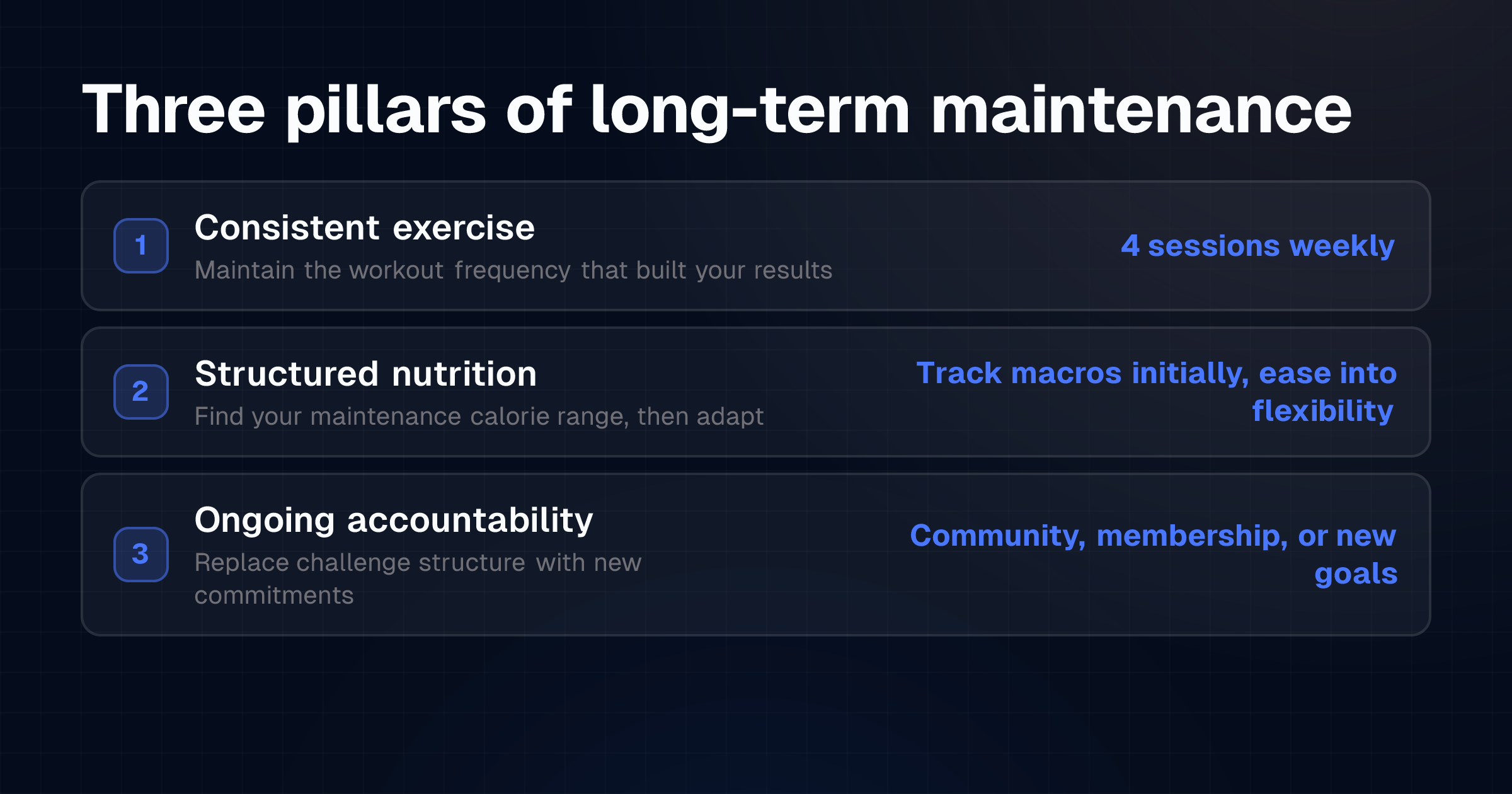
Sustained results rest on three pillars: consistent exercise (4 sessions weekly for most people), structured nutrition (track macros or calories at first, then ease into flexibility), and ongoing accountability through community or new goals. Sleep, stress management, and performance-based goals (not just weight) shape long-term adherence and kill the "all or nothing" mindset that derails so many attempts.
The 8WTC app includes barcode scanning and macro/calorie targets that support the transition. Monthly membership (£24.99) extends access, or annual unlimited plans (£299.99/year) provide two challenges per year for reset points and continued momentum.
What it means: Understanding the maintenance phase
Maintenance is not a break. It's an active, ongoing commitment to the habits that built your transformation in the first place.
During an 8-week challenge, you operate in a calorie deficit, burning more than you consume, to lose fat. Once you reach your goal, continuing that deficit would just keep shrinking you. Maintenance requires consuming roughly the same calories you burn, a figure unique to your body, activity level, and metabolism.
This transition is where most people fall apart. The structure, accountability, and urgency of the challenge disappear overnight. Without a deliberate plan, old eating patterns and exercise habits creep back in, and weight regain follows.
The upside: if you understand what drove your success during the 8 weeks, you can adapt those principles to a sustainable long-term rhythm.
Why it matters: The biology and psychology of regain
Your body actively resists staying at a lower weight.
During weight loss, your resting metabolic rate, the calories you burn at rest, decreases, and hormones like ghrelin (which signals hunger) increase. This isn't a failure of willpower. It's a biological adaptation called metabolic adaptation. Without awareness, you'll feel hungrier and more fatigued, making it absurdly easy to slip back into pre-challenge eating.
Equally important is the psychological shift. The 8-week challenge provides external structure: a start date, a finish line, community deadlines, and the possibility of prize money (the 8WTC prize pool totals £18,000, with weekly giveaways and the first-place prize at £5,000). When the challenge ends, that structure vanishes. Without a new framework, whether it's a continued fitness goal, ongoing community connection, or membership access, motivation erodes fast.
Testimonials from 8WTC participants highlight this shift. Rosalind, an 8WTC participant, noted: "While the financial reward is wonderful, the greatest gift has been how I feel now, healthier, stronger, and more confident, and the pride my husband, my sons, and my extended family have shown." This reveals a critical insight: internal motivation (how you feel, family support, self-belief) outlasts external rewards and is the foundation of long-term maintenance.
How it works: Seven steps to sustain your results
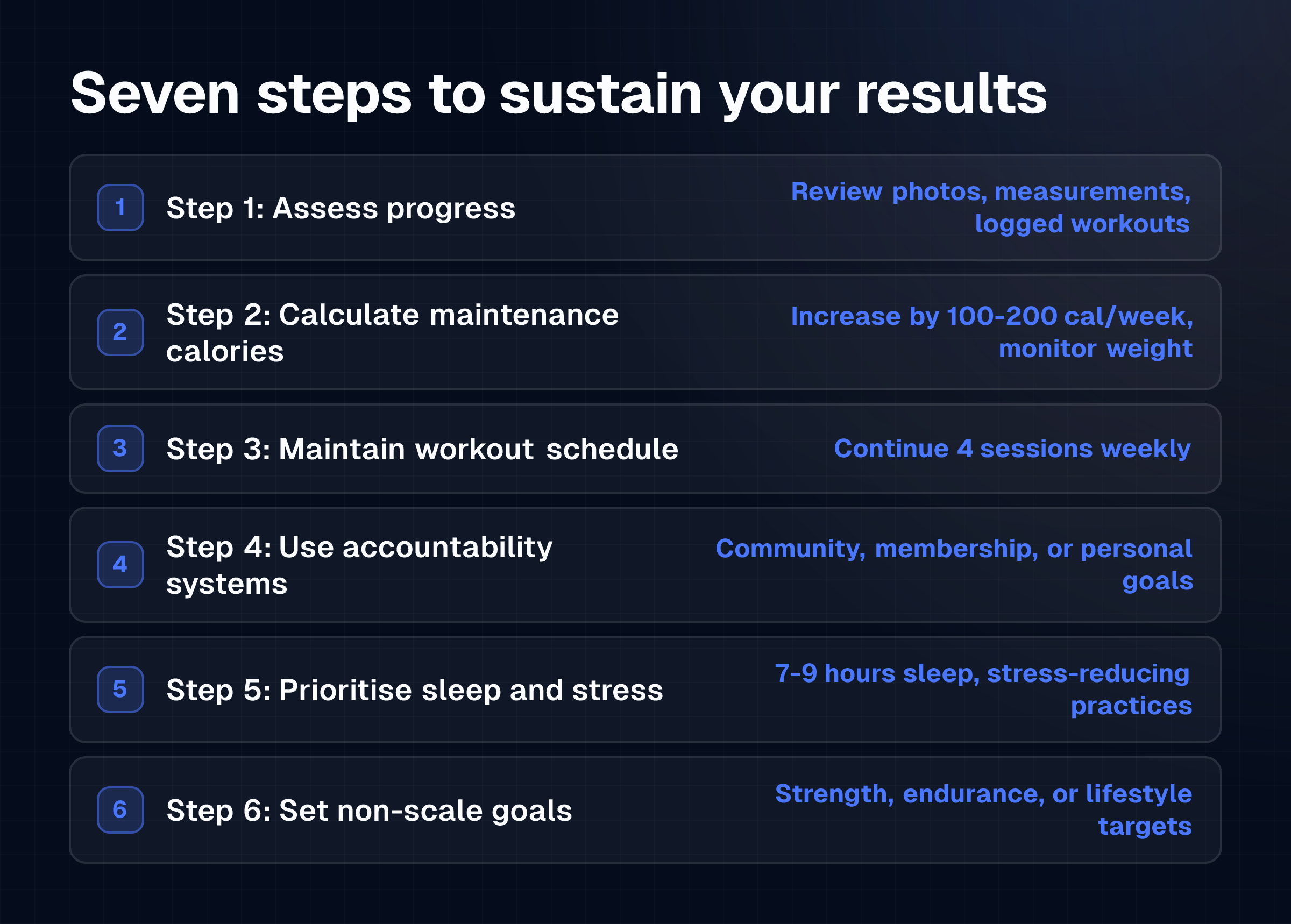
Step 1: Assess and acknowledge your progress
Before moving forward, pause and review what happened over the 8 weeks.
Look at your before and after photos, measurements, and logged workouts. Understand what specifically worked for you, whether it was a particular workout style, a macro split that felt sustainable, or the daily structure of logging meals.
This assessment serves two purposes: it anchors your confidence in what you've already achieved, and it clarifies which habits are worth protecting.
Step 2: Calculate your maintenance calorie needs
During the challenge, you tracked macros or calories to maintain a deficit. Now, gradually increase your intake by 100-200 calories per week while monitoring your weight and energy levels. The goal is to find the sweet spot where your weight stays stable.
The 8WTC app includes barcode scanning and macro/calorie targets. Continuing to log food initially makes this calculation transparent and removes guesswork.
This phase typically lasts 2-4 weeks. Once you identify your maintenance range, the daily calorie band where your weight neither rises nor falls, you can begin introducing flexibility: swapping some logged meals for intuitive eating, while still tracking occasionally to stay calibrated.
Step 3: Maintain a structured workout schedule
The 8WTC program is built around 4 sessions per week, each 45-60 minutes. This consistency is part of what created your results. Maintenance doesn't mean stopping; it means sustaining.
Choose whether you prefer gym or home workouts (8WTC supports both, with equipment flexibility built in), and commit to the same weekly schedule. The workouts may shift in focus, from intense fat loss work to strength maintenance or endurance building, but the frequency and structure should remain.
Progressive overload in maintenance means continuing to challenge your body with new exercises, adjusted weights, or increased reps. This prevents plateaus and keeps engagement high.
Step 4: Use accountability systems
The 8WTC challenge thrives because of its community and shared deadlines. Post-challenge, recreate this layer.
Options include staying active in the 8WTC community (the platform has a community feature available to members), joining the 8WTC Monthly Membership (£24.99/month) for continued access to training plans, recipes, barcode scanning, and progress tracking, enrolling in another challenge via the 8WTC Unlimited plan (£299.99/year), which grants entry to two challenges per year, providing regular reset points and external motivation, or setting personal performance goals (improve your deadlift by 10kg, run a 5K under 25 minutes) and sharing progress with a friend or family member.
Accountability doesn't have to be expensive or complex. It's about staying visible and responsible to someone or something outside yourself.
Step 5: Prioritise sleep and stress
Sleep and stress management are often overlooked, yet they significantly impact metabolism, appetite regulation, and energy levels.
Poor sleep increases hunger hormones and cravings for high-calorie foods. High stress elevates cortisol, which can promote fat storage, particularly around the midsection.
Aim for 7-9 hours of consistent sleep per night. Incorporate stress-reducing practices: daily walks, meditation, yoga, or time with family. These aren't luxuries. They're maintenance tools as important as your workouts.
Step 6: Set new, non-scale goals
The 8-week challenge focuses on transformation, often measured by weight, photos, or measurements. Once you've achieved that, the motivation to pursue the same metric fades.
Set fresh goals that have nothing to do with the scale.
Strength milestones (squat a certain weight, do 20 consecutive press-ups). Endurance targets (run 10km without stopping, cycle 50km in a session). Performance markers (reduce resting heart rate, improve flexibility, increase daily step count). Lifestyle wins (establish a consistent sleep schedule, reduce alcohol to weekends only, cook five new recipes per month).
New goals provide direction and keep your mind engaged, which prevents complacency and the "all or nothing" thinking that derails maintenance.
Step 7: Monitor and adjust regularly
Maintenance isn't a fixed state. It requires regular self-checks.
Every 2-4 weeks, review your weight, measurements, how your clothes fit, and your energy levels. If your weight is creeping up, your deficit has returned; tighten tracking or increase activity slightly. If energy is low, you may be under-eating; increase calories by 100-200 per day and reassess.
This feedback loop keeps you responsive to changes rather than waiting until you've regained 5kg to act.
Example or scenario: Transition in practice
Sarah completed the 8WTC challenge and lost 8kg over eight weeks.
Her results were verified through before/after photos and measurements, and she received confirmation of the full money-back guarantee (having followed the program, logged her diet macros, and completed weekly check-ins). During the challenge, Sarah maintained a balanced diet while working out at home with dumbbells and a resistance band, four times per week.
Week 1 post-challenge: Sarah increased her daily intake to 1,900 calories and continued logging every meal using the 8WTC app's barcode scanner. Her weight stayed stable.
Week 2-3: She increased by another 100 calories (to 1,950) and continued logging. Again, stable weight.
Week 4: She had identified her maintenance range: roughly 1,950-2,000 calories per day. She joined the 8WTC Monthly Membership (£24.99/month) to keep access to her training plans and recipes, and she joined the community forum to stay connected with other members.
Weeks 5-8: Sarah began eating intuitively 4 days per week (not logging) and logged 3 days per week to stay calibrated. She set a new goal: increase her dumbbell bench press by 5kg and reach 10,000 steps per day consistently.
Three months later: Sarah's weight has remained within 1-2kg of her post-challenge low. She feels strong, her clothes fit well, and she's on track for her strength goal. She's considering enrolling in another 8WTC challenge in six months to sharpen her focus and refresh her motivation.
Common mistakes or risks: What derails maintenance
Sudden return to old habits
The biggest risk is treating week eight as the finish line.
The challenge structure, your daily logging, your workout schedule, your community, ends. Without a conscious transition, you slip back into pre-challenge eating and exercise patterns. Your weight regain within weeks or months feels inevitable, but it's not; it's the result of abandoning the systems that created the change.
What to do: Plan your post-challenge routine before the challenge ends. Decide in advance whether you'll join a membership, pursue a new goal, or maintain community connection.
Underestimating metabolic adaptation
Your body wants to regain weight. This is biology, not a personal failure.
If you ignore metabolic adaptation, the decreased metabolism and increased hunger during and after weight loss, you may feel defeated and give up, believing maintenance is impossible.
What to do: Accept that hunger and cravings may increase; this is normal. Address it with higher-protein foods, more volume (vegetables, whole grains), and consistent exercise. Give the transition 4-6 weeks before assuming something is wrong.
Abandoning tracking entirely
Many people stop logging food the moment the challenge ends, reasoning that they've "learned enough." Without data, you lose the ability to self-correct. Weight creeps up, and you don't know why.
What to do: Continue logging, at least occasionally (3-4 days per week). This keeps you calibrated without feeling restrictive. Most 8WTC members keep the app for this reason, even after the challenge ends.
Losing community and accountability
Isolation is a powerful risk factor for regain. Without shared goals or check-ins, motivation fades.
What to do: Stay connected. Use the 8WTC community, join a local gym class, find a workout buddy, or tell your family about your goals. Accountability doesn't require spending money; it requires being visible to others.
"All or nothing" thinking
A single slip-up, a night of overeating, a missed workout, can trigger the belief that you've failed and should give up entirely.
This all-or-nothing mindset is the enemy of long-term maintenance.
What to do: Reframe slip-ups as data points, not failures. One bad meal doesn't undo eight weeks of work. One missed session doesn't derail your fitness. What matters is the pattern over weeks and months. Stay consistent 80-90% of the time, and results follow.
How to choose or what to do next: Your maintenance path
Your next step depends on your circumstances and preferences. Here are the main options.
Option 1: Self-directed maintenance with occasional logging
You continue your 4-session-per-week workout routine at home or at the gym (whichever you prefer), log food 3-4 days per week to stay calibrated, and use free tools or resources to track progress. This works well if you have strong self-discipline and a clear routine.
Cost: £0/month (if you already have gym access or home equipment).
Option 2: 8WTC Monthly Membership
You pay £24.99 per month for continued access to the 8WTC app, including training plans, recipes, barcode scanning, and progress tracking. This removes the burden of designing your own workouts and provides structure beyond the challenge.
Cost: £24.99/month (£299.88/year).
Option 3: 8WTC Unlimited plan
You pay £299.99 per year for two challenge entries per year, plus unlimited access to the app and community. This is ideal if you thrive on external deadlines and prize motivation, or if you want multiple "reset points" throughout the year to sharpen your focus.
Cost: £299.99/year (approximately £25/month, with the added benefit of two challenges).
Option 4: Hybrid approach
You pursue Option 1 or 2 for daily maintenance, but you also set a specific goal (strength, endurance, or health-related) and work toward it over 12 weeks. This gives you a mid-term target without the full structure of another challenge.
Cost: Depends on your choice (£0 to £24.99/month).
To decide, ask yourself: Do you need structured workouts, or are you confident designing your own? (If the former, a membership or Unlimited plan is worth the cost.) Do you thrive on external deadlines and competition, or does internal motivation sustain you? (If the former, another challenge is a good investment.) How important is community to you? (If very, staying in the 8WTC ecosystem is valuable; if not, self-directed maintenance works fine.) What's your risk of regain? (If you've struggled with weight before or feel vulnerable post-challenge, extra support is justified.)
FAQs
What is the difference between calorie deficit and maintenance calories?
A calorie deficit means consuming fewer calories than you burn, creating weight loss. Maintenance calories mean eating approximately the amount you burn, keeping weight stable.
During the 8-week challenge, you eat in a deficit (e.g., 1,800 calories). Post-challenge, you increase to your maintenance level (e.g., 1,950-2,000 calories) by gradually adding 100-200 calories per week. The 8WTC app's tracking tools help you find this number.
How long does the transition from deficit to maintenance take?
Typically 2-4 weeks. You increase calories gradually while monitoring your weight and energy.
Once your weight stabilises for 1-2 weeks at a given intake level, you've found a close approximation of maintenance. Fine-tuning continues for several more weeks as your body adapts.
Can I maintain my results without logging food?
Possibly, if you've built strong intuitive eating skills during the challenge.
However, most people benefit from occasional logging (3-4 days per week) to catch drift early. Complete abandonment of tracking often leads to gradual regain because you lose the feedback loop. The 8WTC barcode scanner makes logging quick, reducing the burden.
What role does exercise play in maintenance?
Exercise is critical.
Continued strength training (4 sessions per week) maintains muscle mass, preserves metabolic rate, and helps regulate appetite. Without exercise, your metabolic rate drops further, making maintenance calories lower and weight regain more likely.
Is it normal to feel hungrier after the challenge ends?
Yes. Metabolic adaptation increases hunger hormones (ghrelin) during weight loss and the weeks immediately after. This is biology, not weakness.
Address hunger with high-protein foods, high-volume, low-calorie options (vegetables, whole grains), adequate sleep, and stress management. If hunger remains extreme after 4-6 weeks, your maintenance calories may be too low; increase them slightly.
How does 8WTC support maintenance after the challenge?
The app includes tools designed for ongoing use: macro and calorie targets, barcode scanning for easy food logging, progress tracking, and access to the community.
Members can join the Monthly Membership (£24.99/month) for continued structured workouts and recipes, or the Unlimited plan (£299.99/year) for two challenges annually plus unlimited app access. Both options provide accountability and structure beyond the initial eight weeks.
This piece draws on the brand's published materials and verified public sources. Last verified: 21 October 2026.
General guidance from the 8WTC team, not medical advice. Individual results vary. Always consult your doctor before starting a weight-loss or exercise programme.