Cardio Benefits Guide
How Weight Loss Cuts Knee Pain (Biomechanics)
When you lose a single kilogram, your knees feel four kilograms lighter with every step. That's not metaphor. It's measured biomechanics from Wake Forest University researchers who tracked how body mass translates into joint force.

When you lose a single kilogram, your knees feel four kilograms lighter with every step. That's not metaphor. It's measured biomechanics from Wake Forest University researchers who tracked how body mass translates into joint force. For anyone dealing with knee osteoarthritis or stubborn knee pain, this multiplier effect explains why weight loss appears in clinical guidelines right alongside exercise as a core treatment, not a nice-to-have, but a foundational intervention that changes the physical stress your joints absorb.
Daily movement compounds this relief. Take 7,000 steps in a day and those per-step reductions stack into serious pressure relief, making the number on the scale less about appearance and more about how much mechanical load your knees are hauling around.
Introduction: The 1kg-to-4kg Force Multiplier Effect
Messier and colleagues at Wake Forest demonstrated that every pound of weight lost produces a four-pound reduction in knee loading during walking. In metric terms: lose 1kg, and your knees experience roughly 4kg less force per stride.
The finding wasn't a fluke. The Arthritis, Diet, and Activity Promotion (ADAPT) trial followed overweight and obese older adults with knee osteoarthritis, measuring how weight reduction altered the mechanical forces their knees endured during everyday activities. The IDEA trial confirmed it again. Weight loss produces measurable drops in knee compressive forces, independent of other changes.
Why the multiplier?
The knee is a lever system. When you walk, joint loading exceeds body weight because of leverage, angles, and the accelerations involved in each stride. Remove mass from that system and every downstream force calculation shrinks. This isn't theoretical, it's a direct, quantifiable shift in the stress your knee manages thousands of times a day.
Why It Matters: How Biomechanical Debt Compounds Across Your Day
Most people log 6,000 to 10,000 steps daily. Each one carries the multiplier forward.
Lose 2kg and walk 8,000 steps, and the cumulative force reduction becomes significant. Over weeks and months, that daily repetition translates into reduced wear on cartilage and joint structures, slowing osteoarthritis progression or easing symptoms in people already experiencing pain.
This reframes what the scale actually measures. It's not just a general health metric or an aesthetic judgment, it's biomechanical debt. The cumulative stress your weight-bearing joints carry with every movement. A kilogram on your frame isn't merely mass; it's a force multiplier applied thousands of times per day, quietly grinding away at cartilage and ligaments.
For middle-aged adults with knee discomfort, this shift in perspective can change everything.
The number isn't a verdict on your willpower or discipline. It's a direct indicator of how much mechanical load your knees are absorbing, and reducing it produces immediate biomechanical benefit regardless of your fitness level or how much you can exercise. Weight loss guidelines from the American College of Rheumatology and the Osteoarthritis Research Society International consistently position weight reduction as a first-line treatment for overweight and obese individuals with knee osteoarthritis, often placing it equal to or alongside exercise. This reflects the biomechanical reality: reducing load is as effective as strengthening the muscles around the joint, and in some cases more accessible.
The Details: Loading Mechanics and Why Weight Loss Rivals Exercise in OA Treatment
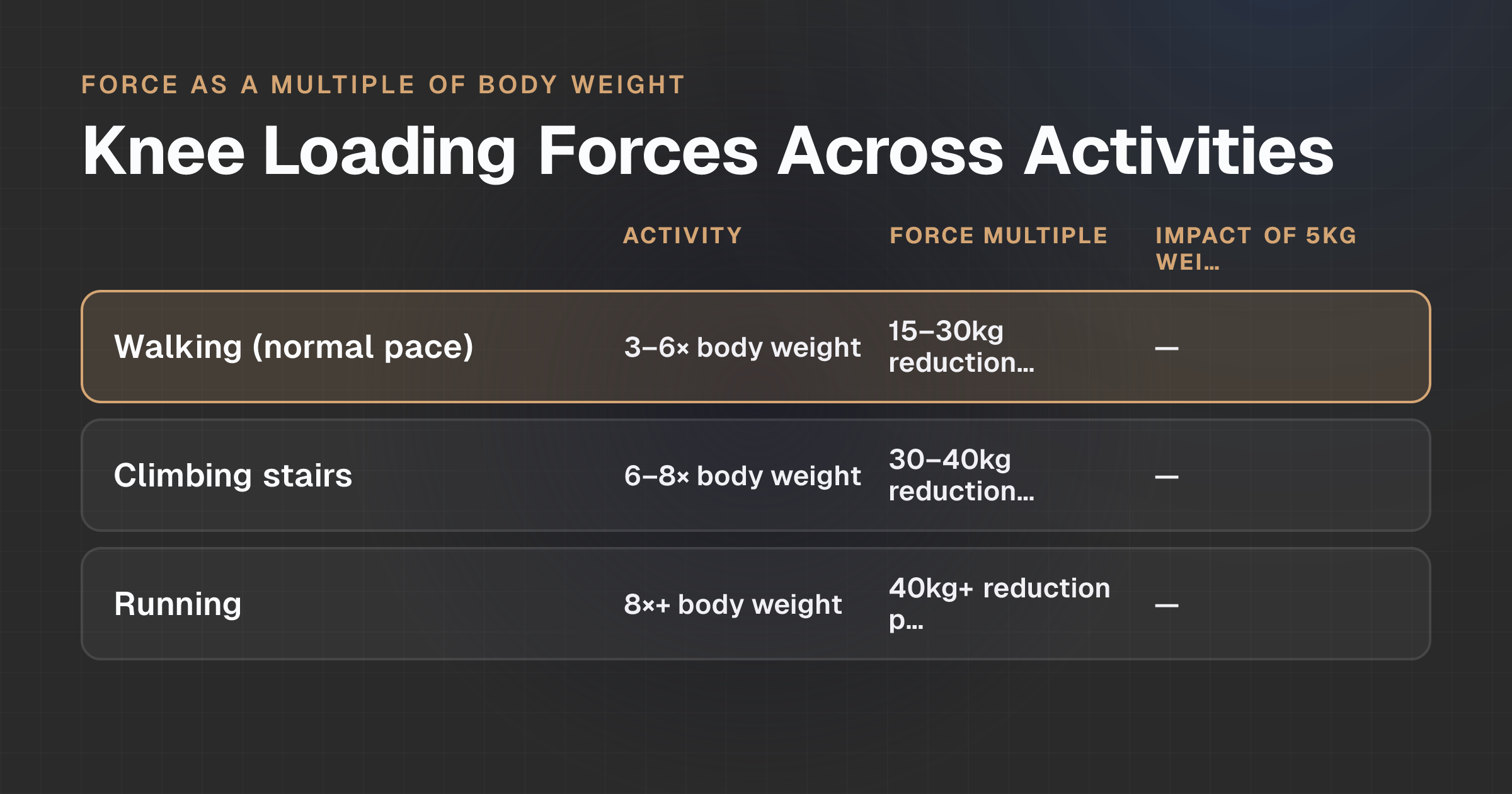
During normal walking, your knees experience forces between three and six times your body weight.
Climb stairs or run, and those forces jump to eight times body weight or higher. The joint can handle these loads, that's what it evolved to do. But add excess mass and the margin for tolerance shrinks. Cartilage degrades under sustained, elevated loading. Inflammation increases. Pain follows.
Weight loss directly reduces these baseline forces. A person weighing 100kg who loses 5kg reduces knee loading by approximately 20kg per step, a 20% reduction in compressive force applied to cartilage, ligaments, and bone thousands of times daily. Over a year, that's millions of steps with substantially less force hammering the joint.
Exercise strengthens the muscles that support and stabilize the knee, improving its capacity to manage load. Weight loss removes the excess load itself. Both work. Both are supported by medical guidelines as core treatments. The distinction matters for people who can't exercise due to pain or mobility limitations, they can still benefit from weight loss because the biomechanical advantage doesn't require increased activity.
It only requires reduced body mass.
This is why weight loss ranks as a treatment equal to exercise in osteoarthritis management. It's not about fitting into smaller jeans or hitting a BMI target. It's about altering the physical forces the joint must bear, step after step, day after day.
Practical Steps: Converting Daily Movement into Pressure Relief
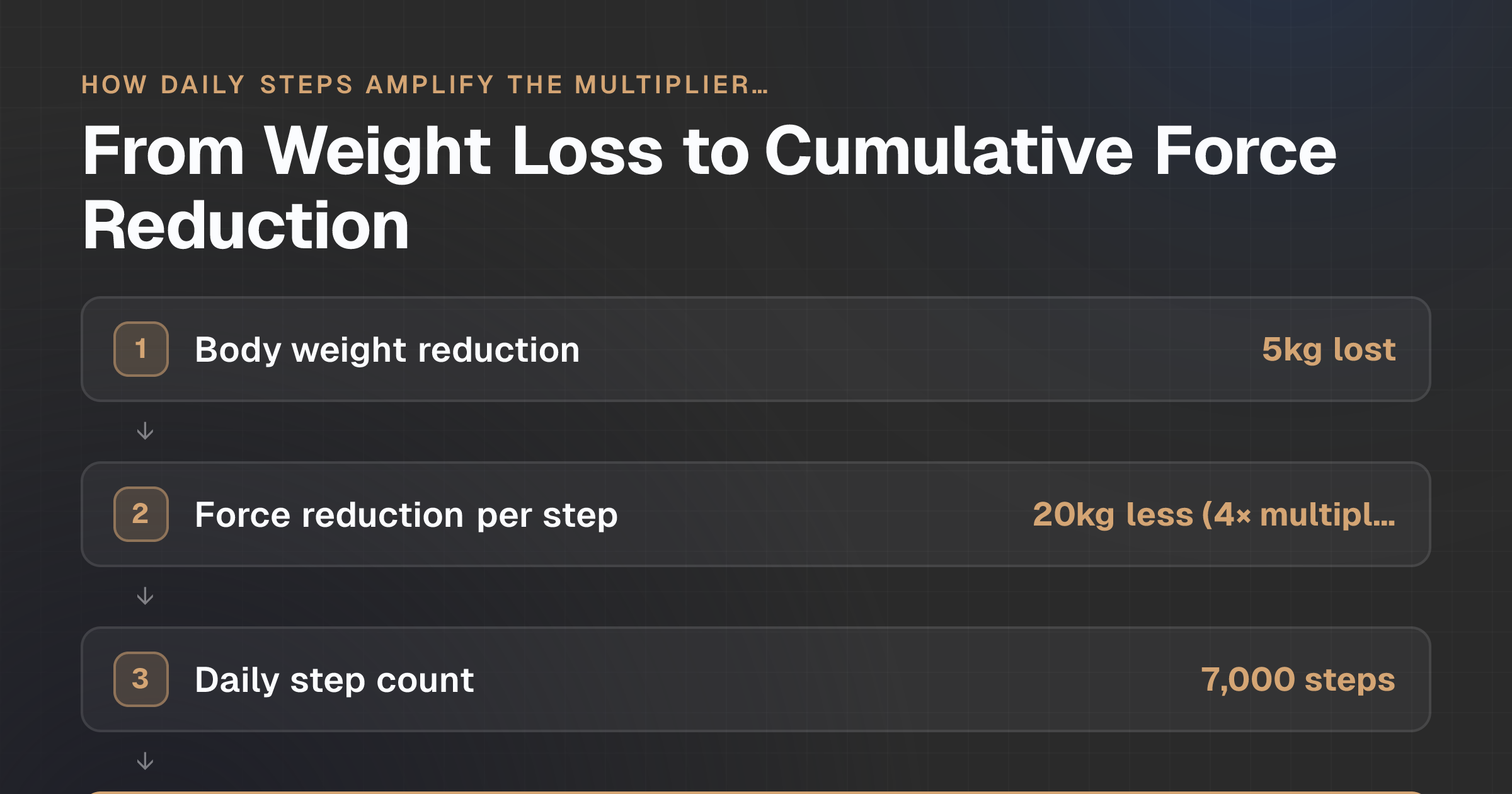
Weight loss requires a caloric deficit. The biomechanical benefits appear once that deficit is sustained and mass drops.
Track current daily movement. Most people with knee discomfort underestimate their daily step count. A baseline measurement clarifies how many times per day the force multiplier is applied. Whether you're hitting 4,000 or 9,000 steps, knowing that number creates context for the cumulative force reduction even small weight changes will produce.
Calculate individual force reduction. If you weigh 90kg and lose 3kg, your knees experience approximately 12kg less force per step. Over 7,000 steps daily, that's 84,000kg of cumulative force reduction, every single day. Extend that across a month and the figure becomes staggering.
Maintain sustainable practices. Rapid weight loss can create other health problems. Sustainable approaches, modest caloric reduction, consistent habits, produce lasting biomechanical benefit. The goal is weight loss you can maintain, because the force reduction persists only as long as the weight loss does. Flexible dieting approaches help create deficits without restrictive protocols that fail after a few weeks.
Pair with existing movement. Walking is often painful for people with knee problems. But walking is also where the force multiplier effect matters most in daily life. As weight decreases, the same walking activity becomes mechanically less painful because loading forces drop. This can create a positive feedback loop: less pain enables more movement, which supports overall health without requiring high-intensity exercise or gym sessions. Warming up properly before movement can reduce acute discomfort, though the long-term answer remains reducing the load itself.
Consider tracking tools. Calorie tracking doesn't require expensive subscriptions, and accuracy matters more than platform choice. Knowing intake relative to expenditure creates the deficit that produces weight loss, which in turn produces the force reduction. Simple math drives the whole system.
Key Takeaways: Small Changes Carry More Weight Than the Scale Suggests
One kilogram of weight loss equals approximately four kilograms of force reduction per step, according to research from Messier and colleagues at Wake Forest University documented in the ADAPT and IDEA trials.
Daily step counts amplify the effect. At 6,000 to 10,000 steps per day, modest weight loss compounds into thousands of kilograms of cumulative force reduction daily.
Knee loading during walking ranges from three to six times body weight. Stairs and running increase it to eight times or more.
Weight loss is a first-line treatment for knee osteoarthritis, positioned by major medical guidelines alongside exercise because it directly reduces the mechanical load the joint must bear, not because it improves cardiovascular health or body composition, though those matter too.
Framing the scale as biomechanical debt helps shift perspective. The number represents cumulative stress applied to weight-bearing joints, not an aesthetic measure alone.
Sustainable weight loss produces lasting biomechanical benefit because the force reduction is mechanical, it exists as long as the reduced mass exists. Recovery protocols support activity levels that maintain weight loss without aggravating existing joint problems.
Small changes in body weight produce disproportionate reductions in joint loading. This is measured biomechanics, not motivational rhetoric. For people with knee discomfort, the implications are direct: losing even a few kilograms produces force relief that compounds across thousands of daily steps, slowing osteoarthritis progression or alleviating pain without requiring high-intensity exercise or flawless fitness performance. Small changes carry more weight than the scale suggests.
General guidance from the 8WTC team, not medical advice. Individual results vary. Always consult your doctor before starting a weight-loss or exercise programme.