Cardio Benefits Guide
Extended Cardio Before Strength: Transform Your Results
Extended cardio before strength training can reduce your immediate performance, fewer reps, less weight lifted, because aerobic exercise depletes energy reserves and induces fatigue.

Extended cardio before strength training can reduce your immediate performance, fewer reps, less weight lifted, because aerobic exercise depletes energy reserves and induces fatigue. Research shows that moderate-to-high intensity cardio sessions performed before resistance work can acutely impair strength and power output. However, the impact depends entirely on intensity, duration, and your primary fitness goal.
A brief 5-10 minute warm-up? That's different. It won't carry the same risk and can prepare your body safely for lifting.
The question isn't whether cardio and strength belong together. It's in what order and at what intensity they serve your specific aims.
Introduction: The Timing Question
Most people assume the order of exercise doesn't matter much.
Get the work done, and results follow. That assumption misses a critical detail: the sequence in which you perform cardio and strength training can influence both immediate performance and long-term adaptation.
Early research identified what scientists called the "interference effect", the finding that combining endurance training with resistance training in the same session or training cycle could blunt strength and muscle-building gains compared to resistance training alone. R. C. Hickson's seminal 1980 work in Exercise and Sport Sciences Reviews documented this phenomenon. Later research refined the understanding considerably.
The practical takeaway: extended cardio sessions performed immediately before strength work can compromise how much weight you lift and how many quality reps you complete. This matters if your primary goal is strength or muscle gain. It matters less if fat loss or cardiovascular fitness is the priority, though even then, total energy expenditure and caloric adherence typically trump exercise order.
Why It Matters: Goals Drive the Decision
Exercise order isn't a universal rule. It's a tool matched to your objective.
Strength and Muscle Gain
If you want to build strength or muscle mass, research consistently shows that performing strength training first, when you're fresh, yields better results. Robert W. Hippensteel and colleagues (2018) found in the Journal of Strength and Conditioning Research that moderate-to-high intensity aerobic work performed before resistance exercise acutely reduced maximal strength and power output. Wilson et al. (2012) in the same journal showed that concurrent training, endurance before resistance, attenuated strength development compared to resistance training alone.
The mechanism is straightforward. Your nervous system and energy stores are finite. Heavy lifting demands maximal neural recruitment and sufficient glycogen, and performing 30-60 minutes of cardio first depletes both, leaving you with less capacity to generate force, recruit muscle fibres, or complete challenging sets.
Endurance and Fat Loss
For fat loss, total caloric expenditure matters more than order.
Baechle and Earle's Essentials of Strength Training and Conditioning (3rd ed., 2008) recommends a general warm-up including low-intensity aerobic activity, not extended cardio, but 5-10 minutes of easy movement. Schoenfeld's 2013 review in the Journal of Strength and Conditioning Research found that for body composition change, total training volume and caloric deficit are paramount; exercise order has a minor impact by comparison.
One nuance: performing strength training first and cardio afterwards doesn't impair endurance performance, according to Drummond et al. (2008) in Medicine & Science in Sports & Exercise. In fact, this sequence may enhance fat oxidation during the subsequent cardio bout, though the advantage is modest and doesn't justify sacrificing strength performance if strength is your goal.
The Interference Effect in Context
Hickson et al. (1988) refined earlier work in the Journal of Applied Physiology, showing that the interference effect is more pronounced with higher frequency, intensity, and duration of concurrent training. A single 30-minute moderate-intensity cardio session before strength work carries a different risk profile than 60 minutes of hard running. Similarly, one session per week differs from five concurrent sessions weekly.
The Details: What Extended Cardio Actually Does
Performance in the Session
Extended cardio, typically defined as 30-60+ minutes, before strength training produces measurable acute effects:
- Reduced force output: Heavy compound lifts (squats, deadlifts, bench presses) elicit fewer reps or require lighter loads when performed after extended aerobic work.
- Lower power production: Plyometric and explosive movements are compromised because the nervous system requires recovery between high-intensity efforts.
- Altered muscle recruitment: Fatigue shifts reliance away from fast-twitch muscle fibres, which are primary drivers of strength and hypertrophy.
Long-Term Adaptations
Over weeks and months, the pattern matters.
Training that consistently places extended cardio before heavy lifting can blunt hypertrophy (muscle growth) and strength gains relative to a programme that prioritises resistance training when energy is highest.
That said, this doesn't mean you can't do both. The research distinguishes between brief warm-up cardio (5-10 minutes, low intensity), which doesn't significantly impair strength performance and can enhance readiness, and extended cardio (30-60 minutes, moderate-to-high intensity), which produces meaningful acute and chronic effects on strength and hypertrophy.
Individual Variability
Thresholds for interference vary by training age, intensity tolerance, and recovery capacity. A highly trained athlete with excellent work capacity may tolerate extended cardio before strength better than a beginner.
Intensity of the cardio matters more than duration: 20 minutes of easy walking poses far less risk than 20 minutes of hard running.
Practical Steps: Matching Order to Your Goal
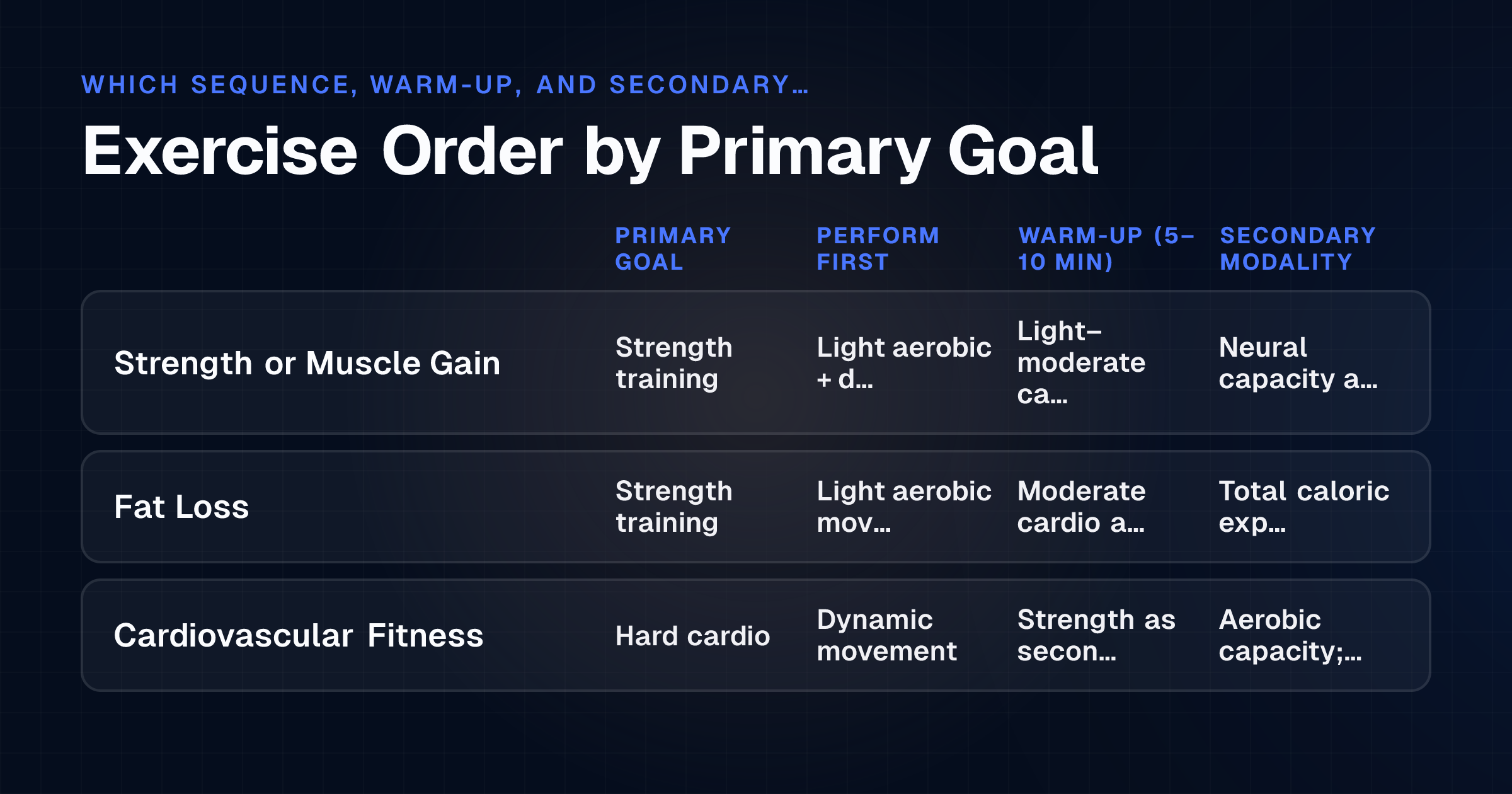
If Your Primary Goal Is Strength or Muscle Gain
Perform strength training first, when your nervous system is primed and glycogen stores are full.
Use a brief warm-up, 5-10 minutes of light aerobic work or dynamic stretching, to prepare joints and elevate heart rate. Perform steady-state cardio after strength if you want to include cardiovascular work. Light-to-moderate intensity (60-70% max heart rate) for 20-30 minutes doesn't meaningfully compromise strength adaptation and supports recovery and fat loss.
Separate hard cardio sessions from heavy strength days when possible. If concurrent training is necessary, prioritise the modality that aligns with your primary goal.
Reference: Warming up and stretching before workouts: science-based benefits covers low-intensity preparation in detail.
If Your Primary Goal Is Fat Loss
Total caloric expenditure matters most. Perform whichever modality is sustainable and fits your schedule.
Consider strength first, then moderate cardio, to maintain muscle mass during a caloric deficit. Preserving muscle protects metabolic rate and body composition. Track total weekly volume rather than session order, consistency over 8 weeks outweighs a single "optimal" session structure.
Reference: Nutrition & Macro Targets: Flexible Dieting for 8 Weeks explains how caloric targets interact with training order.
If Your Primary Goal Is Cardiovascular Fitness
Perform hard cardio when fresh, then add strength work as a secondary modality if time and recovery allow.
Accept a minor trade-off in strength gains. This is a deliberate choice aligned with your priority. Manage volume carefully to avoid overtraining and injury.
A Worked Example
A person beginning an 8-week structured programme with goals of fat loss and modest strength retention might structure sessions like this:
- Monday: Strength training (primary focus), 40 minutes; followed by 15 minutes easy steady-state cardio.
- Wednesday: Strength training (primary focus), 40 minutes; followed by 15 minutes easy steady-state cardio.
- Friday: Moderate cardio, 30 minutes (no strength this session).
- Saturday or Sunday: Optional recovery walk or light activity.
This approach prioritises strength when neural capacity is highest, includes cardiovascular stimulus without compromising force production, and maintains total weekly volume.
Reference: Recovery Between Cardio Sessions: Timing and Nutrition explains how to pace these sessions for genuine recovery.
Key Takeaways
Extended cardio before strength training acutely reduces performance and, over time, can attenuate strength and muscle-building gains if used consistently.
Brief, low-intensity warm-up cardio, 5-10 minutes, doesn't produce this effect. It can enhance readiness.
Exercise order should match your primary goal. Strength or muscle gain demands strength training first; fat loss is less sensitive to order but benefits from strength prioritisation to preserve muscle. Total volume, intensity, and consistency matter more than rigid adherence to one sequence, and a well-structured 8-week programme balances both modalities according to what you want to achieve.
Individual tolerance varies. Training age, recovery capacity, and specific intensity all influence how much concurrent cardio you can handle without compromising results.
Real people using structured programming, like participants in transformation challenges, often see best results by matching exercise sequence to stated goals rather than assuming a single "correct" order applies universally.
General guidance from the 8WTC team, not medical advice. Individual results vary. Always consult your doctor before starting a weight-loss or exercise programme.