FAQs
Can You Do 8WTC Without a Gym? Home Workouts Explained
The 8WTC is designed for home training with bodyweight, resistance bands, and dumbbells—no gym required. This guide covers equipment, structure, progression, and how to avoid common home-training mistakes.

Yes. You can complete 8WTC at home without a gym membership. When you join, you choose home or gym training, and the programme is built around your experience and the equipment available to you. Sessions generally take 45–60 minutes and are designed to fit around work, family and other commitments. This guide explains what home training involves, what equipment may be useful and where its limitations should be considered.
Key takeaways: home training is proven in the programme design
- The 8WTC is explicitly designed as home-workout-friendly; gym membership is optional, not required.
- Bodyweight, resistance bands, and dumbbells form a complete training toolkit for the eight-week cycle.
- Four sessions per week, typically 60 minutes each, fit into a home space with minimal setup.
- Nutrition guidance is built into the app and works identically whether you train at home or in a gym; it's the second pillar of transformation.
- The programme's flexibility means beginners can start with bodyweight alone and add resistance over time.
- More than 10,000 documented transformations have come through the 8WTC; the programme doesn't rely on heavy gym equipment to deliver results.
What it means: home setup beats the gym-membership myth
The 8WTC offers a choice. When you sign up, the plan adapts to your environment. You select home or gym workouts, and the app structures four weekly sessions around the equipment you tick off: bodyweight, dumbbells, resistance bands, or a mix. The programme doesn't lock you into a specific setting or require subscription fees on top of the challenge entry.
Bodyweight exercises, push-ups, squats, lunges, planks, form the foundation. These use your own mass for resistance and scale from beginner to advanced by altering leverage, tempo, or volume. Resistance bands add progressive challenge without floor space or noise; they cost £10-30 for a decent set.
Adjustable dumbbells (optional) let you increase load in small jumps, crucial for progressive overload, and a single pair covers dozens of movements.
The point: transformation doesn't hinge on expensive equipment or a gym contract. It hinges on following the plan, eating to your targets, and showing up consistently.
Why it matters: cost, time, and barrier removal
Many people delay starting because they assume they must join a gym, pay the fee, travel there, and fit workouts into a commute. That friction stops action. Home training removes three blockers at once: no membership cost, no travel time, no scheduling around gym hours.
The 8WTC entry is £149.99. A basic home setup, which includes dumbbells and resistance bands, can be obtained for an additional cost. Overall, the initial investment is manageable, and you will have the equipment for future use.
A gym membership runs £30-80 per month. Over a year, the maths is clear.
Time matters too. Four 60-minute sessions per week at home mean no commute. That's four hours of actual training, recoverable from a single location. For parents, shift workers, or anyone with unpredictable schedules, this is the difference between starting and not.
How an 8-week Body Transformation Challenge Works covers the full structure; the key point here is that the structure doesn't require a gym.
How it works: structuring four weekly sessions at home
Each of the eight weeks includes four training sessions. The app prescribes exercise, sets, reps, and rest periods.
A typical session runs 60 minutes and uses either compound movements (squats, deadlifts, push-ups, rows) or metabolic finishers.
Progressive overload in a home setting
Progressive overload, gradually increasing workout difficulty, is how you force adaptation and keep results coming. In a gym, this means adding weight. At home, it means:
- More reps or sets for the same exercise (e.g., 3 sets of 10 push-ups → 3 sets of 12).
- Shorter rest between sets (e.g., 90 seconds → 60 seconds).
- Harder exercise variations (e.g., regular push-ups → archer push-ups → one-arm push-ups).
- Adding resistance bands or light dumbbells to bodyweight moves.
- Increasing dumbbell weight as you adapt (e.g., 5kg → 7.5kg).
The 8WTC app guides this progression automatically; you don't need to guess. The plan is built so that by week 8, your body is far more capable than on day 1, and the workouts reflect that.
Sample home workout structure
A typical session might include:
- Warm-up: 5-10 minutes (dynamic stretching, light movement).
- Strength block: 3-4 exercises, 3-4 sets each (e.g., squats, push-ups, rows, lunges).
- Metabolic finisher: 10-15 minutes of higher-rep, lower-rest work to elevate heart rate.
- Cool-down: 5 minutes (stretching, breathing).
This structure fits a home space (you need a clear floor, roughly 2m × 2m minimum), requires no machinery, and produces measurable strength and aesthetic changes.
Example or scenario: the home-training journey
Consider a real user starting the 8WTC with no gym access and minimal equipment.
Week 1-2: They do bodyweight workouts only. Push-ups, squats, lunges, planks, burpees. They hit all four sessions, follow the app's rep targets, rest as prescribed. Nutrition is tracked via the app's calorie and macro targets.
No weights, no bands. They hit their sessions at 6 a.m. before work or at 9 p.m. after kids sleep.
Week 3: Midway through, they order a pair of adjustable dumbbells (£25) and a resistance band set (£15). The app's programming adapts; they now add weight to squats, use dumbbells for chest presses, add band tension to rows.
Week 5-6: Dumbbells feel lighter now. They're stronger, moving more weight for the same reps, or hitting more reps with the same weight. This is progressive overload in action. They add a second band to increase tension or bump dumbbell weight up another 2.5kg.
Week 8: They complete the final session. Eight weeks of consistent four-session weeks, disciplined nutrition, and incremental strength gains have shifted their body composition. They submit their progress photos and measurements to the prize pool.
No gym. No membership. No fancy equipment. The transformation came from consistency, nutrition, and intelligent progression, the same drivers that work anywhere.
For more context on real-world outcomes, see From Couch to Confidence: Real 8WTC Winner Transforms in 8 Weeks.
Common mistakes or risks: what stops home trainers
Underestimating bodyweight
Many people assume bodyweight exercise is "easy" because there's no weight to add. That's a trap. Bodyweight can be brutally hard: single-leg squats, archer push-ups, handstand holds, decline push-ups, and pistol variations challenge even experienced lifters.
The app builds these progressions in. Respect them and progress deliberately.
Not progressing at all
The biggest home-training failure is repeating the same routine for eight weeks. Ten push-ups in week 1, ten push-ups in week 8. No adaptation, no change.
The 8WTC app prevents this by auto-progressing, but only if you follow it. Ignore the progression cues and you'll stall.
Poor form from lack of feedback
Without a coach watching, form errors compound. Bad squat mechanics, rounded-back deadlifts, or half-range push-ups reduce effectiveness and risk injury.
Mitigations: film yourself and compare to the app's demo videos; start lighter and move intentionally; prioritise warming up and stretching before workouts to move safely.
Neglecting nutrition
Home training makes it easy to ignore diet. No gym community or check-ins to keep you honest. But 70% of body transformation is nutrition.
The 8WTC includes macro and calorie targets, meal plans, and flexible dieting guidance. Track them. The app has a built-in calorie tracker. Use it. Compare its simplicity to other tools if you're curious about alternatives.
Space or noise limits not planned for
Some exercises are noisy (burpees, jump squats, box jumps on a wooden floor). Some need space.
Early planning matters. Know your constraints: ceiling height, floor type, neighbour tolerance. The app's exercise library includes low-noise, tight-space alternatives. Ask or explore.
Isolation and motivation drop-off
Home training can feel lonely. The 8WTC runs a community of 31,000 members; use it.
Join the chat, post progress, follow others' wins. The social element replaces what the gym floor offers and keeps momentum when week 5 feels hard.
How to choose or what to do next: starting a home setup
Step 1: Commit to the eight weeks
Decide now. Home training works, but only with adherence. Four sessions weekly, nutrition tracking, eight weeks. If that commitment is real, move to step 2.
Step 2: Verify your space
You need roughly 2m × 2m of clear floor, good ventilation, and safe footing. No breakables in the zone. That's it.
A spare bedroom, lounge corner, or garage works. Noise matters if you have downstairs neighbours; plan lower-impact sessions or quieter times.
Step 3: Choose your starting equipment
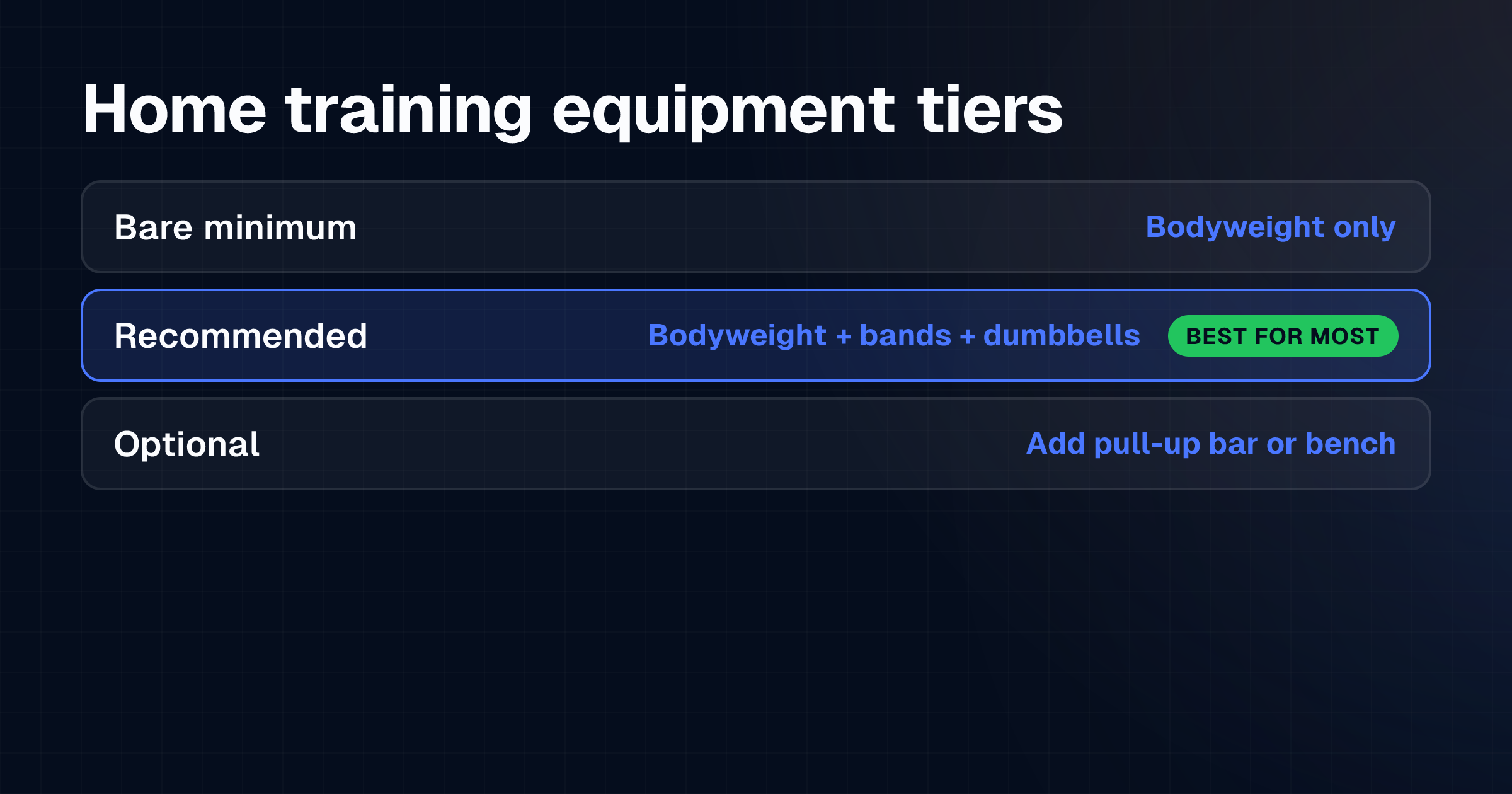
Bare minimum: Bodyweight only. Perfectly valid for the first 2-3 weeks. Many users start here.
Recommended: Add a resistance band set (£10-20) and adjustable dumbbells if budget allows (£30-60 for a basic pair). This covers 95% of the programme's movements.
Optional: A pull-up bar (£20-40) or a bench (£50+). Neither is required, but they unlock extra exercise variety later.
Step 4: Download the app and start
Sign up at 8wtc.com, download the app from iOS or Android, select "Home Workouts," and follow the onboarding. The app assigns your first week's plan and nutrition targets.
Press play on day 1.
Step 5: Track and progress
Log workouts, track calories and macros, check progress every two weeks. The app does most of the thinking; you just execute and eat to plan. Learn more about recovery between cardio sessions if you add conditioning work.
Step 6: Use the community
Post your week-1 photo. Follow other home trainers. Message the team if you're stuck.
The community and support are part of what you paid for; use them.
One final note: the 8WTC includes a 30-day money-back guarantee. If the programme doesn't fit your life or you don't see early signs of progress by day 30, you get a refund (terms exclude custom one-on-one coaching). That removes the financial risk of starting.
For a deeper dive into other common concerns, read Objection-Busting: Common 8WTC Questions Answered.
FAQs
What if I don't own any equipment at all?
You can start and complete the full eight weeks using bodyweight alone. The programme includes scalable variations: easier versions early on, harder progressions as you strengthen.
Dumbbells and bands accelerate progress and add variety, but they're not essential for transformation. Many users add them in week 3 or 4 once they've built habit.
Can I do home workouts if I live in a small flat or flat-share?
Yes. You need roughly 2m × 2m. Choose quieter times (early morning or midday) to avoid noise complaints. The app includes low-impact, quiet exercise options.
Talk to housemates upfront so they're not surprised by four weekly sessions. Consistency beats comfort; inconvenience is temporary.
How long does setup take if I'm buying equipment?
£10-20 for a resistance band set arrives in 2-3 days via Amazon or a local sports shop. Adjustable dumbbells take 5-7 days. You don't need to wait; start immediately with bodyweight and add resistance later.
No start delay required.
Will I get sore doing home workouts if I'm a complete beginner?
Likely, yes, soreness is normal when muscles adapt to new stress. It decreases after 1-2 weeks. The 8WTC structures warm-ups and progressions to minimise excessive soreness, and the app's guidance keeps form safe.
If soreness is severe or doesn't ease, scale back intensity and let the team know via in-app support.
What if I need to miss a session or two?
Four sessions per week is the target, but life happens. Missing one session is fine; make it up the next week if possible. Missing multiple weeks will slow progress, but you can still finish the eight weeks and see changes.
The app tracks consistency and flags patterns. Aim for the schedule; imperfection doesn't disqualify you.
Is the 30-day money-back guarantee actually real?
Yes. The 8WTC offers a 30-day 100% money-back guarantee on the standard programme (excludes custom one-on-one coaching). If you're unsatisfied or don't see early progress by day 30, you can request a refund per the terms.
No arguments, no tricks. It's stated in the guarantee terms and enforced.
General guidance from the 8WTC team, not medical advice. Individual results vary. Always consult your doctor before starting a weight-loss or exercise programme.