FAQs
Objection-Busting: Common 8WTC Questions Answered
The programme costs £149.99 for 8 weeks, works at home or in a gym with minimal kit, takes 45 minutes per session, and includes a money-back guarantee if you complete the challenge and see no measurable change.

Considering 8WTC but held back by cost, time, equipment concerns or worries about results? The programme costs £149.99 as a one-off entry fee and runs for 8 weeks with workouts lasting around 45 minutes each. It works from home with minimal kit or in a full gym, includes personalised nutrition guidance, and comes with a genuine money-back guarantee: complete the 8 weeks, log your macros and weekly check-ins, and if your photos and measurements show no measurable change, you get a full refund. Beginners are welcome. This article addresses six real hesitations that stop people from joining and shows how the programme handles each one.
Key takeaways: Six concerns fence-sitters raise, and what actually matters
Cost: £149.99 entry covers 8 weeks of personalised training, nutrition support, and app access. One-off payment per challenge. No hidden monthly fees unless you choose a subscription after week 8.
Home workouts: The programme adjusts to your equipment. Dumbbells, resistance bands, a full gym, or just bodyweight, the plan adapts. No gym membership required.
Time investment: Sessions run 45 minutes. Factor in separate time for meal prep and nutrition logging, which varies depending on the chosen nutrition style (macro targets, calorie targets, or barcode scanning).
The money-back guarantee: Real but conditional. Complete all 8 weeks, follow the programme, log diet macros and weekly check-ins consistently, and provide before and after photos and measurements. If they show no change, the full £149.99 entry fee is refunded. This isn't a blanket satisfaction refund, it's a promise that the programme works if you follow it.
Beginner-friendly: Serves multiple fitness levels and goals: weight loss, muscle gain, recomposition or general fitness. Scales to your starting point and experience.
Weight regain risk: Research doesn't cover long-term outcome data beyond the 8-week challenge period. Sustaining results depends on whether you maintain the habits and activity level built during those 8 weeks.
What it means: How 8WTC structures flexibility around your situation
8WTC is built as an 8-week challenge with synchronized start dates. Everyone enters the same challenge together, which creates shared accountability.
The programme operates via a mobile app and web platform. Three core elements: personalised workouts, nutrition guidance, and community support through weekly check-ins. Workouts are structured for approximately 45 minutes per session, adjusting based on fitness level and available equipment.
Starting the challenge doesn't require a gym membership, the app offers modifications for bodyweight training, resistance bands, dumbbells, or a full gym setup. Specific duration and intensity shift based on what you're working with.
Nutrition guidance comes built into the entry fee and isn't optional. Choose the preferred approach: macro targets, calorie targets, or barcode scanning for flexible dieting. The app handles the tracking, meaning you record what you eat and drink during the challenge period.
Coaching is provided through the app, supported by community and weekly progress check-ins. There's no one-on-one personal trainer assigned to you. If you thrive with structured deadlines and a shared cohort of people starting at the same time, this model works well. If you prefer intensive one-on-one guidance, this coaching style may feel different from other fitness offerings.
Why it matters: What the hesitation is really about
Money and time are real constraints. Most people don't have spare hours or cash to waste on something that doesn't fit their life or deliver results.
The hesitations people raise, "Is £150 worth it?" "Do I need a gym?" "How much time does it take?", aren't objections to fitness itself. They're questions about fit, value, and risk.
8WTC's structure tries to answer these by being explicit. Price is transparent. The guarantee (if conditional) exists. The app rating is 4.9 out of 5, which suggests users find enough value to rate it positively. The programme has documented over 10,000 transformations, though individual results vary based on effort, consistency, and starting point.
The real risk isn't the money or the time. It's the effort.
The programme requires following the training plan, logging nutrition consistently, and attending weekly check-ins for the full 8 weeks. People who skip workouts, don't log food, or miss check-ins reduce their own chances of seeing measurable change, and therefore of qualifying for a refund if they don't.
How it works: The four practical steps to getting started
Decide on your setup. Training at home or in a gym? If at home, what equipment is available or can be accessed cheaply (dumbbells, resistance bands, a yoga mat)? If in a gym, is there an existing membership or plans to get one? The app asks this during onboarding and builds workouts around it.
Choose your nutrition approach. Three options: macro targets (track protein, carbs, fats), calorie targets (track total calories), or barcode scanning (log food by scanning barcodes). None is harder than the others; it's a preference. If granular detail appeals, macros work. For simplicity, calorie targets or barcode scanning may feel easier.
Plan for the time commitment. Set aside 45 minutes per workout session, plus separate time for meal prep (varies by cooking style) and daily food logging. The weekly check-in is typically a photo, measurement, and a few written responses, roughly 10-15 minutes. Build this into the schedule before starting, not after.
Understand the refund condition. Qualification for a refund happens only if the full 8 weeks are completed, the programme is followed as written, macros (or calories) and weekly check-ins are logged every week, and before and after photos and measurements show no measurable change. Stopping partway through, skipping logging, or not providing final photos and measurements means the guarantee doesn't apply.
Example: How the guarantee works in practice
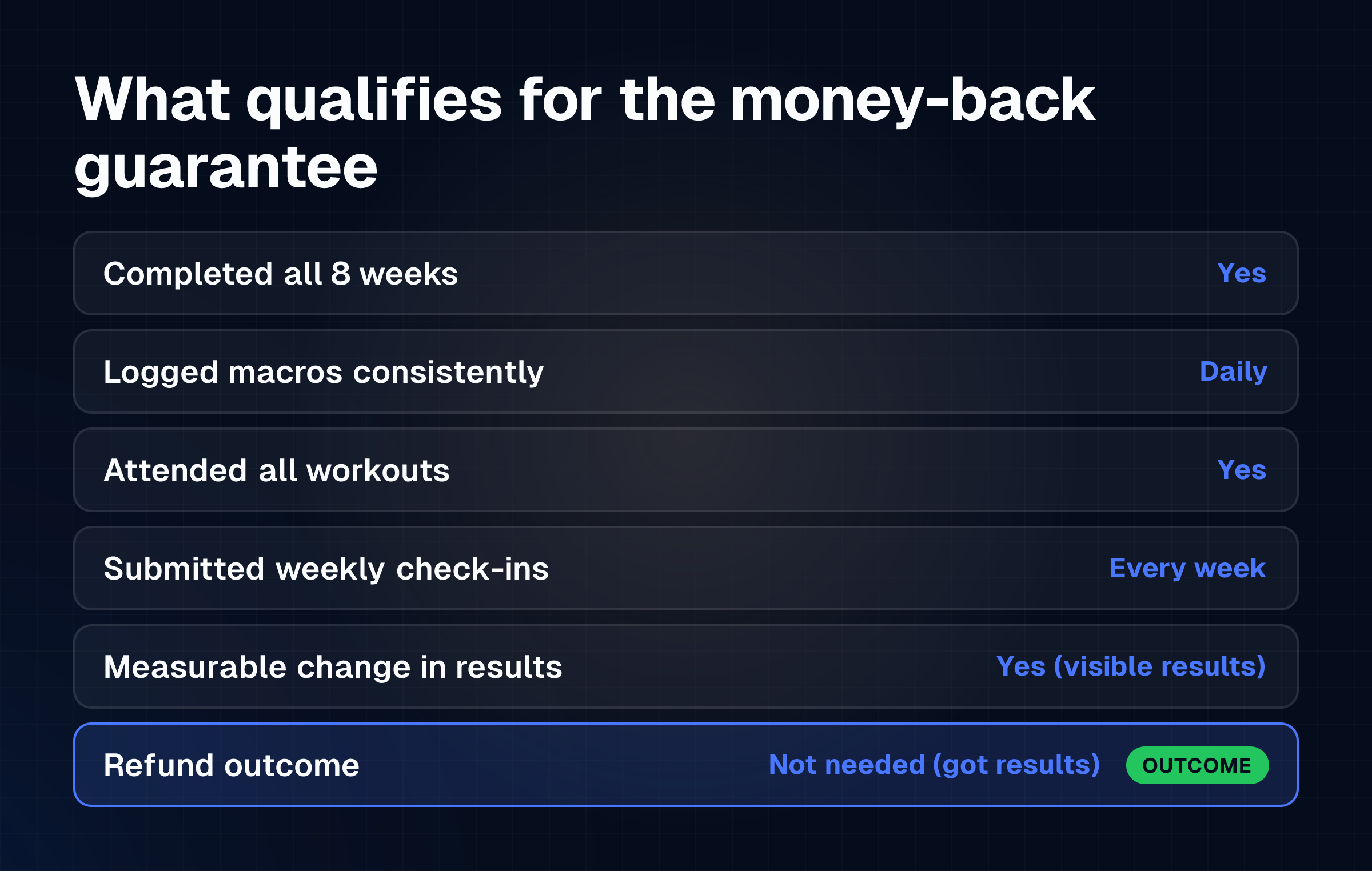
Anna enters 8WTC at £149.99. She has dumbbells and a resistance band at home and chooses the macro-tracking nutrition option.
She completes all 8 weeks of workouts, logs her macros daily, and submits weekly check-ins on time. At week 8, her before and after photos show visible muscle definition in her shoulders and arms, and her measurements show a 2cm reduction in waist circumference. The programme worked, the guarantee is satisfied, and she sees results.
David also enters at £149.99 but skips workouts in weeks 3 and 4 due to work travel. He logs his macros sporadically. By week 8, his measurements haven't changed meaningfully because he didn't follow the programme consistently. When he requests a refund, it's denied because the guarantee requires full adherence to the plan and consistent logging. The condition wasn't met.
The distinction is clear: the guarantee protects people who do the work and don't see results. It doesn't protect people who don't do the work, regardless of results.
Common mistakes or risks: What derails people mid-challenge
Underestimating the logging burden. A 45-minute workout is manageable, but tracking every meal, snack, and drink daily for 8 weeks takes discipline. If food logging is hated or forgotten, the habit doesn't build and the data needed to adjust nutrition mid-challenge is lost. Set phone reminders or pick a time of day (after dinner, for example) when logging always happens.
Expecting results in week 2. Visible body recomposition often takes 4-6 weeks to show. Stepping on the scale in week 2 and seeing no change, or only a small drop, easily kills motivation.
Scale weight fluctuates. Progress shows up in how clothes fit, energy levels, and how photos look. Don't rely on the scale alone.
Not using the community or skipping check-ins. The accountability built into 8WTC relies on the shared start date, weekly check-ins, and the sense that thousands of other people are doing the challenge simultaneously. Treating it as a solo app and skipping the community loses that psychological lever. Engage with the check-ins and the community features, they matter.
Choosing a nutrition style that doesn't fit lifestyle. If meals are mostly home-cooked, macro tracking works well. If most food is packaged or from restaurants, barcode scanning is faster. If eating intuitively and hating numbers, calorie targets might feel better. Pick wrong and logging becomes dreaded. Choose the style that matches how eating actually happens.
Not adapting training when injured. The app includes modifications for different fitness levels, but if an injury develops mid-challenge, the plan needs adjusting. Skipping sessions or pushing through pain reduces ability to finish strong or see results. Communicate this through the check-in or adjust equipment selection in the app.
How to choose or what to do next: Making the decision
Four questions to consider:
Is there 45 minutes per session, plus time for meal prep and logging? If yes, move forward. If no, clarify when this time could be carved out. The challenge is 8 weeks, it's temporary.
Can there be commitment to logging nutrition daily for 8 weeks? This is non-negotiable for results and for the guarantee to apply. If unsure, the daily experience requires consistent tracking and weekly photo submissions.
Is there access to at least minimal equipment, or willingness to train with bodyweight? If yes, all set. The programme adapts to the setup.
Is this starting because of genuine desire to change habits for 8 weeks, or hoping to "undo" it after? The challenge works because it builds consistency. Seeing it as a temporary sprint with no plan to maintain the habits afterward may lead to weight regain or lost fitness gains after week 8. That's not the programme's fault, it's the nature of any temporary change.
If the first three get yes answers and the fourth has been thought through, 8WTC is worth trying. The £149.99 entry is low relative to other fitness commitments (personal training, gym memberships, online courses). The guarantee means money isn't at risk if the work is done and no change happens. The app is well-rated (4.9/5), which indicates real users find value in it.
FAQs
Is £150 worth it for an 8-week challenge?
That depends on what it's compared to. A single month of personal training typically costs £200-500. A gym membership runs £20-60 per month. A nutrition app or fitness app alone costs £10-30 per month.
For £149.99, there's 8 weeks of personalised workouts, nutrition guidance, app access, community support, and entry into a prize pool (weekly giveaways plus £5,000 first prize). If it's used, it's good value. If payment happens and there's no engagement, it's wasted money, but that's true of any fitness programme.
Do I need a gym to do 8WTC?
No. The programme works at home with dumbbells, resistance bands, or bodyweight alone. Training in a gym is also possible if there's access. When joining, the app is told what equipment is available, and it adjusts workouts. Many people have completed the challenge using only home equipment.
How much time does the challenge actually take per week?
Expect approximately 45 minutes per workout session. If 4 sessions happen per week (a common structure), that's 3 hours of training. Add 30-60 minutes per week for meal prep and daily nutrition logging, and 10-15 minutes for the weekly check-in.
Total is roughly 4-5 hours per week, spread across 8 weeks. This isn't a huge commitment for a structured transformation programme, but it's not passive either.
Is the money-back guarantee real, or is it just marketing?
It's real but conditional. A full refund of the £149.99 entry fee happens if all 8 weeks are completed, the training plan is followed, nutrition macros (or calories) and weekly check-ins are logged consistently, and before and after photos and measurements show no measurable change.
If these conditions are met and no results appear, money comes back. But if workouts are skipped, food isn't logged, or final measurements and photos aren't provided, the guarantee doesn't apply. Read the terms carefully before joining so there's no surprise.
Can beginners do 8WTC, or is it for people who already work out?
Beginners are welcome. The programme offers fitness levels from beginner to advanced, chosen during sign-up. Workouts will scale to the starting point, including how the app modifies movements and intensity.
Will I regain the weight or lose the fitness after the 8 weeks end?
Research doesn't cover long-term outcomes beyond the 8-week period. What happens after week 8 is individual choice.
Returning to old eating and exercise habits likely leads to weight regain or lost fitness. Maintaining the habits built, keeping movement consistent, keeping nutrition reasonably steady, that holds onto most progress. The 8 weeks isn't a permanent fix; it's a sprint that builds momentum and habits. What gets done with those habits afterward determines the long-term result.
General guidance from the 8WTC team, not medical advice. Individual results vary. Always consult your doctor before starting a weight-loss or exercise programme.