FAQs
How to Get 12,500 Steps in Every Day
Reaching 12,500 steps daily is realistic for most busy adults without a gym membership.

Yes, reaching 12,500 steps daily is realistic for most busy adults, and it doesn't require a gym membership or structured exercise routine. The key is integrating movement into existing daily routines through what researchers call NEAT (Non-Exercise Activity Thermogenesis): the energy expended for everyday activities like walking to coffee, taking stairs, or active playtime with children. Breaking the goal into smaller increments (1,000-2,000 steps at a time) and leveraging simple environmental changes, parking further away, choosing stairs over elevators, or pacing during phone calls, makes the target achievable without sacrificing time or adding stress.
Research shows that accumulating more daily steps is linked to measurable health benefits, particularly for mortality risk reduction. This guide outlines practical, evidence-backed strategies tailored to working professionals, stay-at-home parents, and other busy adults.
Key takeaways: Practical strategies to reach 12,500 steps without gym time
- Track baseline activity first. Use a pedometer, fitness tracker, or smartphone app to establish current step count and identify the gap to 12,500.
- Break the goal into micro-increments. Aim for 2,000 steps by 9 AM, another 3,000 by lunch, and 2,500 by evening, smaller targets feel less overwhelming.
- Leverage commute and work time. Park further away, get off public transport one stop early, take stairs instead of elevators, walk to nearby coffee shops, and suggest walking meetings.
- Integrate movement into parenting and home life. Active play with children, stroller walks, walking to local errands, and pacing while folding laundry all accumulate steps naturally.
- Use technology and environmental design. Fitness trackers maintain motivation; placing water bottles or trash cans across the room creates reasons to move.
- Find accountability and enjoyment. Share goals with a partner or friend; listen to podcasts or audiobooks while walking to make the habit sustainable.
What it means: How NEAT and daily step accumulation support your health
Non-Exercise Activity Thermogenesis (NEAT) refers to the energy expended through everyday activities, not deliberate exercise, eating, or sleeping. According to research from the Mayo Clinic, NEAT significantly contributes to daily energy expenditure and plays a key role in weight management and metabolic health.
Unlike structured gym sessions, NEAT-building activities are seamless: climbing stairs during a work break, pacing while on a call, or walking to the grocery store instead of driving. Step accumulation, a simple measure of NEAT activity, reflects how much movement is woven into daily routines.
The goal of 12,500 steps is roughly 5-6 miles depending on stride length. While this number may sound large, it becomes manageable when spread across morning, work, and evening hours through repeated small movements rather than one concentrated effort.
Why it matters: The science behind step targets and mortality risk reduction
Daily step count is associated with health outcomes beyond weight loss. A 2020 study published in JAMA Network Open found that taking more steps per day was correlated with lower risk of all-cause mortality in older women, with the steepest benefit up to approximately 7,500 steps per day and continued gains up to 10,000-12,000 steps. This means stepping up activity levels can extend lifespan and improve overall wellness.
The American Heart Association recommends at least 150 minutes of moderate-intensity aerobic activity or 75 minutes of vigorous-intensity activity per week. Increasing daily steps is an accessible way to contribute to these guidelines without needing a gym or formal workout schedule.
For busy adults juggling work, caregiving, or other obligations, step-based movement offers a flexible path to meeting cardiovascular health targets.
How it works: Integrating movement into your existing routines as a working parent or busy adult
Morning momentum
Begin the day with small movement habits:
- Walk while brushing teeth or waiting for coffee to brew.
- Take a short walk around the block before starting work or daily tasks.
- Park further from the office, school drop-off, or grocery store entrance.
These micro-movements accumulate quickly. They set an active tone for the day.
Workday strategies for employed adults
Office and work environments offer numerous step opportunities:
- Replace smoke or sitting breaks with stair breaks. Walk up and down a few flights of stairs every couple of hours.
- Walk to a nearby coffee shop a few blocks away instead of using the office machine, or walk a loop around the building with your coffee.
- Propose walking meetings with colleagues when the agenda permits.
- Stand and walk for 5-10 minutes every 1-2 hours rather than remaining at a desk.
- Optimize commute time. Get off public transport one stop earlier, or park at the far end of the lot to build in a walk.
Stay-at-home and caregiver routines
Parents and caregivers have unique opportunities to build steps into daily life:
- Engage in active play with children in parks or at home, chasing, dancing, or exploring burns steps naturally.
- Walk to local errands when feasible instead of driving.
- Take long, brisk stroller walks with infants or toddlers.
- Move intentionally during housework. Pace while folding laundry, walk between rooms when tidying, or stand and move during chores rather than sitting.
Evening and wind-down movement
End the day with consistent stepping:
- Take a family walk after dinner.
- Pace while on phone calls.
- Walk around the house while preparing children for bed or tidying up.
These habits add hundreds of steps and can become anchors for daily routine.
Leveraging technology and environment
- Use a fitness tracker, smartwatch, or phone app to monitor progress and stay motivated by seeing real-time step counts.
- Always choose stairs over elevators or escalators to maximize stepping opportunities.
- Arrange your home or workspace strategically. Place the water bottle across the room, trash can further away, or store frequently used items at a distance to create movement reasons.
Example or scenario: A working parent's typical day
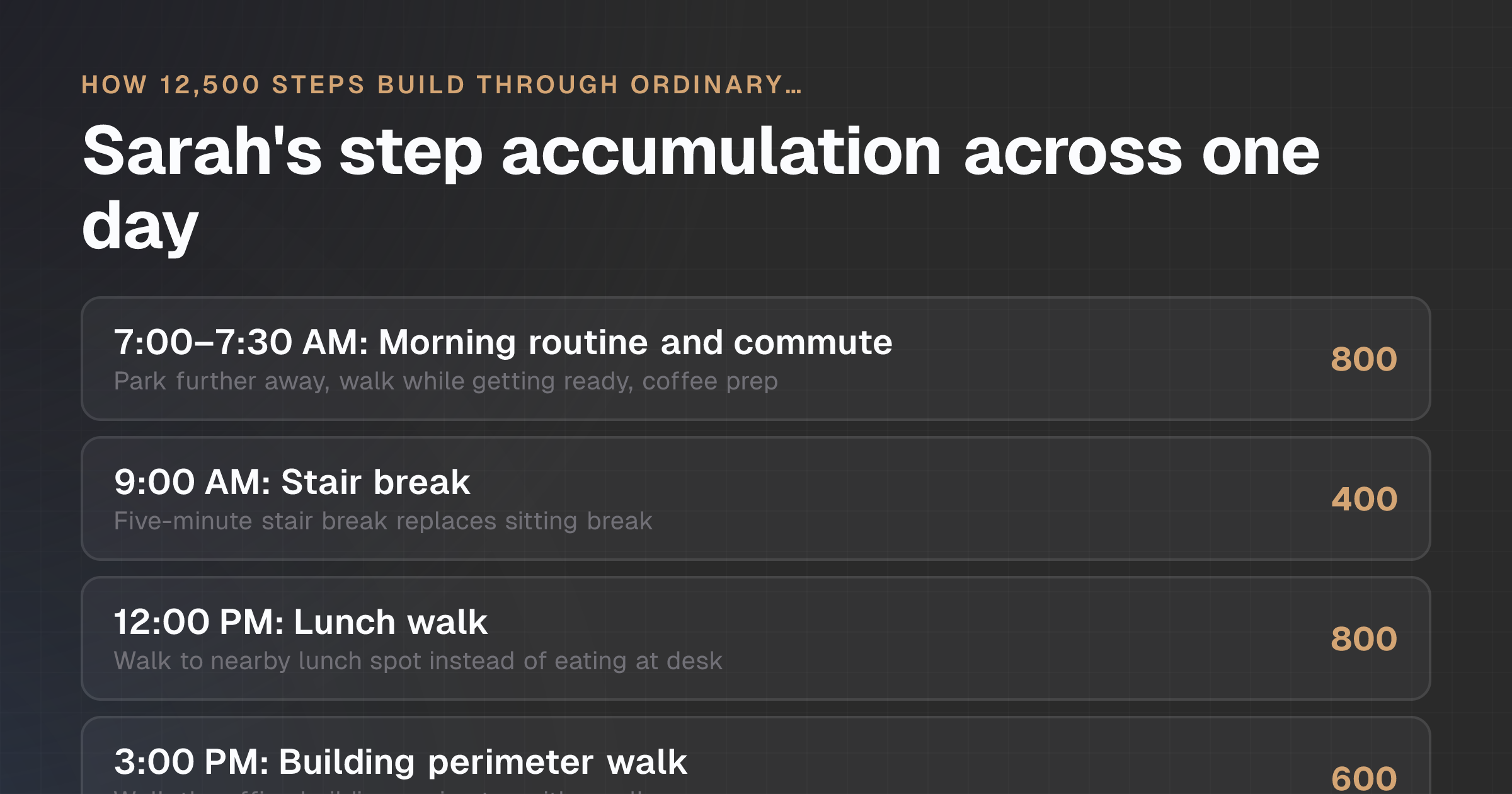
Consider Sarah, a working parent who aims for 12,500 steps:
- 7:00-7:30 AM: Park further from the office (500 steps). Walk while getting ready and during coffee prep (300 steps). Total: 800 steps
- 9:00 AM: Take a 5-minute stair break instead of a sitting break (400 steps). Running total: 1,200 steps
- 12:00 PM: Walk to a nearby lunch spot instead of eating at desk (800 steps). Running total: 2,000 steps
- 3:00 PM: Walk the office building perimeter with a colleague (600 steps). Running total: 2,600 steps
- 5:30 PM: Park further from school pickup; walk to the entrance (400 steps). Running total: 3,000 steps
- 6:30 PM: Active play with children at home or nearby park (1,500 steps). Running total: 4,500 steps
- 7:30 PM: Walk around the house while tidying and preparing dinner (1,000 steps). Running total: 5,500 steps
- 8:00 PM: Post-dinner family walk (2,000 steps). Running total: 7,500 steps
- 8:30-9:30 PM: Evening routine: pacing while folding laundry, walking between rooms (2,000 steps). Running total: 9,500 steps
- Throughout the day (incidental): Walking to restrooms, between meetings, short hallway loops (3,000 steps). Final total: 12,500 steps
Sarah hits her target without a single gym session or dedicated "exercise time", all steps are embedded in her regular day. The key is recognizing that consistency, not intensity, drives the total.
Common mistakes or risks: Time traps, footwear issues, and unrealistic expectations
Unrealistic starting pace
Beginning aggressively, jumping from 3,000 steps to 12,500 overnight, often leads to soreness, fatigue, or injury. A gradual increase of 1,000-2,000 steps per week allows the body to adapt without strain.
Poor footwear
Walking thousands of steps daily in unsupportive shoes can cause blisters, plantar fasciitis, or joint pain. Investing in comfortable, cushioned walking shoes is essential to prevent injury and maintain consistency.
"All or nothing" mentality
Missing a single day or failing to hit the target one day often triggers discouragement and abandonment. Progress, not perfection, is the goal.
A day with 10,000 steps is still a success and shouldn't derail the next day's effort.
Ignoring discomfort
Pushing through pain signals increases injury risk. If a knee, hip, or foot feels strained, reduce intensity or volume and reassess. Listening to the body prevents setbacks.
Lack of tracking
Without a record of daily steps, it's difficult to identify patterns or know where improvements can be made. Using a tracker keeps the goal visible and measurable.
Neglecting hydration
Increased daily activity requires more water intake. Dehydration can lead to fatigue, headaches, and reduced performance. Drinking consistently throughout the day supports sustained step accumulation.
Overlooking complementary fitness
Walking alone doesn't build strength or flexibility. Pairing step accumulation with periodic stretching or bodyweight exercises ensures well-rounded fitness and reduces injury risk. See warming up and stretching before workouts for evidence-based guidance on preparation.
How to choose or what to do next: Building the habit
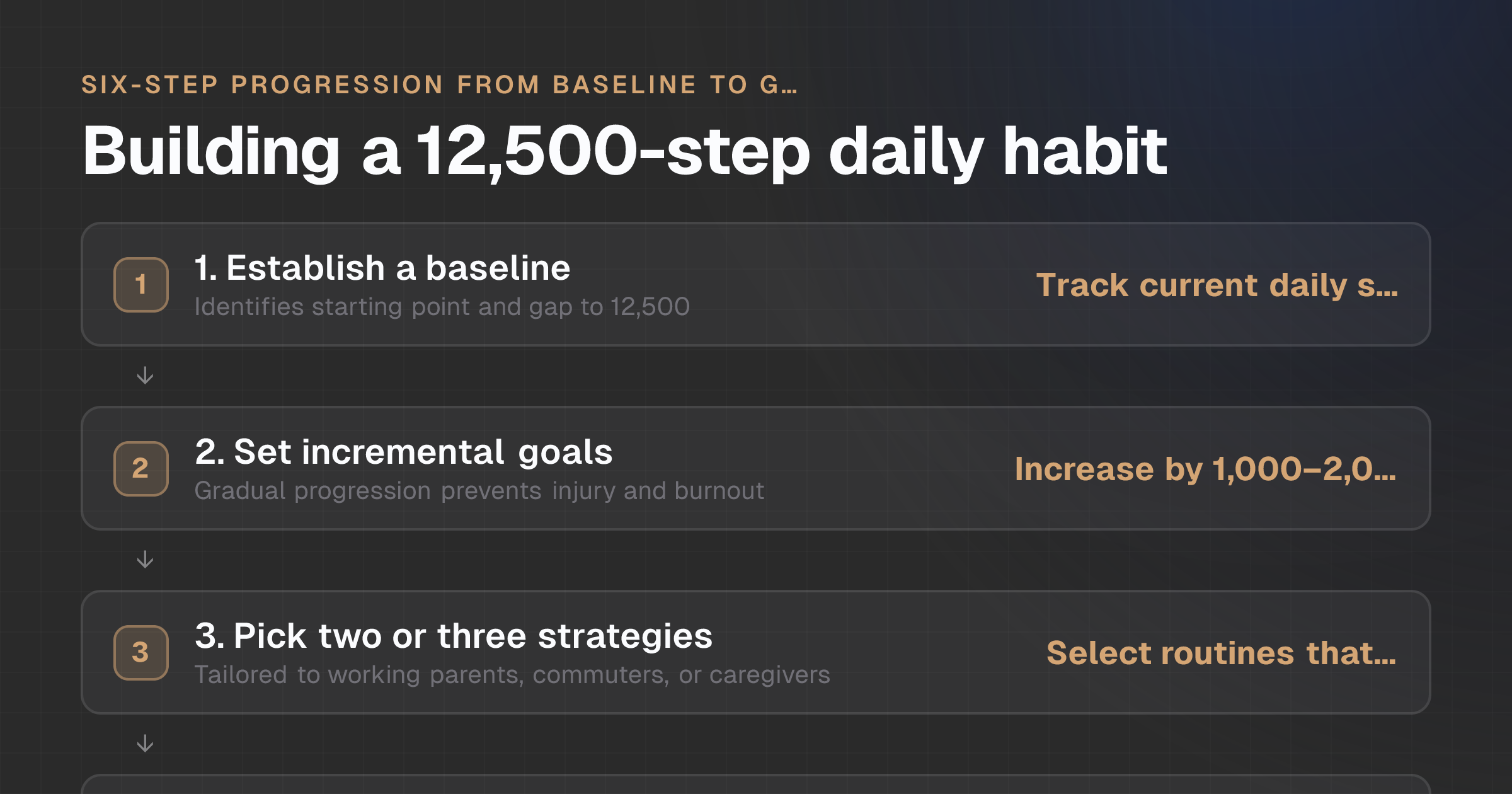
- Establish a baseline. Track current daily steps for 3-5 days using a pedometer, fitness app, or smartwatch to identify the starting point.
- Set incremental goals. If the baseline is 4,000 steps, aim for 5,500 steps next week, then 7,000 the following week, gradually reaching 12,500 over 4-6 weeks.
- Pick two or three strategies from the routines above that fit your schedule (e.g., parking further away + taking stairs + evening walks).
- Find accountability. Share the goal with a partner, friend, or colleague and check in weekly.
- Review and adjust weekly. Look at which activities generated the most steps and which felt unsustainable, then refine the routine.
- Stay flexible. Bad weather, illness, or schedule disruptions happen. Missing one day doesn't erase progress; consistency over time matters most.
For those interested in broader fitness goals, including nutrition and structured training, explore flexible dieting and macro targets or visit real transformations from working adults to see how step accumulation fits into comprehensive wellness plans.
FAQs
Does reaching 12,500 steps require a gym membership?
No. Gym membership isn't necessary to accumulate steps. The goal is built through everyday activities: walking to work, climbing stairs, running errands on foot, active play with children, and pacing during calls. All these activities add steps without formal exercise facilities.
How long does it take to reach 12,500 steps daily?
Step accumulation happens throughout the day, typically taking 2-3 hours of casual walking spread across morning, work, and evening hours. Most of the time isn't dedicated exercise but rather regular activities reframed as movement (e.g., walking to coffee instead of driving). The time commitment is primarily conscious planning and habit building rather than extra hours carved out of the schedule.
Can beginners start at 12,500 steps, or should they begin lower?
Beginners should start at their current step count and increase gradually, about 1,000-2,000 steps per week. Jumping to 12,500 from a baseline of 3,000-4,000 steps risks injury, soreness, and burnout.
A realistic progression takes 4-6 weeks to reach 12,500 safely.
What type of shoes are best for daily step accumulation?
Supportive walking or athletic shoes with good cushioning and arch support prevent blisters, plantar fasciitis, and joint pain. Avoid flat or unsupportive footwear for sustained daily walking. A podiatrist or shoe specialist can recommend options based on individual foot shape and gait.
Will reaching 12,500 steps alone lead to weight loss?
Step accumulation supports weight management through increased energy expenditure and improved metabolic health, but weight loss also depends on nutrition. For guidance on combining step goals with nutrition planning, see calorie tracking and flexible dieting approaches or consult a nutrition professional.
Is 12,500 steps the right target for everyone?
Research shows health benefits from 7,500 to 12,000+ steps daily, with individual needs varying by age, fitness level, and health status. The 12,500-step target is a reasonable goal for many adults, but consulting a healthcare provider ensures the target fits personal circumstances.
General guidance from the 8WTC team, not medical advice. Individual results vary. Always consult your doctor before starting a weight-loss or exercise programme.