
FAQs
How to Find a Beginner Fitness Challenge You'll Actually Finish
Choosing a fitness challenge that fits your equipment access, time availability, and preferred support style is the first step toward finishing it. This guide walks you through the self-assessment process so you can match yourself to a challenge built for where you are now.

Choosing a fitness challenge that actually fits your life is the first step toward finishing it. Beginners often struggle because they pick programmes designed for people further along, or ones that demand equipment they don't have, or time commitments that are unrealistic. This guide walks you through assessing your equipment access, weekly time availability, and preferred support style, so you can match yourself to a challenge built for where you are now, not where you think you should be.
Key takeaways: matching your needs to the right challenge
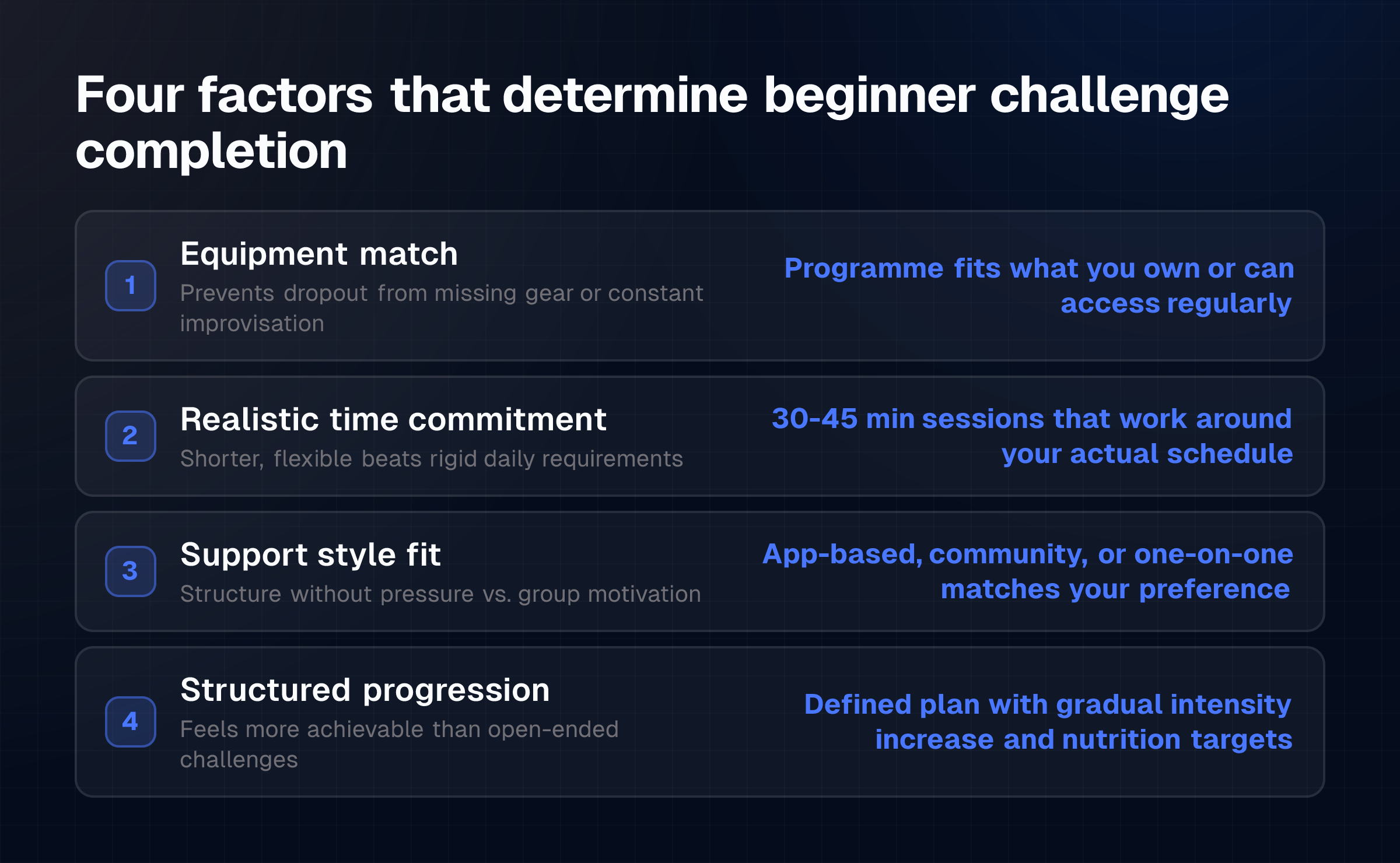
- Equipment matters: Know what you have or can access regularly. Programmes range from bodyweight-only to full-gym options; picking one that fits prevents frustration and dropout.
- Time commitment is real: Shorter, flexible programmes (30-45 minutes, workable around your schedule) suit beginners better than rigid daily requirements.
- Support style shapes adherence: App-based guidance with clear instructions and tracking works well for people who want structure without community pressure; others thrive with group motivation.
- Structure beats flexibility for beginners: A defined plan with progressive workouts and nutrition targets feels more achievable than open-ended challenges.
What it means: decoding the fitness challenge landscape
A fitness challenge is a structured exercise and nutrition programme with a fixed start and end date. For beginners, "structured" is what matters most.
It means workouts are planned in advance, intensity builds gradually, and you know exactly what to do each day rather than guessing or improvising. Beginner fitness itself emphasises foundational movements, lower starting intensity, and progressive overload, adding more challenge over time as your fitness improves. A well-designed beginner challenge won't throw you into advanced exercises on day one; instead, it scaffolds your progress so you build strength and confidence alongside fitness gains.
The fitness market offers several support models. Some programmes are app-based, delivering workouts and nutrition guidance digitally with no human interaction. Others blend community forums where members share experiences and motivation. A small number offer one-on-one coaching, usually at higher cost. Each has trade-offs: app-based programmes are often cheaper and work around your schedule; community models build accountability through peer support; one-on-one coaching offers personalisation but requires scheduling and budget.
Understanding these categories helps you recognise what you're choosing and why it matters to you.
Why it matters: completion rates hinge on fit, not willpower
Choosing a challenge misaligned with your life doesn't test your motivation, it tests your ability to keep doing something that doesn't fit.
That's why so many people quit, and why the choice at the start matters more than effort later. A challenge designed for beginners with equipment access that matches yours removes a major friction point. If the workouts assume dumbbells and a bench, but you only have a yoga mat and resistance bands, you'll either skip sessions or improvise constantly. The former kills consistency; the latter wastes mental energy every session.
Time commitment works the same way. If a programme demands 60-minute sessions five days a week and you realistically have 30 minutes most days, that gap isn't a motivation problem, it's a mismatch. You can follow a challenge designed for 30-45 minutes, flexible scheduling much more reliably than you can squeeze sessions into a timetable that doesn't exist.
Support style also shapes whether you stick with it. Some people thrive on structured solitude: they want clear instructions, zero social obligation, and the app to handle everything. Others feel isolated without group energy or check-ins from a real person. Neither is wrong. Picking the wrong one is just friction in disguise.
How it works: the self-assessment process
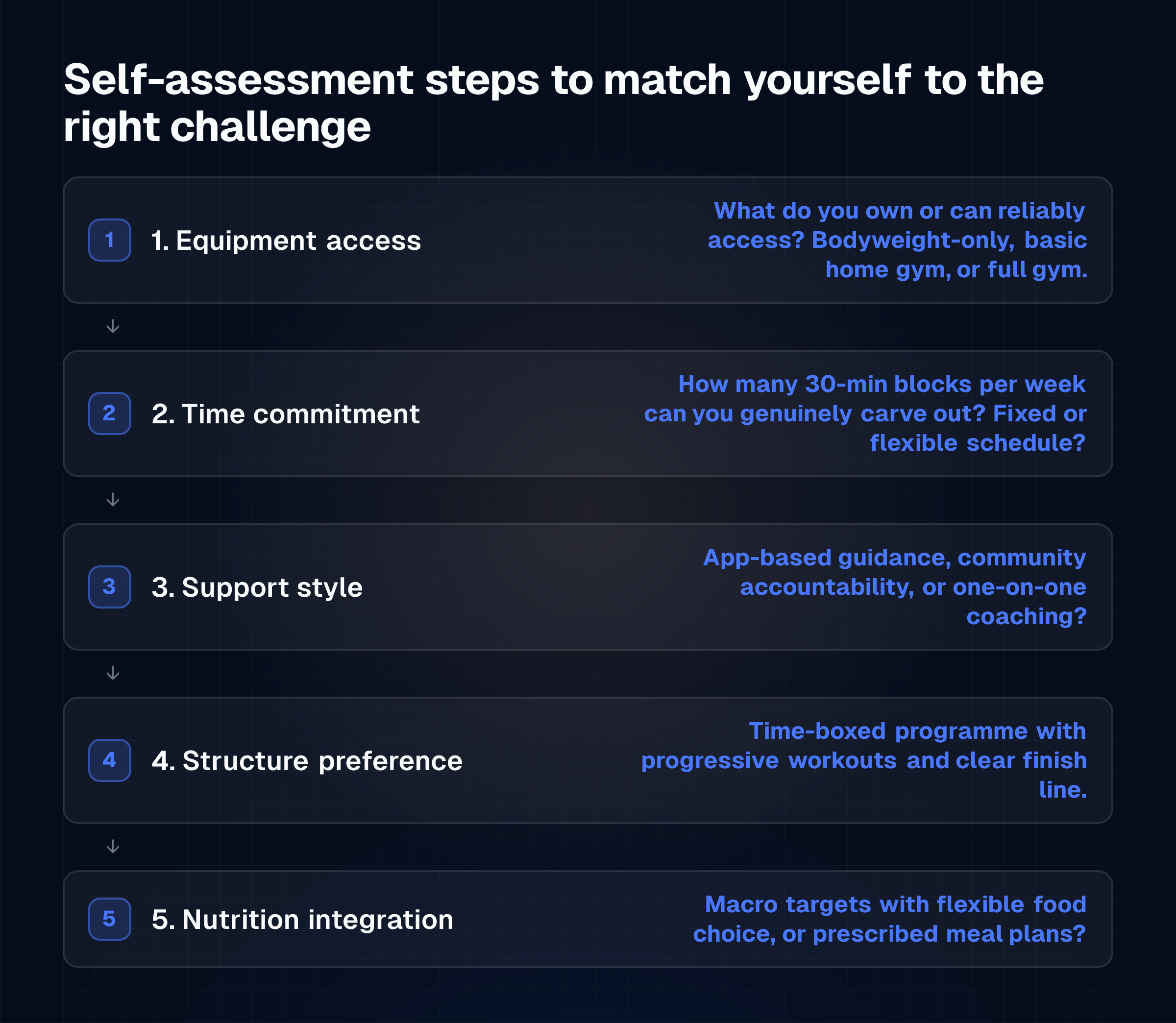
Assess your equipment access
Start by answering honestly: What equipment do you realistically have access to on a regular basis?
Write down what you actually own or can use: a gym membership, dumbbells at home, resistance bands, a yoga mat, bodyweight-only space, or a mix. Then ask yourself whether that access is reliable, can you count on it most days, or does it depend on other people's schedules or the weather?
No equipment or minimal (bodyweight, resistance bands, light dumbbells): Programmes built around these offer the most flexibility. You can work out anywhere, anytime.
Basic home gym (dumbbells, yoga mat, resistance bands): Many beginner programmes focus here. It's the sweet spot: enough variety to progress without needing a commercial facility.
Full gym access (barbells, squat racks, benches, machines): These programmes use the full range of equipment but often work for beginners too. The key is ensuring the workouts scale down if you're new to lifting.
If you're unsure what a programme requires, check the onboarding process. Some programmes ask you to specify your equipment when you sign up and adapt accordingly. For example, 8WTC lets you choose home or gym workouts when you join, and the plan structures around what you've told them you have available.
Evaluate your realistic time commitment
Next: How much time can you consistently dedicate to working out each day or week, without overcommitting?
Not what you'd like to do. What you actually will do.
If you have two young children, a full-time job, and a long commute, pretending you'll train for 90 minutes daily sets you up to fail.
Short, focused sessions (30-45 minutes): Realistic for most working people with other responsibilities. These fit around lunch breaks, early mornings, or evenings.
Flexible scheduling: Can you do the workouts any time of day, or do they have to happen at set times? Flexibility matters if your week is unpredictable (shift work, client meetings, childcare that shifts).
Fixed schedule: Some challenges ask for workouts on specific days or times. These work if your routine is stable but add stress if you're juggling variable commitments.
Write down a typical week: how many 30-minute blocks could you genuinely carve out? That number tells you whether a 5-day-a-week programme is realistic or whether you need something that works with 3-4 sessions.
Determine your support style
Ask yourself: How much guidance and accountability do you need to stay motivated and on track?
This is personal. There's no right answer, only an honest one.
App-based guidance: You get digital coaching, structured workouts, video demonstrations, nutrition tracking, macro and calorie targets, barcode scanning for food logging. No community, no check-ins from a real person, no group chat. You move through the programme solo, but with clear instructions. This suits people who prefer autonomy, don't want social obligation, or work better with digital structure.
Community support: Group forums, shared photos, group motivation, peer accountability. You might never meet these people face-to-face, but you're not alone. This works for people who thrive on seeing others' progress, who want to celebrate milestones together, or who need external motivation to show up.
One-on-one coaching: A real coach checks in, adjusts your plan, answers questions directly. High personalisation and accountability, but usually higher cost and less schedule flexibility.
Be honest here. If you know you get demotivated by seeing others' progress, a community-heavy programme might backfire. If you work best with gentle accountability and you know you'll ignore an app but respond to a person, one-on-one coaching might be worth the cost. Most people land somewhere in the middle: they like structure, don't need hand-holding, but appreciate some form of feedback or milestone celebration.
Consider programme structure and duration
Beginners benefit from clear, progressive plans that gradually increase intensity and complexity rather than overwhelming you from the start.
A time-boxed programme gives you a finish line to work toward. That end date keeps you focused without the overwhelm of an indefinite commitment that stretches beyond your mental horizon.
Look for integrated nutrition guidance
Most beginner fitness challenges include nutrition advice. The styles vary:
Macro and calorie targets with flexible food choice: You're given calorie and macro targets, then you choose what foods fit those numbers. Barcode scanning in an app makes logging faster. This suits people who like flexibility within a framework.
Meal plans: Specific recipes and portion sizes planned for you. Less decision-making day-to-day, but less freedom to swap ingredients or eat foods you prefer.
Beginners often benefit from clear, actionable nutrition advice that integrates with fitness goals. You don't have to become a nutrition expert; the programme should handle the maths and give you a simple rule to follow.
Example or scenario: three beginner journeys
Sam: working parent, home-based, app-only
Sam has two school-age children, a desk job, and can carve out 30-40 minutes most mornings before the school run.
There's no nearby gym, and childcare costs rule out membership. Flexibility is non-negotiable: some weeks will be chaotic.
Sam needs minimal equipment (bodyweight plus resistance bands), short sessions (30-45 min), flexible scheduling, app-based guidance with no community pressure, clear progression, and integrated nutrition tracking.
An app-based challenge with home or bodyweight workouts, macro targets with barcode scanning, and no community obligation fits perfectly. No guilt about missing sessions; just pick them up when life settles.
Jordan: gym member, time-rich, wants structure
Jordan has a gym membership already, works standard hours with predictable time off, and enjoys being around other gym-goers.
Jordan wants clear workouts prescribed, no thinking, just executing, and enjoys seeing progress numbers (weights, reps, measurements).
Jordan needs full gym access, structured workouts (30-45 min), consistent schedule (workouts on Monday/Wednesday/Friday/Saturday, say), digital guidance with clear progression, and tracking that shows measurable change.
A gym-friendly app-based challenge with macro targets and weekly check-ins (photos and measurements) works well. No need for community chat; the app does the job.
Casey: beginner returner, scared of commitment
Casey hasn't exercised in years, worries about starting wrong, and is sceptical that any £150 programme is worth it.
Casey has dumbbells and a mat at home, can do 30 minutes a few times a week, and wants proof before going all-in.
Casey needs beginner-friendly progressions, home-workout-friendly, and low-risk entry.
A programme with a clear structure and manageable time commitment removes barriers. Learn more about how beginner-friendly programmes work.
Common mistakes or risks: what derails beginners
Overcommitting to time or intensity
The number-one reason people quit is choosing a challenge that demands more time or effort than their life actually allows.
A 60-minute workout five days a week might work for someone with flexible hours; it's a guarantee-to-fail recipe for a parent working full-time with two kids. Start with what's realistic. You can always add more later.
Picking a programme without clear structure
Vague challenges, "get fitter in 8 weeks", leave too much room for guessing.
You don't know if you're on track, what to do next, or whether to scale down if an exercise feels too hard. Beginners thrive with detailed workout plans, progression built in, and daily guidance. If the app or coach doesn't spell out exactly what to do and how many reps, that's a red flag.
Ignoring what actually motivates you
Choosing a challenge because it's popular, highly rated, or what your friend did is common and risky. If you hate high-intensity workouts, a HIIT-focused challenge will make you miserable. If you're motivated by community and accountability, a solo app-based programme might feel lonely.
Pick based on your preferences, not someone else's.
Expecting instant or extreme results
Fitness is a slow process. You might see strength gains in 2-3 weeks, but visible body changes often take longer.
If you start a challenge expecting to look completely transformed by week 4, disappointment will hit and motivation will crumble. Realistic expectations keep you going. Read about realistic timelines and how to prevent regain.
How to choose or what to do next: a decision map
Write down your constraints in plain language.
- Equipment available: ___
- Minutes per week realistically available: ___
- Support style preferred: app-only / community / one-on-one
- Typical programme length sustainable: ___
Filter programmes by these criteria, not by reputation or price alone.
- Does it work with your equipment?
- Does the workload fit your schedule?
- Does the coaching model match what motivates you?
- Is the duration something you believe you can finish?
Check what's included: nutrition, tracking, terms.
- Is nutrition guidance part of the package, or is it extra?
- Can you track progress in the app (workouts logged, measurements recorded)?
- Are the programme terms clear and transparent?
Look for beginner-specific information.
- Does the programme scale for beginners, or assume you're already fit?
- Are there examples or testimonials from beginners who finished?
- Is there a first-week guide or orientation?
Start with a single challenge, not a subscription.
- Most programmes let you pay per challenge (e.g., £149.99 for one block) rather than committing to monthly or annual billing. This reduces risk whilst you test fit.
- If it works and you want to continue, then consider a subscription or membership.
Set one non-negotiable win for yourself.
- Not "lose 20 pounds" or "look like a fitness model." Instead: "log every workout," "stick to macros five days a week," "take progress photos on day 1 and day 56." A behaviour you control, not an outcome you can't fully predict.
FAQs
Is £150 worth it for a fitness challenge?
That depends on what's included and whether the cost aligns with your alternatives.
A challenge at £149.99 works out to roughly £18-19 per week for structured workouts, nutrition guidance, and app tracking. A single gym membership might cost £30-50/month, or a personal trainer £50-150/hour. If the challenge includes progressively designed workouts, macro targets with barcode scanning, and weekly check-ins, the value proposition is reasonable. The real question is whether you'll use it, not whether it's objectively cheap.
Do I absolutely need a gym to do a transformation challenge?
No. Many challenges work entirely at home with bodyweight, resistance bands, and dumbbells.
Some programmes let you choose home or gym workouts when you sign up and adapt the plan accordingly. The key is finding a programme that matches your available equipment. If you have zero equipment and no budget for bands or dumbbells, bodyweight-only programmes exist, though progress is slower. Most beginners benefit from at least one or two dumbbells or a set of bands to add variety and challenge.
How much time does a challenge actually take per week?
This varies by programme, but most beginner-friendly challenges expect 30-45 minutes per workout session, 3-5 times per week.
That's 90-225 minutes weekly, roughly 2-4 hours. Add 10-15 minutes per day for meal logging if nutrition is included. So a realistic estimate is 2-5 hours per week depending on frequency and detail. If that doesn't fit your life, either pick a programme with fewer sessions per week or accept that you'll need to adjust somewhere else.
Can a complete beginner actually do this, or is it designed for people already fit?
Beginner-friendly challenges scale workouts for people new to exercise or returning after a long break. The key is finding one that explicitly says it's beginner-designed and that starts at low intensity with progressive increases.
If a programme jumps into advanced movements on day one or assumes you have a fitness base, it's not beginner-friendly, it's beginner-hostile. Look for programmes with testimonials from beginners, beginner-specific onboarding, and exercises that scale down. Over 10,000 documented transformations from 8WTC include people at all fitness levels, including complete beginners who had not exercised in years.
Will I regain the weight or lose the fitness gains after the challenge ends?
Fitness and body changes are not permanent without continued effort, but the habits you build during the challenge can stick.
The difference between regain and maintenance is usually whether you have a plan for what comes next. If the programme includes guidance on ongoing nutrition targets, maintenance workouts, and how to adjust for different goals, you're far more likely to keep progress. If it dumps you at the finish line with no next steps, regain is common. Choose a programme that bridges the gap between challenge and ongoing fitness, or plan your own transition before the challenge ends.
General guidance from the 8WTC team, not medical advice. Individual results vary. Always consult your doctor before starting a weight-loss or exercise programme.