
FAQs
How Much Weight Can You Realistically Lose in 8 Weeks?
CDC guidance supports 1-2 pounds per week as safe and sustainable for most adults. This guide explains the science behind deficits, shows real member results, and addresses the concerns holding you back.

CDC guidance supports a safe calorie deficit of 500-1,000 calories daily, which typically results in 1-2 pounds of weight loss per week for most adults. Medicines, health conditions, age and other factors affect how your body responds, so this is a guideline rather than a guarantee. Faster loss often means muscle sacrifice and rebound gain. Slower progress still counts.
This guide explains the science behind sustainable deficits, shows real examples from people who've completed 8-week challenges, and addresses the specific concerns, cost, time, gym access, beginner status, that might be holding you back.
Key takeaways: Realistic 8-week weight loss expectations
- CDC guidance recommends 1-2 pounds per week as safe and sustainable for most adults.
- Individual factors, age, health conditions, medications, affect your trajectory. The range is a guideline, not a guaranteed outcome.
- Early weight loss often includes water drop. This slows as you progress, and that's normal.
- Consistency with diet logging, weekly check-ins, and strength training matters more than perfection.
- Home or gym workouts both deliver results; pick what fits your life.
What it means: Understanding the calorie deficit
A calorie deficit happens when you consume fewer calories than your body burns.
CDC guidance supports a consistent deficit of 500-1,000 calories per day as a route to 1-2 pounds of loss per week, a rate the NIH also backs as safe for most adults. Two people following identical protocols may see different results. That's biology.
The deficit is the engine. Macro targets, protein, carbs, fat, support muscle preservation during weight loss and help you feel full, making the deficit sustainable rather than punishing.
Why it matters: Avoiding crash-and-regain cycles
Aiming for extremely fast weight loss, say, 5+ pounds per week, often backfires.
When you lose weight too quickly, your body sacrifices muscle along with fat, creates nutrient deficiencies, and sets you up for rebound weight gain once the intensity stops. Slower, consistent progress feels less dramatic on the scale week-to-week, but it's more likely to stick because you're preserving muscle, building sustainable habits, and losing mostly fat.
How it works: The first weeks and beyond
Initial water weight drop
In the first 1-2 weeks, weight loss often includes water loss.
You may see a bigger drop on the scale early on. Don't mistake this for fat loss alone, your body sheds water as glycogen stores deplete and sodium adjusts. This is temporary.
Steady-state progress
After week 2, weight loss typically settles into a more consistent 1-2 pounds per week. This is the real, sustainable progress: mostly fat, muscle preserved.
Individual variation
Medicines, health conditions, age, and other factors affect how your body responds to a calorie deficit. If you're on medications that affect metabolism, or managing a thyroid condition, your results may differ from someone without those variables.
That doesn't mean the deficit isn't working. It means your baseline is different.
Example or scenario: Real 8WTC member results

8WTC has documented over 10,000 transformations. Here's what that range looks like:
- Pauline Wrenn lost approximately 15 pounds.
- Samantha lost approximately 15.4 pounds.
- Graeme lost approximately 17.6 pounds.
- Blair lost approximately 28.6 pounds, saying: "Really loved this challenge, definitely the best shape I've been in and also the lightest I've been since I was a teenager. I've learned a lot about my body that's for sure."
- Dartavious Glass lost approximately 29.7 pounds, reporting: "Feeling amazing! The plan just fit around my week instead of fighting it."
The variation here is real. It reflects different starting points, effort levels, and individual metabolism, not failure or success, just human biology.
These are selected examples, not typical results. Most members who stay consistent with diet logging, weekly check-ins, and their workouts see progress, but the amount varies based on individual circumstances.
Common mistakes or risks
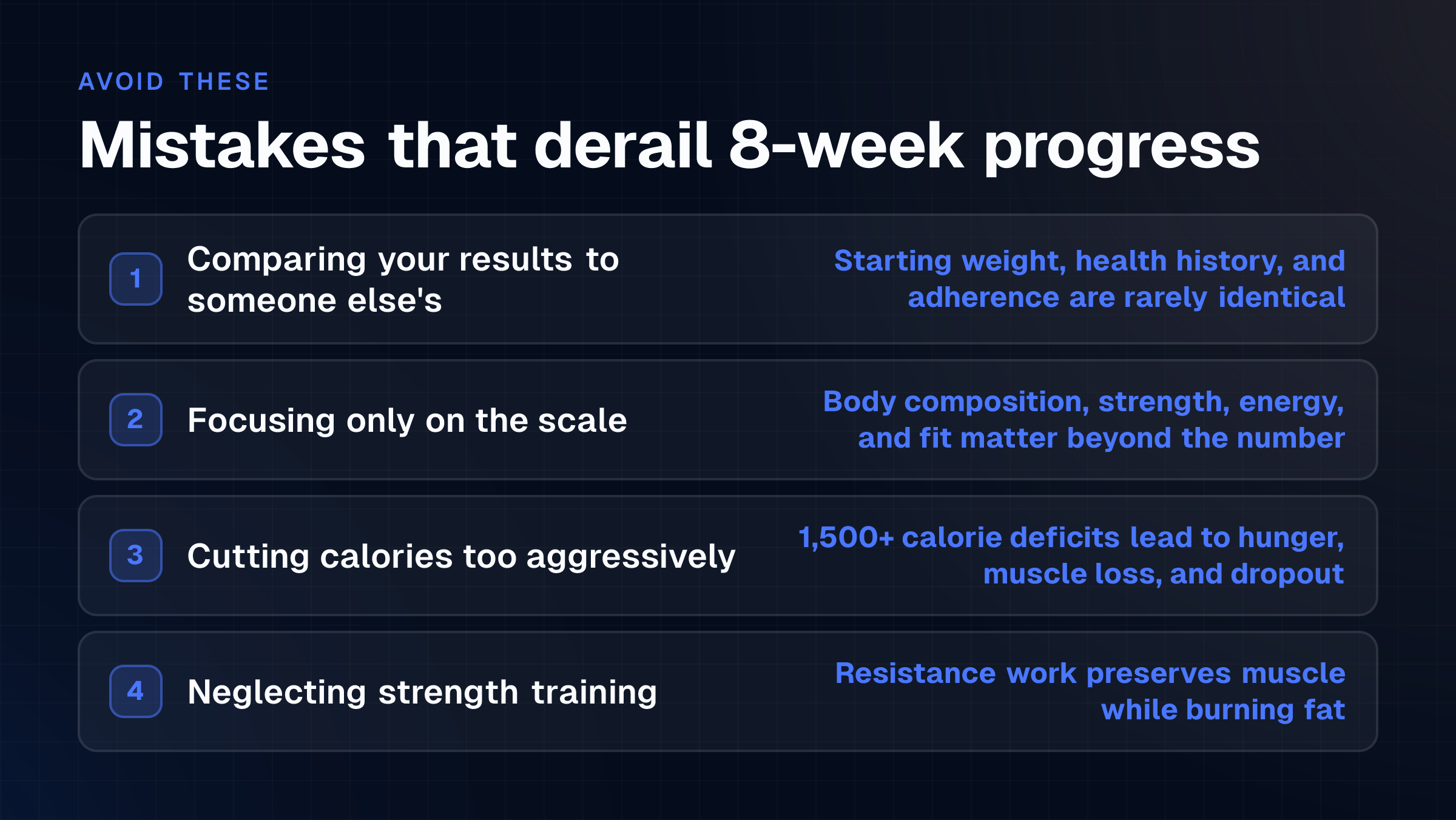
Comparing your results to someone else's
Both are solid progress.
Comparison kills motivation and ignores the fact that starting weight, health history, and adherence are rarely identical.
Focusing only on the scale
The scale doesn't capture everything. Body composition changes, muscle gain, fat loss, matter even if the number doesn't move dramatically. Strength improvements, energy levels, and how your clothes fit are also progress worth tracking.
Cutting calories too aggressively
A 500-1,000 calorie deficit is sustainable. A 1,500+ calorie deficit leads to hunger, muscle loss, irritability, and dropout.
Slow and steady wins.
Neglecting strength training
Cardio alone won't preserve muscle during weight loss. Resistance training, weights, bands, bodyweight, signals your body to keep muscle while burning fat. Include it in your plan.
How to choose or what to do next
Assess your readiness
Do you have 8 weeks ahead with minimal major disruptions, travel, illness, work chaos? Can you commit to logging your diet and weekly check-ins? Are you willing to follow a calorie and macro target?
If yes to most of these, you're ready.
Pick your workout style
You don't need a gym.
8WTC workouts are designed for home or gym, with flexible equipment options: dumbbells, resistance bands, bodyweight, yoga mats, or machines. Choose what you have or can access. Consistency beats perfection; a home dumbbell plan you'll actually follow beats a fancy gym membership you won't.
Set realistic expectations
Plan for steady progress, celebrate every pound, and remember that 8 weeks is the start, not the finish line. Medicines, health conditions, and age all play a role in how quickly you see changes.
For more on how to structure your 8 weeks, read How an 8-week Body Transformation Challenge Works. If you're new to this, check out Can Beginners Do 8WTC? Start Today.
FAQs
Is £149.99 worth it?
Entry costs £149.99. You get personalised workouts (home or gym), flexible calorie and macro targets, weekly check-ins, and access to the app for 8 weeks. Whether that's worth it depends on your budget and commitment level.
Do I need a gym?
No.
8WTC is designed for home or gym workouts, with equipment options ranging from dumbbells and bands to bodyweight alone. Choose what you have or can access. Consistency matters more than location.
How much time does this take?
The research doesn't specify exact session length or weekly hours required. Time investment depends on workout frequency and your diet-logging speed. Weekly check-ins are part of the structure.
If time is a concern, read 8WTC Objections: Time Investment & Realism for a deeper look.
Can beginners do this?
Yes. 8WTC is designed for all fitness levels.
Workouts scale to your starting point, and macro targets are flexible. If you're completely new to structured training or calorie tracking, you may need a week or two to adjust, but beginners succeed on the platform. For more, see Can Beginners Do 8WTC? Start Today.
Will I regain the weight after 8 weeks?
Not if you build sustainable habits during the challenge. Weight regain happens when you return to the eating and activity patterns that got you there in the first place.
If you use the 8 weeks to learn portion control, macro balance, and consistent training, you're far more likely to maintain results. For strategies to prevent regain, read Regain Prevention After 8WTC: Keep Results.
General guidance from the 8WTC team, not medical advice. Individual results vary. Always consult your doctor before starting a weight-loss or exercise programme.