How It Works
8WTC Objections: Time Investment & Realism
The 8WTC demands 4 hours of workouts per week across 4 sessions, with flexible scheduling for home or gym. Results come from consistency, not perfection—here's how the time commitment works in practice.

The 8-Week Transformation Challenge requires around 4 hours of workout time per week across 4 sessions of typically 60 minutes each, a realistic commitment for most schedules. The programme is built around flexibility: workouts can happen at home or in the gym, at any time that suits you, and nutrition targets use calorie and macro goals rather than rigid meal plans. Results don't depend on perfection; the 10,000+ documented transformations come from everyday people who missed workouts, had off-plan meals, and still progressed through consistent effort over eight weeks.
If you're hesitant about whether the challenge fits your life, this guide breaks down the actual time investment, shows how the scheduling works in practice, and addresses the fear that you need to be flawless to see change.
Quick answer: realistic weekly time commitment and flexibility
The core time demand is straightforward. Four workouts per week, each typically lasting 60 minutes, totalling roughly 4 hours of exercise weekly. Weekly check-ins, weighing in, taking progress photos, logging data, add minimal extra time on top of that core commitment.
The challenge is built to adapt to your life, not the other way around. Workouts don't have a fixed time slot. You fit them in when you can. The programme supports both home and gym training, so equipment access doesn't block entry. Nutrition is based on flexible calorie and macro targets, not meal plans you must follow exactly. You can hit your targets with the foods you already eat.
Results come from consistency, not perfection. Missing a session, going over your calorie target one day, or skipping a check-in doesn't undo your progress. Thousands of people have completed the challenge while managing work, family, and other demands, because the structure permits real life to happen.
What you need first
Before starting, clarify three things: your realistic weekly availability, your workout environment preference, and your relationship with nutrition tracking.
Assess your available time
Be honest about how many hours per week you can commit without burning out. The challenge asks for 4 hours of structured workouts, roughly an hour on four separate days. This is the non-negotiable core. Beyond that, weekly check-ins and app logging add time, but not a significant amount.
If you can't realistically find 4 hours spread across a week, the challenge will feel overwhelming.
Write down which days and rough times suit you best. You don't need to pick exact slots now, but knowing that Mondays and Thursdays mornings work better than weekends helps you plan.
Choose your training environment
The 8WTC programme offers both home and gym workouts. If you have gym access and prefer it, use it. If home workouts suit your schedule better, no commute, equipment already there, family obligations nearby, the app delivers those too. The workouts are designed to work in either setting; you pick based on what's most sustainable for you over 8 weeks.
Prepare for nutrition tracking
The app uses flexible calorie and macro targets (carbohydrates, protein, fats) rather than prescribed meal plans. You'll log what you eat to track progress against your targets. If you've never tracked macros before, this might feel unfamiliar at first. The learning curve is gentle, and the community within the app can help you navigate it.
You don't need specialist knowledge to start. The app guides you.
Step-by-step: how to navigate 8 weeks with flexible scheduling
1. Download the app and complete your initial setup
Start with the 8WTC app (iOS). Create your account, input your baseline measurements (height, weight, age), and set your goal, whether that's fat loss, muscle gain, or general fitness. The app asks about your environment (home or gym) and available equipment so it can personalise your workouts.
This setup takes 10-15 minutes. Happens once, at the start.
2. Review your first week's workouts and schedule them loosely
The app delivers your first week's four workouts immediately. Open each one to see the duration (typically 60 minutes), the equipment needed, and a full breakdown of exercises. You don't need to memorise anything, the app guides you through each session.
Pick which days suit you this week. If Monday and Friday mornings work, and Wednesday and Saturday afternoons work, block those in your calendar. The exact times can shift day-to-day; the structure is flexible.
3. Complete your first workout and log it
Do your first session whenever you've scheduled it. The app walks you through each exercise: sets, reps, and rest periods are all there. You can pause, rewind, or skip ahead if you need to.
Log the session when complete. This updates your progress tracker and builds accountability.
First workouts often feel harder than later ones because your body is adjusting. Normal and temporary.
4. Begin logging your nutrition
Each day, log your meals and snacks into the app. You're tracking calories and macros (protein, carbs, fats) against daily targets the app sets for you. You don't need to eat "clean", pizza, chocolate, and takeaway all count toward your targets. If you fit them in without exceeding your daily numbers, they're fine.
Logging typically takes 5-10 minutes per day once you learn where foods are in the app's database. Most common foods are already there; you search, tap, and the app calculates.
5. Check in weekly
Once per week (usually at the start or end of the week), weigh yourself and take a progress photo. The app prompts you to do this. Log the weight; this creates a trend line that shows progress over weeks, not just day-to-day fluctuation.
Weekly check-ins take 2-3 minutes. They're the data points that help you and the community see whether the plan is working.
6. Engage with the community feature
The app has a community section where you can see other participants' progress, ask questions, and share wins. This is optional but valuable: seeing others manage similar challenges (missed workouts, travel, plateaus) normalises the non-linear journey and keeps you motivated.
7. Adapt as you progress through 8 weeks
Weeks 1-2: Energy levels may dip as your body adjusts. Workouts feel harder. Nutrition logging is still new. This is the "adjustment phase", consistency matters more than intensity. Stick to the plan even if results aren't visible yet.
Weeks 3-4: Energy improves. Workouts become more familiar. You're likely seeing first visual or scale changes. Motivation is typically high here, ride it.
Weeks 5-6: Progress may plateau. Your body has adapted to the stimulus. This is where many people doubt the plan. Don't change everything; small tweaks (slightly different exercises, adjusted macros) help. The community often discusses this phase, lean on their experience.
Weeks 7-8: Final push. You're close to 8 weeks. Energy often returns. Many people see final visual changes here. Consistency in these last weeks matters as much as the first four.
Example scenario: fitting the challenge around a typical working week
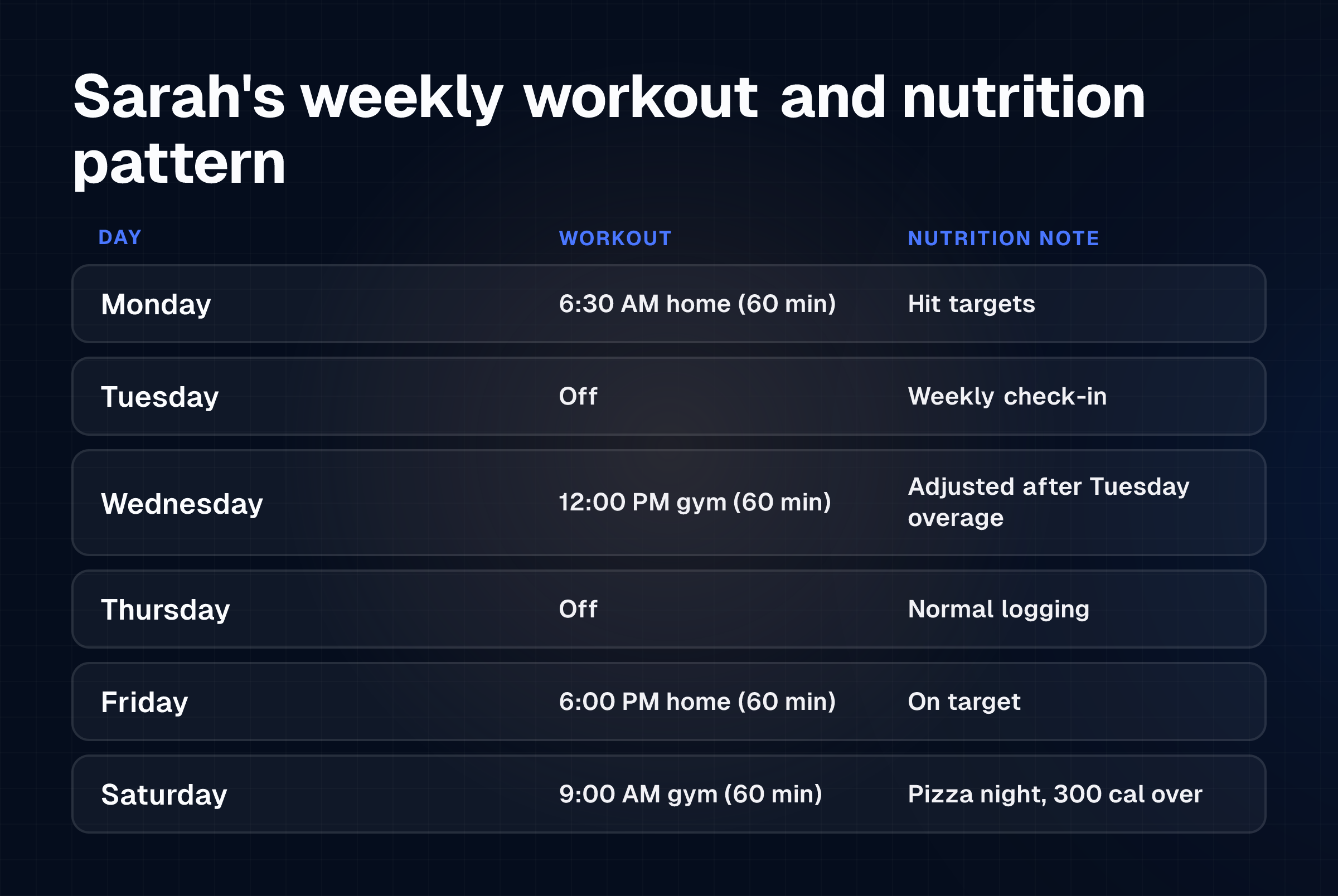
Sarah works 9-5, has two young children, and exercises sporadically. She's hesitant that the challenge will demand too much time or force her to eat a restricted diet.
Sarah's week:
- Monday 6:30 AM: 60-minute home workout before the children wake. (She has dumbbells and a mat at home.)
- Tuesday: Off, she logs her meals and takes her weekly check-in weigh-in.
- Wednesday 12:00 PM: 60-minute gym session during her lunch break (gym 10 minutes from work).
- Thursday: Off, normal day, logs meals.
- Friday 6:00 PM: 60-minute home workout after the children's bedtime.
- Saturday 9:00 AM: 60-minute gym session while a partner watches the children.
- Sunday: Off, meal prep for the week, light activity.
Sarah's nutrition:
Her daily target is 1,900 calories, 130g protein, 200g carbs, 60g fat. This week she ate:
- Monday: chicken, rice, vegetables, hit target.
- Tuesday: work lunch at a café, had a burger and fries, went 200 calories over; adjusted Wednesday down slightly.
- Wednesday: home-cooked curry, fits targets.
- Thursday: pizza night with family, went 300 calories over; didn't "restart" or panic, just moved on.
- Weekend: flexible, within or slightly over targets.
By the end of the week, her total calories and macros are close to targets across the 7 days. One high day or low day doesn't matter; the trend does.
Sarah's check-in shows a 1-pound loss this week, small, but consistent. Over 8 weeks, that compounds.
Why this works for Sarah: She fitted workouts into existing gaps (before work, lunch break, after children sleep). She ate foods her family eats, not separate meals. She missed nothing; she adapted.
Common mistakes to avoid
Expecting perfection from day one
Many people start strict, zero off-target meals, never missing a workout, then falter by week 3 and abandon the plan. Real change is built on consistency, not perfection. If you miss a workout, you've missed one of 32; it doesn't derail you. If you go over your calorie target one day, balance it across the week and move forward.
Not using the flexibility the app offers
Some people treat their workout time as fixed, or their meal plan as rigid. The app is designed to be flexible: workouts can move to different days, nutrition targets are daily averages (not hourly requirements), and the community supports life happening. Use this flexibility. If Wednesday doesn't work, move that workout to Thursday without guilt.
Ignoring the community feature
The community is the accountability backbone. When you're questioning whether to skip a session or when you hit a plateau, seeing others in the same boat, and how they pushed through, is powerful.
Isolation makes the challenge feel harder. Connection makes it feel normal.
Trying to out-exercise a poor nutrition habit
Workouts alone won't deliver results if nutrition targets aren't being met. The challenge depends on both moving consistently and eating at the right level. If you're logging everything but still not seeing progress after 3-4 weeks, review your nutrition honesty before blaming the workouts.
Overcomplicating the app
The app is simple by design. Search for a food, log it, check your totals. Don't spend an hour researching the "perfect" macro split or overthinking the timing of meals.
Log, track, adjust weekly. That's it.
FAQs
How much time do weekly check-ins really take?
Weekly check-ins, weighing in, photographing yourself, logging the data, take around 2-3 minutes. They're prompted by the app on your chosen check-in day, so you don't have to remember.
Can I move workouts around if my week changes?
Yes. The schedule is a guide, not a prison. If Friday doesn't work, move that workout to Saturday or Sunday. The app lets you reschedule. Consistency over the 8 weeks matters more than hitting a specific day.
What if I miss a workout?
You've missed one of 32 planned sessions. It doesn't undo your progress or disqualify you. Log the miss if the app asks, note it, and do the next session. People who complete the challenge successfully almost always miss 1-3 workouts over 8 weeks. Normal.
Do I need to eat "clean" to see results?
No. Your nutrition target is built into the app's calorie and macro goals. If you hit those targets with pizza, chocolate, or takeaway, you're on track. The app doesn't judge food choices, only whether your daily totals fit your targets.
Is the app difficult if I've never tracked macros before?
The app handles the maths for you. Search a food, log the amount, and it calculates macros automatically. The first week feels unfamiliar; by week 2, it's habit. The community and the app's guides help if you're stuck.
Do I need gym equipment, or can I do this at home?
Both are supported. If you have access to a gym and prefer it, choose gym workouts. If home works better, the app delivers bodyweight and equipment-free variations (or uses minimal equipment like dumbbells or resistance bands). You choose your environment when you set up.
General guidance from the 8WTC team, not medical advice. Individual results vary. Always consult your doctor before starting a weight-loss or exercise programme.