
Cardio Benefits Guide
Can You Out-Train a Bad Diet? Nutrition Plans vs. Workout-Only
Hard training alone cannot offset poor eating habits when your goal is to change body composition. Combined structure integrating personalised workouts with flexible calorie and macro targets consistently outperforms exercise-only programs.

Hard training alone cannot offset poor eating habits when your goal is to change your body composition. Studies consistently show that dietary changes drive weight loss more effectively than exercise on its own. You cannot build muscle without adequate protein, nor fuel intense workouts without carbohydrates. The body requires specific macronutrients to adapt to training stress. Combining structured eating with consistent training accelerates results by addressing energy balance, muscle repair, and workout performance simultaneously.
Introduction: Why Exercise Alone Falls Short
Training hard feels productive. You push through workouts, log your sessions, and expect the physique to follow.
The reality is tougher. A workout-only approach, one focused entirely on exercise without deliberate nutrition guidance, often leads to slower progress, frustration, and even burnout. Without proper fuel and recovery nutrition, intense training can exhaust your body faster than it adapts.
Your body composition changes only when you address both sides of the equation: what you do in the gym and what you eat outside it. This is why transformation challenges that integrate training and nutrition consistently outperform exercise-only programs. The 8 Week Transformation Challenge (8WTC), for example, combines personalised workouts with flexible calorie and macro targets, not because nutrition is nice to have, but because it's foundational to results.
Why It Matters: The Science Behind Combined Training and Nutrition
Exercise creates the stimulus for change. Nutrition provides the raw materials and energy to respond to that stimulus.
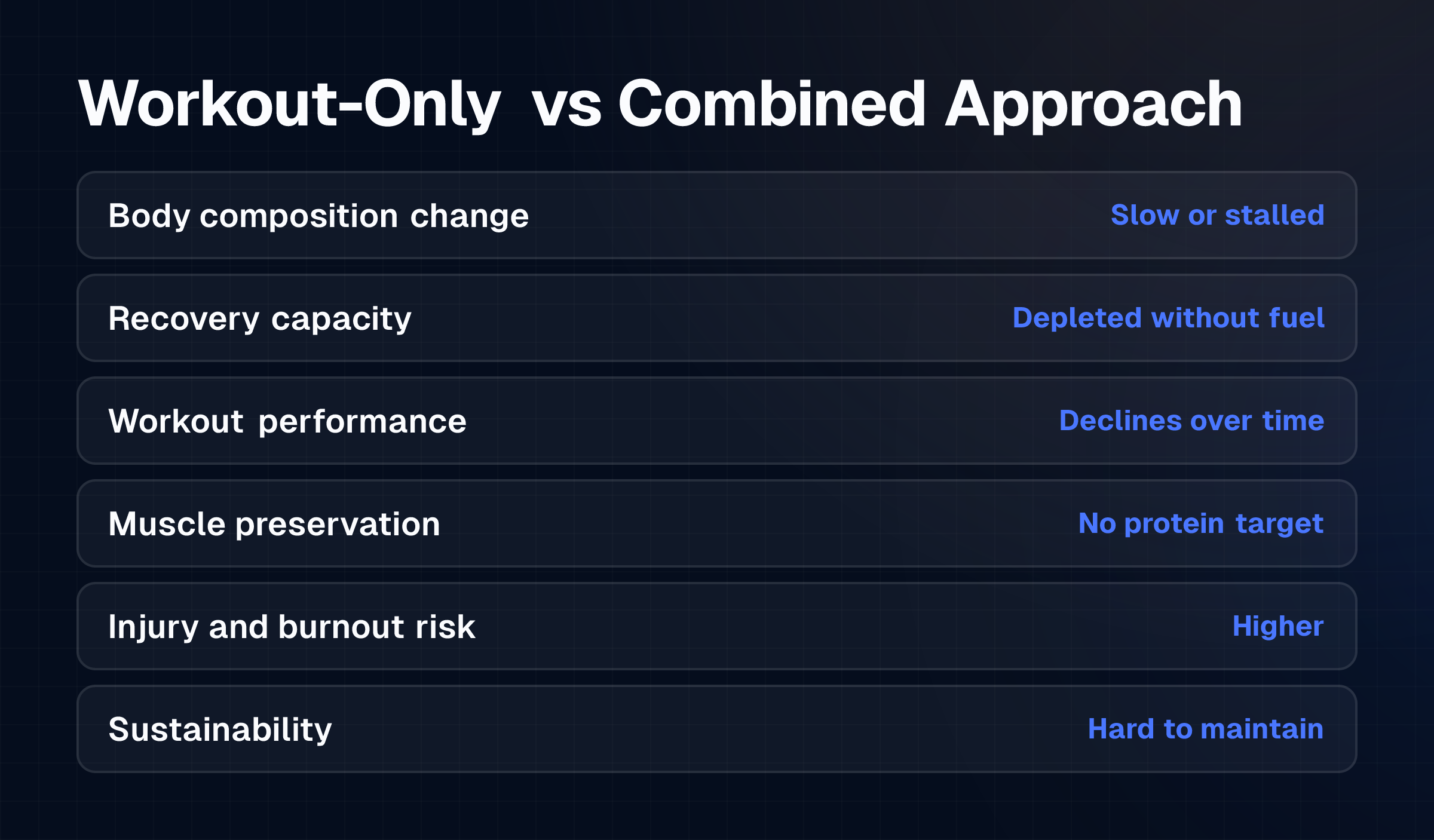
When you train hard without matching nutrition, several things go wrong. Limited body composition changes: you might build some strength, but fat loss stalls and muscle gains plateau. Hard training alone rarely produces the dramatic physique changes people seek. Fatigue and injury risk increase because intense workouts without adequate calories, protein, and carbohydrates drain your recovery capacity. Burnout and injury become more likely. Nutritional deficiencies creep in when you sideline the micronutrients and macronutrients your body needs to repair tissue, maintain energy, and stay healthy.
A combined approach works differently. When you structure both training and eating around your goal, whether that's fat loss, muscle gain, or body recomposition, your body receives a clear signal. The calorie balance (a deficit for fat loss, a surplus for muscle gain) determines overall weight change, while macronutrient targets (especially protein) preserve and build muscle. Carbohydrate timing supports workout performance. Together, they amplify results.
The 8WTC model reflects this reality. Participants follow personalised workouts for home or gym settings alongside flexible calorie and macro targets tracked via barcode scanning in the app. Documented transformations demonstrate what happens when structure meets consistency on both fronts.
Macronutrients and Energy Balance
Body composition change rests on two pillars: energy balance and nutrient composition.
Energy balance is the calorie maths. To lose fat, you consume fewer calories than your body burns; to gain muscle, you consume more. Without this baseline, neither training nor diet alone moves the needle.
Macronutrient targets layer precision on top. Protein supports muscle repair and growth, carbohydrates fuel workouts and recovery, and fats regulate hormones and nutrient absorption. A workout-only challenge ignores these entirely. A nutrition-integrated programme personalises them to your goal and current habits.
8WTC uses flexible dieting, calorie and macro targets you can hit with foods you actually enjoy. This isn't restrictive meal plans; it's structure within choice. Barcode scanning in the app lets you log quickly and stay on track without guesswork.
The Workout-Only Trade-off
A workout-only challenge seems simpler at first. No food logging, no macro calculations, no discipline around eating.
You train hard and hope results follow.
The trade-off is steep. Slower or stalled progress: most people trying to lose fat or build muscle discover that training intensity alone doesn't overcome poor nutrition. You might feel fitter but look the same. Unsustainable effort follows because without fuelling your workouts and recovery properly, you exhaust yourself faster. Sessions become harder to complete, motivation drops, and many people quit before 8 weeks end.
Many assume they can "out-train a bad diet." The research and real-world results consistently prove this wrong.
Why Combined Programs Deliver Different Results
When a challenge integrates both elements, participants benefit from aligned signals: your training stimulus and nutritional support work toward the same goal, not against each other. Proper nutrition means you can recover and return to hard training session after session, making sustainable intensity possible over the full eight weeks.
Combined structure produces consistent patterns: people who follow both the workout and nutrition components see measurable changes in photos, measurements, and how clothes fit.
Weekly Check-ins and Accountability
8WTC adds weekly check-ins to the mix. Logging your diet macros and submitting progress photos and measurements weekly creates a feedback loop, you see what works, adjust, and stay consistent. This accountability layer is missing from solo workout routines and explains much of why challenge participants stick with programmes longer.
Practical Steps: Getting Started With a Combined Approach
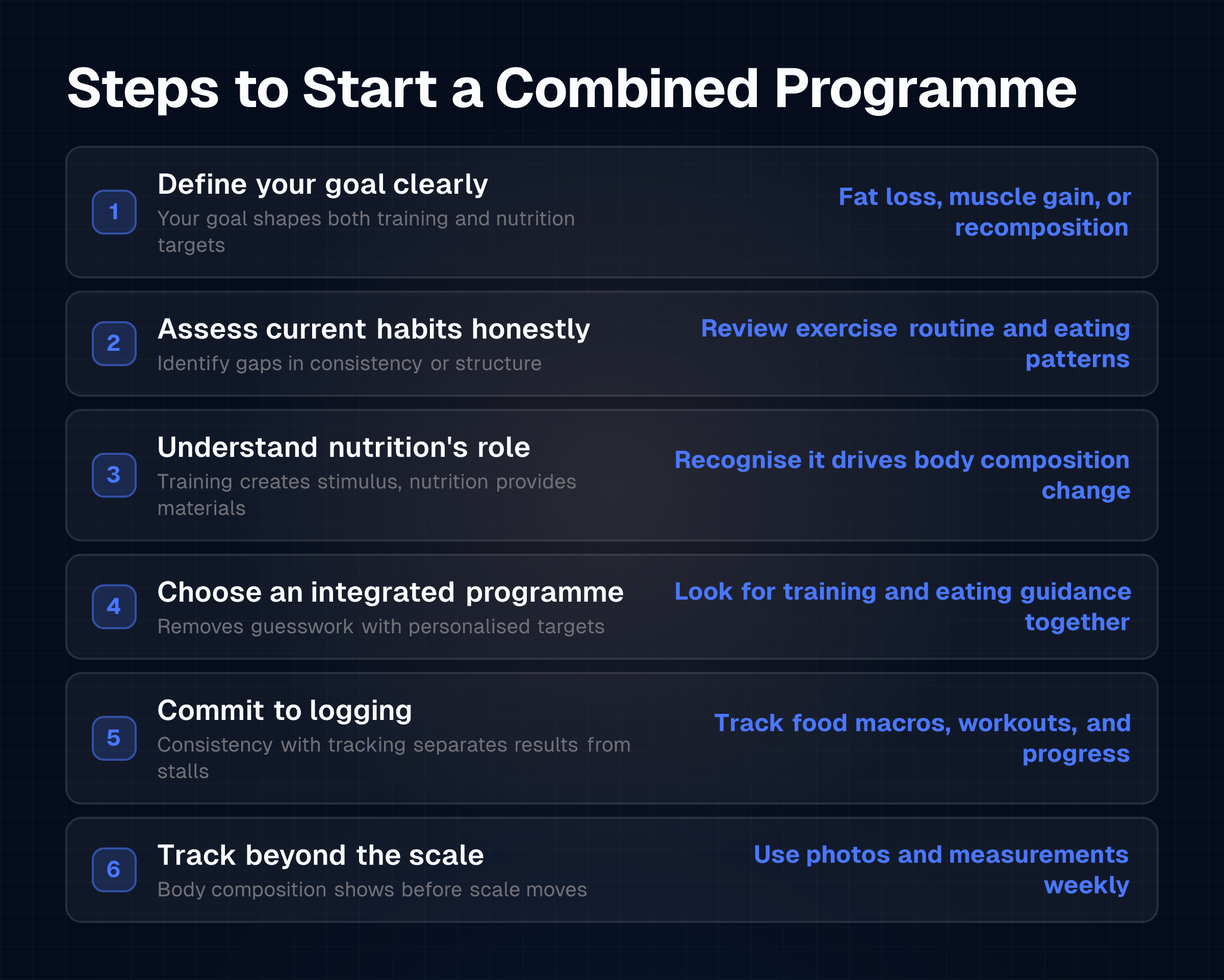
If you're considering whether to pursue a nutrition-integrated challenge or a workout-only one, follow these steps.
Define your goal clearly. Fat loss, muscle gain, or body recomposition? Your goal shapes both your training and your nutrition targets.
Assess your current habits honestly, review your exercise routine and eating patterns. If eating has been chaotic or restrictive, a flexible dieting approach may suit you better than a meal-plan-only model.
Understand the role of nutrition. Recognise that you can't sustainably change body composition through training alone; nutrition isn't an add-on, it's a driver.
Choose a programme that covers both. Look for challenges offering integrated guidance on training and eating. A well-designed programme handles the personalisation and removes guesswork. If you're just starting out, consider whether the challenge makes sense for beginners.
Commit to logging. Whether it's food macros, workouts, or weekly photos, consistency with tracking is what separates people who see results from those who don't. The 8WTC app uses barcode scanning to make food logging faster.
Track beyond the scale, take progress photos and measurements weekly. Body composition changes sometimes show in how you look and feel before the scale moves.
Stick to the full programme. Transformation takes time, and early progress isn't always obvious. Consistent effort across all eight weeks builds momentum that becomes visible later.
Key Takeaways
Nutrition planning isn't optional if you want body composition change. Hard training alone rarely produces the results people seek.
Energy balance matters first. You must control calories relative to your goal (deficit for fat loss, surplus for muscle gain). Macronutrients enable adaptation: protein, carbohydrates, and fats support muscle repair, workout performance, and recovery.
Combined structure accelerates results because programmes integrating both training and nutrition work faster than exercise-only challenges. They address the full picture. Flexibility beats restriction, flexible dieting with personalised calorie and macro targets is more sustainable than rigid meal plans, which is why many people stick longer and see bigger changes.
Accountability drives consistency. Weekly check-ins, logging, and progress photos keep you on track when motivation fades.
The full picture is in 8WTC vs Other Fitness Challenges: Key Differences.
General guidance from the 8WTC team, not medical advice. Individual results vary. Always consult your doctor before starting a weight-loss or exercise programme.