
Cardio Benefits Guide
How to Stay Consistent With Exercise for 8 Weeks
Consistency isn't a matter of willpower. This guide shows you how to build a system using scheduling, tracking, and accountability to finish your eight-week fitness challenge.

Consistency isn't a matter of willpower. It's a system you build and refine over time.
Rather than relying on motivation alone, successful challengers treat fitness as a structured habit anchored to specific times, measurable feedback, and community, not something they force through raw discipline.
Introduction: Building a System That Lasts
Finishing an eight-week fitness challenge means moving past the idea that consistency requires endless willpower.
Willpower is finite. Systems are sustainable. The difference between someone who quits after two weeks and someone who completes eight weeks lies not in their character but in how they structure their routine. By scheduling workouts as non-negotiable appointments, tracking progress week by week, and tapping into community support, you create conditions where showing up becomes easier than staying home.
This article outlines how to build that system and why each component matters.
Why It Matters: The Science Behind Sticking
Consistency works because it removes decision-making from the equation. Research on habit formation shows that specific, concrete plans, knowing when and where you'll exercise, increase the likelihood you'll actually do it. A study by Gollwitzer and Sheeran (2006) found that implementation intentions (detailed "if-then" plans) significantly boosted goal attainment compared to vague motivation alone.
Tracking progress is equally critical.
According to research by Michie et al. (2009) on effective health interventions, monitoring your own behaviour, logging workouts, nutrition, and weekly check-ins, provides reinforcement and helps you spot patterns that drive change. You see evidence of effort even when the scale moves slowly, which keeps you engaged.
Community and accountability amplify both. A meta-analysis by Carron et al. (2003) on group cohesion found that higher levels of social support predict better exercise adherence. Knowing others are on the same journey reduces isolation and raises the cost of skipping a session.
The ability to adapt when life happens, a work deadline, illness, a busy week, is what separates finishers from people who collapse after the first setback.
Define Your Internal "Why" First
Research by Ryan and Deci (2000) shows that intrinsic motivation, doing something because it matters to you personally, not for external rewards, predicts long-term adherence far better than external incentives alone.
Before you commit, identify what fitness means to you: better energy, confidence, strength, or simply reclaiming time for yourself. This personal anchor is what pulls you through week five when enthusiasm fades.
Schedule Your Workouts Like Appointments
Vague plans fail.
"I'll work out sometime this week" doesn't work; "I'll do my session Tuesday at 7 a.m. in my living room" does. Blocking out a specific time and place removes friction. When the time arrives, your brain treats it like a meeting you can't cancel. This is why How an 8-week Body Transformation Challenge Works emphasises planning: workouts that fit your life, not your life rearranged around your workouts, are the ones people actually finish.
Personalised home or gym workouts that adapt to your available equipment (dumbbells, resistance bands, barbells, machines, or bodyweight alone) mean no excuses about "not having the right setup." The workouts meet you where you are.
Track and Log Weekly
Monitoring creates feedback loops.
Logging your workouts in an app or journal shows you patterns: days you're most consistent, sessions you dread, weeks where energy dips. Logging nutrition, calories, macros, or both, gives data that connects effort to outcomes. Weekly check-ins (a photo, measurements, how you felt) remind you that progress is real even if it's not always visible on the scale.
This isn't about perfectionism. It's about awareness. You spot what works and what doesn't, then adjust.
Lean on Your Community
You don't have to do this alone. Find an accountability partner, join a fitness group, or simply share your goal with someone who'll check in on you. The act of telling someone else raises commitment. Knowing a community exists, people on the same journey, normalises struggle and celebrates wins.
Practical Steps: Building Your Consistency System This Week
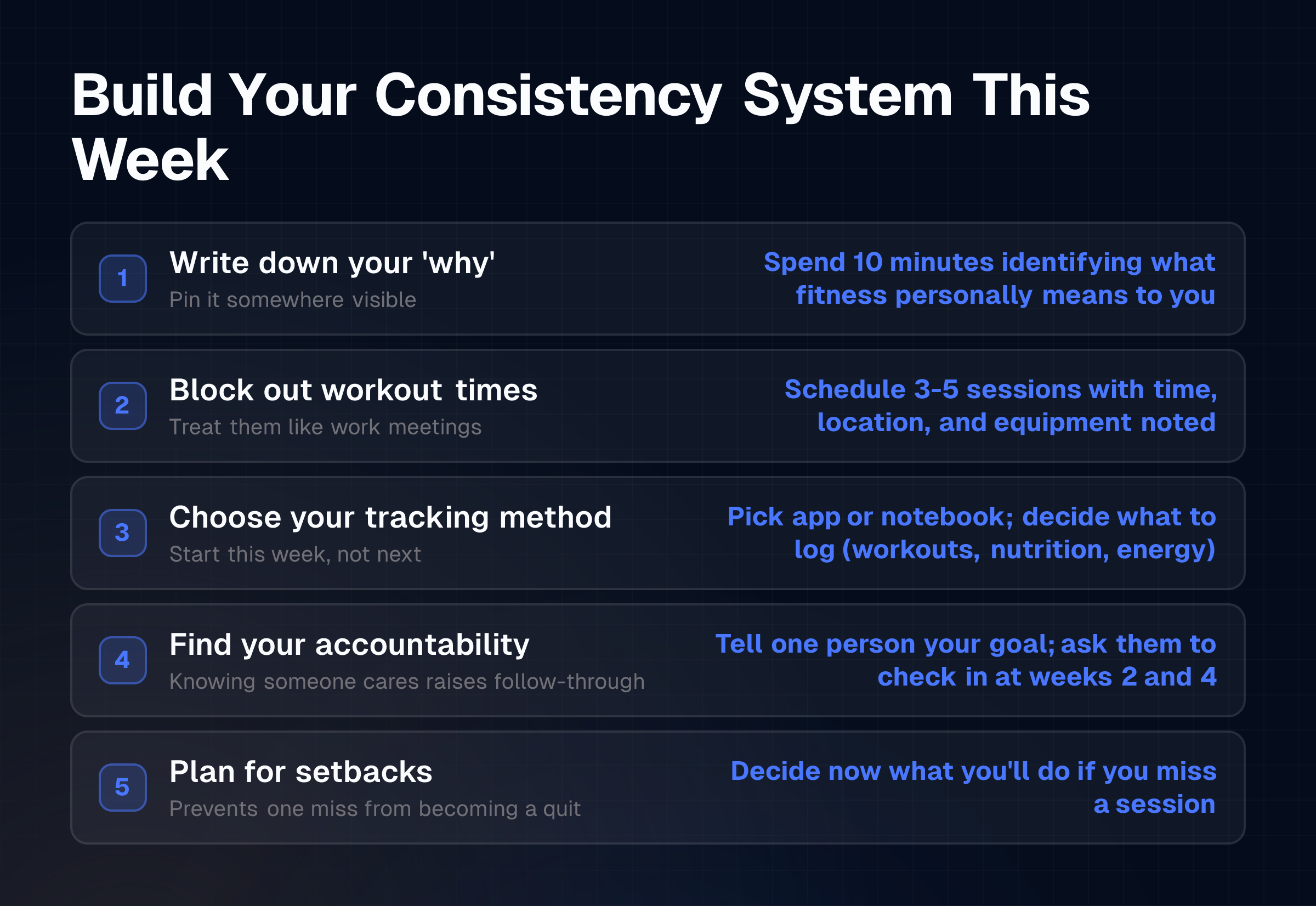
Write down your "why": Spend 10 minutes writing down why this matters to you. Not why you think it should matter, why it actually does. Pin this somewhere you see it.
Block out three to five workout times in your calendar: Treat them like work meetings. Write them down now. Include the time, the location (home or gym), and the equipment you have available. If Wednesday at 6 p.m. doesn't work, change it to a time that does. Consistency comes from realistic scheduling, not heroic discipline.
Choose your tracking method: Pick an app or a notebook. Decide what you'll log: workouts completed, calories or macros, energy level, how you felt. Start this week, not next week. Tracking from day one builds the habit.
Find your accountability: Identify one person (friend, family member, online community) who'll know about your goal. Tell them. Ask them to check in at the end of week two and week four. Knowing someone cares raises follow-through.
Plan for setbacks in advance: Life will happen. You'll miss a session. Decide now: if you miss a workout, what's your backup plan? Do you make it up the next day, or do you move on and pick up the next scheduled session? This "coping strategy" sounds small but prevents one missed session from becoming a full quit.
Key Takeaways
Consistency is a system, not a test of willpower. Build it with scheduling, tracking, and support.
Schedule workouts at a specific time and place, treating them like non-negotiable appointments. Log your progress, workouts, nutrition, weekly check-ins, to see patterns and stay motivated. Tap into community or accountability: tell someone your goal and let them help you stay on track.
Anticipate setbacks and have a plan for them. Missing one session isn't failure; abandoning the system is.
Real 8WTC member transformations illustrate what structured consistency looks like in practice, people following the plan around the demands of their actual lives.
General guidance from the 8WTC team, not medical advice. Individual results vary. Always consult your doctor before starting a weight-loss or exercise programme.