Guarantee
Money-Back Guarantee: Terms, Conditions & Peace of Mind
8WTC refunds your £149.99 entry fee if you complete all eight weeks, follow your personalised plan, log consistently, and your before and after documentation shows no measurable change. Here's what qualifies, what doesn't, and how to claim.

8WTC supports its £149.99 challenge entry with a performance guarantee: complete all eight weeks, adhere to your personalised plan, log your progress consistently, and if your before and after photos and measurements show no change, you receive a full refund. No change indicates no visible difference in body composition and no significant shift in measurements. The scale fluctuating by a few pounds is not the only criterion. 8WTC relies on photos and measurements to determine if a transformation has taken place. This guarantee applies solely to the one-time entry fee, not the £24.99/month membership that follows.
Most fitness programmes don't offer refunds at all, especially when they involve personalised coaching. Once you've accessed custom nutrition plans and workouts, that service can't be "un-delivered." 8WTC's guarantee exists because the programme is personalised and results-driven. If you do the work and the data shows nothing happened, the company refunds your entry fee.
Key takeaways: What 8WTC's money-back guarantee covers
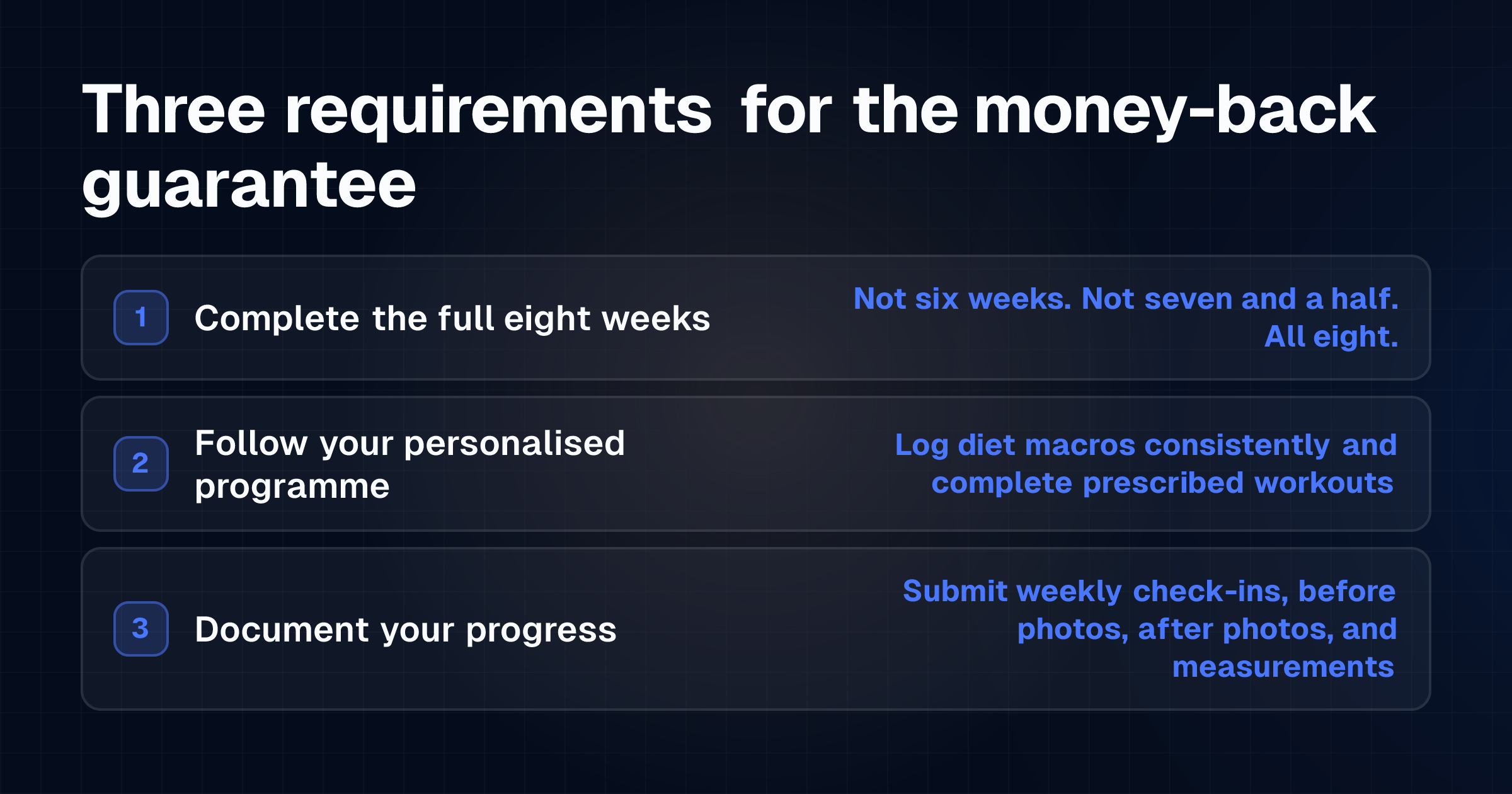
8WTC's guarantee is straightforward. Do three things and you're protected.
First, complete the full eight weeks. Not six weeks. Not seven and a half. All eight.
Second, follow your personalised programme: the nutrition targets (calories and macros adjusted weekly) and the workout plan you chose at sign-up, whether home-based or gym. This means logging your diet macros consistently and completing your prescribed sessions.
Third, document your progress. Submit weekly check-ins, before photos, after photos, and body measurements. 8WTC uses these metrics to determine whether measurable change occurred.
If you meet all three conditions and your before and after documentation shows no change, 8WTC refunds your £149.99 entry in full. Simple.
What the guarantee doesn't cover: The £24.99/month membership after week eight. That's separate. The guarantee applies to the eight-week challenge entry only.
What it means: Understanding fitness guarantees and how 8WTC's works
Money-back guarantees in fitness come in wildly different forms. Some apps offer vague "satisfaction guaranteed" promises with hidden eligibility clauses. Others exclude refunds entirely because value transfers the moment you access a custom plan or coaching session.
8WTC's approach is unusual.
The guarantee exists because the programme is personalised and outcome-focused, not despite it. Most coaching services argue that refunds aren't possible once you've received bespoke advice or plans. 8WTC flips that logic: if you receive a custom programme, follow it for eight weeks, and nothing happens, the company considers that a failure worth refunding. It's a trust signal. The business is confident enough in its system to stake your entry fee on documented results.
This isn't a "try it risk-free for 30 days" offer where you can bail at any time. It's a performance guarantee tied to mutual commitment: you do the work, 8WTC provides the system, and if the outcome doesn't materialise despite genuine effort, you get your money back.
Why it matters: Building confidence in your £149.99 investment
If you're hesitant about spending £149.99 without a safety net, the guarantee removes one major barrier. You're not gambling on unknown results. You're investing in a structured eight-week process with a financial backstop if measurable change doesn't happen.
This is especially valuable for first-timers who've never done a structured transformation programme.
You can commit knowing your money isn't at risk if you follow the plan and don't see change. That reduces anxiety and increases follow-through.
The guarantee also filters uncommitted sign-ups. People who want a refund without putting in effort won't meet the three conditions. It protects both you and the programme by creating clear, mutual expectations.
For risk-averse prospects, this transparency matters more than flashy promises. You know exactly what qualifies for a refund, what doesn't, and what you need to do to prove your case. No surprises.
How it works: The three requirements and refund process
To claim a refund, three things must happen.
1. Complete the full eight weeks. You must engage in the programme for the entire duration. Signing up and logging in twice doesn't count. This is the foundation of the commitment.
2. Follow your personalised programme. Stick to your custom nutrition targets, calorie and macro goals adjusted weekly based on your progress, and your personalised workout plan. You choose home or gym when you join; the workouts are structured around your available equipment. Following the plan means logging your diet macros consistently and completing your prescribed workouts.
3. Log your progress honestly. Submit weekly check-ins, before photos, after photos, and body measurements. This documentation is your proof of effort and participation. 8WTC uses these metrics, photos and measurements, to determine whether change has occurred.
If all three conditions are met and your before and after photos and measurements show no measurable change, 8WTC refunds your £149.99 entry fee in full.
The refund process is direct: you submit your documentation (photos and measurements), 8WTC reviews them against your starting point, and if no change is evident, the refund is processed.
Critical note: The monthly membership after the challenge (£24.99/month) is explicitly excluded from this guarantee. The guarantee covers the entry to the eight-week challenge only.
Example or scenario: A challenger's path to the guarantee
Here's how the guarantee works in practice.
Sarah signs up for the 8WTC challenge on Monday, 26 October for £149.99. She chooses home-based workouts because she doesn't have a gym membership. She receives a personalised nutrition plan with daily calorie and macro targets, plus a workout routine using bodyweight and resistance bands.
Over eight weeks, Sarah logs her workouts in the app, tracks her food using the barcode scanner, submits weekly check-ins, and hits the vast majority of her training sessions and nutrition targets. She's not perfect. She misses one session, goes over her macros a few days, but she genuinely commits.
At the end of week eight, she submits her final photos and measurements. The data shows a 4 lb increase in weight, but her body composition has improved: her waist measurement is down 1 inch, her chest is up half an inch, and visually she looks noticeably leaner in the photos.
This is measurable change, even though the scale went up slightly. The before and after evidence is clear. The guarantee is satisfied. Sarah sees results and keeps her money.
Now imagine Tom. He also signs up for £149.99 and commits to the process for the full eight weeks. He logs consistently, attends most workouts, tracks his nutrition. However, his before and after photos and measurements show no change: same weight, same measurements, no visible difference in body composition.
Tom meets all three conditions: he completed eight weeks, followed the programme, logged everything. But his documented results show no change. Under the guarantee, Tom receives his £149.99 refunded in full.
This second scenario is rare. Genuinely following an eight-week structured programme with personalised coaching typically produces measurable results. But the guarantee stands if it happens.
Common mistakes or risks: What disqualifies a refund claim
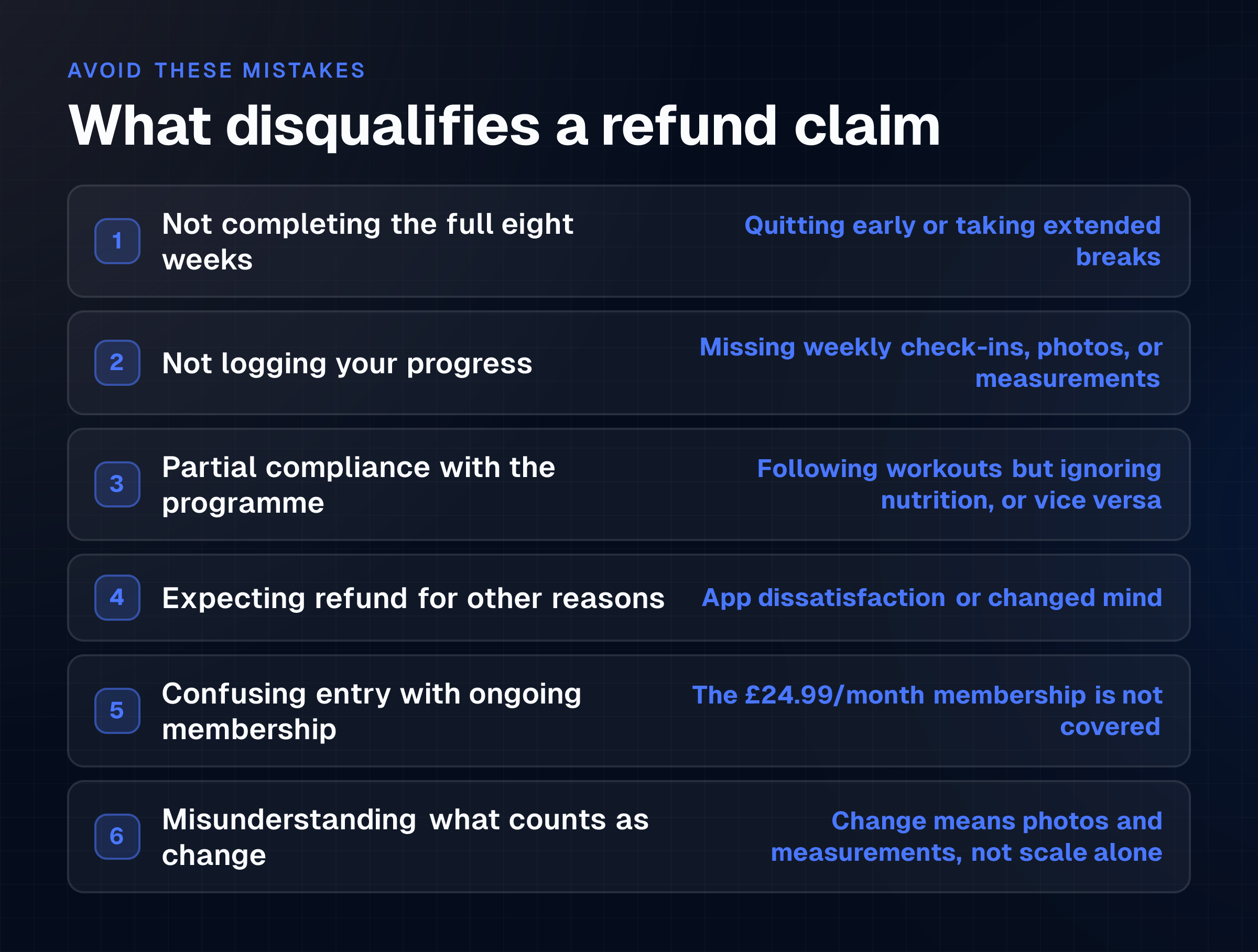
The guarantee is straightforward, but misunderstandings can prevent you from claiming it.
Not completing the full eight weeks. If you quit after week five or take an extended break, you're no longer eligible. The guarantee requires full participation.
Not logging your progress. If you don't submit weekly check-ins, before photos, after photos, or measurements, 8WTC has no documented proof of your effort or results. The before and after documentation is essential to the refund decision. Without it, the claim cannot be assessed.
Partial compliance with the programme. If you follow the workouts but ignore the nutrition plan, or vice versa, you're not following the full programme. The guarantee requires adherence to both elements.
Expecting a refund for other reasons. The guarantee covers one specific scenario: completion plus effort plus no documented change. It does not cover refunds for "I didn't like the app," "the workouts were too hard," or "I changed my mind." Those are outside the guarantee's scope.
Confusing the entry guarantee with ongoing membership. The £149.99 one-time entry is covered. The £24.99/month membership after week eight is separate and not refundable under this guarantee.
Not understanding what "change" means. Change is measured by before and after photos and body measurements. The scale moving up or down is one data point, but visual changes and measurement shifts are what define "measurable change" for the guarantee.
How to choose or what to do next: Beyond the guarantee
A money-back guarantee is valuable, but it shouldn't be your only criterion for choosing 8WTC. Consider the broader picture.
Documented results. 8WTC has over 10,000 documented transformations on record as of 20 October 2026. Real people, not fitness models, sharing real before and after photos. Real results from 8WTC members shows examples.
Coaching quality and personalisation. 8WTC's app-only coaching model adjusts your macro targets weekly based on your actual progress. This isn't a generic plan; it's adaptive. Understanding the 8-week body transformation process explains the mechanics.
Community and accountability. Everyone starts on the same Monday (26 October for the next challenge), which builds a cohesive, supportive environment. Weekly check-ins and group motivation keep you engaged.
Flexibility. You choose home or gym workouts when you join. Home workouts for 8WTC explained breaks down what's possible with minimal equipment.
Prize pool incentive. The 8WTC challenge includes an £18,000 prize pool with a top prize of £5,000, plus weekly giveaways. This adds a tangible goal beyond body transformation.
Beginner-friendly. First-timers often worry about whether they're "fit enough" to start. What beginners can expect from 8WTC addresses common concerns.
Before signing up, make sure the eight-week timeframe fits your life, you're ready to log food and workouts consistently, and you understand that the guarantee is a backstop, not a substitute for genuine effort.
FAQs
What counts as "no change" under the guarantee?
"No change" means your before and after photos and measurements show no measurable difference in body composition or physique. The scale moving slightly up or down isn't the sole measure; visual change (how you look in photos) and measurement shifts (waist, chest, limbs) are what 8WTC uses to assess change. If both photos and measurements show no meaningful difference, the guarantee applies.
Can I get a refund if I miss a few workouts or go over my macros sometimes?
The guarantee requires you to follow the programme, not be perfect. Minor slips, missing one session, overeating on a weekend, don't disqualify you. The expectation is genuine commitment and consistency, not 100% adherence. 8WTC uses your overall logging and engagement as the measure of effort.
What if I complete eight weeks, show improvement, but then want a refund anyway for another reason?
The guarantee covers one scenario: completion plus adherence plus no documented change equals refund. If you see results but want your money back for other reasons (you didn't like the app, you prefer a different programme, you changed your mind), those are outside the guarantee. It's not a "satisfaction guaranteed" blanket refund; it's a performance-based promise.
How long does the refund take after the eight weeks end?
That timing detail is not covered in this comparison. For exact processing timelines, consult the terms at 8WTC's official site.
Does the guarantee cover the £24.99/month membership after week eight?
No. The guarantee covers only your £149.99 one-time entry to the eight-week challenge. Any ongoing membership (£24.99/month after the challenge ends) is separate and not covered by this guarantee.
What if I have a legitimate reason for not completing the eight weeks, like an injury or family emergency?
The guarantee requires full participation for eight weeks. Exceptions or case-by-case reviews are not detailed here. If extraordinary circumstances prevent you from completing the challenge, contact 8WTC directly to discuss your situation.
General guidance from the 8WTC team, not medical advice. Individual results vary. Always consult your doctor before starting a weight-loss or exercise programme.