
Cardio Benefits Guide
Fitness Challenge Ideas: Choose a Format You Can Stick With
Fitness challenges vary from rigid 8-week programmes to flexible app-based models. This guide walks through six decision points—goal, time, accountability, structure, incentives, and continuation—so you can pick a format that matches your lifestyle and builds lasting habits.

Fitness challenges come in many formats, from rigid 8-week programmes to loose community-driven models, and picking the wrong one for your lifestyle leads to burnout or wasted money. The choice depends on how much time you have, what motivates you, whether you need external accountability, and whether you're chasing a quick result or building lasting habits. This guide walks through six key decision points so you can pick a challenge format that actually sticks.
Introduction: What Makes a Fitness Challenge Work Long-Term
Not all fitness challenges are built the same.
Some lock you into a fixed workout schedule with strict nutrition rules. Others offer flexibility but rely on you to stay disciplined. A few combine structure with a supportive community. The fitness market now includes challenges ranging from app-only programmes to group-coaching models, often with cash prizes to sweeten the commitment.
Before you search "transformation challenge" or "fitness challenge ideas," know this: the right choice depends on your goal, your schedule, your personality, and what happens after the final week. A challenge that works for someone training five days a week at a gym may fail for someone who can only commit to three home workouts. A programme that motivates through competition might burn out someone who thrives on steady, solo progress.
Why It Matters: Long-Term Habit Building Over a Quick Fix
The difference between a challenge that transforms your life and one you abandon in week four comes down to alignment. When a fitness challenge matches your lifestyle, you show up. When it doesn't, you quit, and often feel worse about yourself than before you started.
Most people chase fitness challenges for one of two reasons: they want visible results fast, or they're looking for the structure and accountability to finally stick with healthy habits. Both are valid. What matters is finding a format you can sustain. A heavily structured programme works brilliantly if you enjoy following a plan and you have the time. A community-driven challenge suits people who struggle alone but thrive when others are doing it too. A flexible app-based model works if you have high self-discipline and prefer autonomy.
Research into habit formation shows that consistency matters far more than perfection.
Missing one workout or one meal off-plan is not a failure, it's normal life. What counts is whether you pick up the next day and keep logging, keep showing up. Early visible changes, clearer skin, reduced puffiness, better energy, often appear within three weeks and can significantly boost motivation before the scale shifts.
The Details: Matching Challenge Formats to Your Needs
Define Your Goal
Start specific.
"Get fit" is too vague. Are you aiming for general fitness, weight loss, muscle gain, or body recomposition (losing fat while building muscle)? The clearer your goal, the easier it is to pick a challenge designed for it.
Structured programmes may focus on "general fitness," "weight loss," "muscle gain," or "recomp." Knowing which one aligns with what you actually want means the workouts and nutrition guidance will serve you, not work against you.
Assess Your Lifestyle and Time Commitment
This is where most people go wrong. They pick a challenge that looks impressive and then realise they don't have the time.
Be honest about:
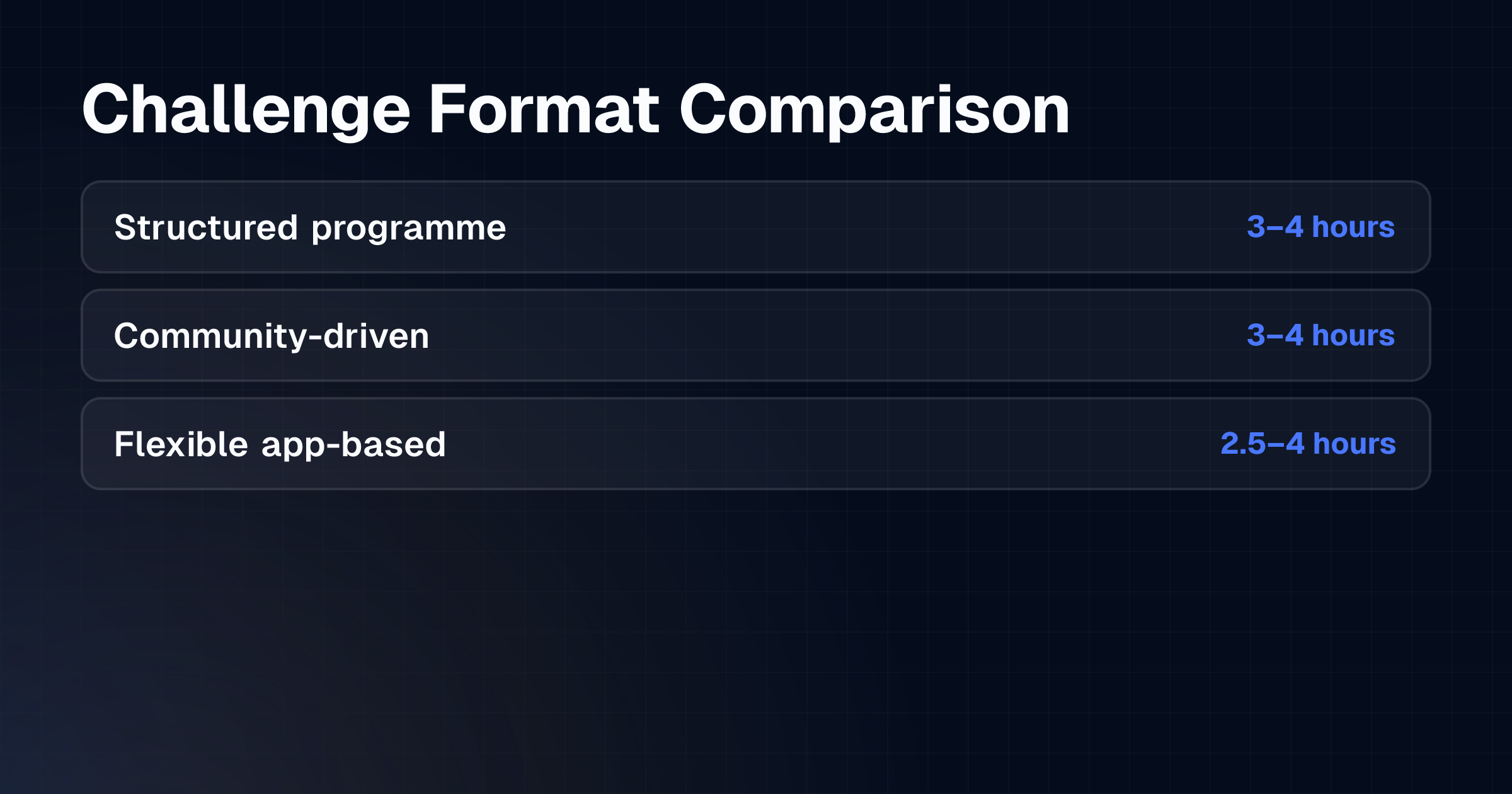
- Weekly hours available. A typical structured challenge might ask for 4 sessions per week at 45 minutes each. That's 3 hours per week, plus meal prep and tracking time. Can you do that every week?
- Where you prefer to work out. Do you have access to a gym, or do you train at home? Some challenges are home-workout-friendly and require only bodyweight, resistance bands, dumbbells, and a yoga mat. Others assume gym access.
- Your schedule volatility. If your work or family life is unpredictable, a rigid schedule will frustrate you. A more flexible app-based model might suit better.
If you're unsure whether a time commitment is realistic, explore how to fit an 8-week challenge around a demanding schedule.
Consider Your Accountability Needs
Some people thrive alone. Others need external deadlines and community pressure to stay on track.
Neither is wrong, it's just personality.
External deadline people often do well in structured programmes with fixed start and end dates, weekly check-ins, and progress tracking. The app becomes a habit: logging your food, uploading weekly photos, hitting your macro targets.
Community-driven people perform better when they're part of a group working toward the same goal. Shared wins, shared struggles, and peer support keep motivation high. Weekly check-ins with a supportive community can transform a solitary slog into something you actually look forward to.
Solo trackers may prefer a flexible app-based model where they set their own pace and log independently, without feeling watched or compared.
Evaluate Programme Structure and Support
Consider the trade-off between structure and flexibility:
- Highly structured: Predefined workouts each week, fixed nutrition targets (calories and macros adjusted weekly), clear progression. Best for beginners or people who want to remove decision-making. Risk: if life disrupts your schedule, the rigid plan feels like failure.
- Flexible: Personalised workout options (home or gym), adjustable calorie and macro targets, guidance rather than prescription. Best for experienced exercisers or people with unpredictable schedules. Risk: requires more discipline and self-direction.
Look for programmes that offer nutrition guidance (not just workouts), include weekly check-ins to keep you accountable, and provide a supportive community so you're not isolated.
Understand the Role of Incentives
Cash prizes can be a powerful motivator, but they shouldn't be your only reason to join a challenge.
Winners like Leah and Rosalind have achieved significant success in past challenges. For many participants, the opportunity to win real money enhances their motivation and commitment.
However: Use prizes as a boost, not the sole driver. If you stop the moment you're out of the running, you've missed the point. The real win is the habit you build.
Review Duration and Continuation Options
Challenge duration varies. This is long enough to see real progress and build new habits, but short enough that the commitment feels manageable.
What matters more than the length is what happens after. Does the programme support you to continue on your own, or do you drop off a cliff at the end? Look for challenges that teach you sustainable practices extending beyond the finish line.
Practical Steps: How to Choose Your Challenge Format
Step 1: Write down your goal (not "get fit", be specific).
Example: "Lose 10 kg and feel stronger in daily life" or "Build visible muscle in my arms and chest."
Step 2: Audit your time.
Count the hours per week you can realistically dedicate to workouts and meal prep. Add 20 percent as a buffer for life getting in the way. If you have fewer than 2.5 hours available, pick a low-commitment challenge. If you have 3-4 hours, a standard programme fits. If you have more than 4 hours, you can handle a demanding one.
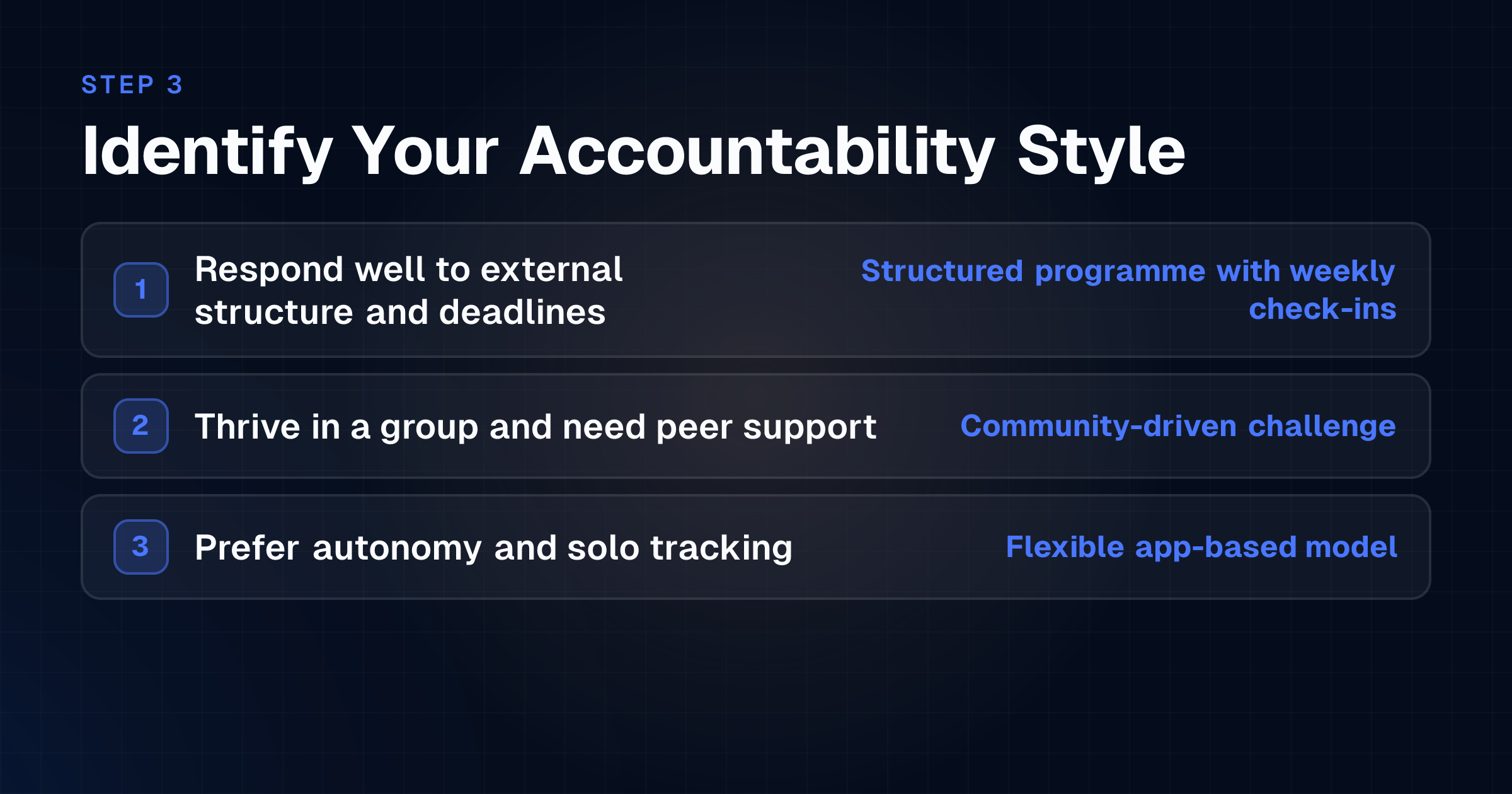
Step 3: Identify your accountability style.
Do you:
- Respond well to external structure and deadlines? → Structured programme with weekly check-ins.
- Thrive in a group and need peer support? → Community-driven challenge.
- Prefer autonomy and solo tracking? → Flexible app-based model.
Step 4: Choose home or gym.
Can you access a gym consistently? If no, pick a challenge that works without a gym. If yes, check whether the programme lets you choose. Flexibility here removes a major source of friction.
Step 5: Review the nutrition approach.
Does the programme offer flexible calorie and macro targets, or is it prescriptive meal plans? Can you adjust targets if life changes? Does the app support barcode scanning to make logging easier? If nutrition tracking stresses you, pick a less rigid approach.
Step 6: Check what happens after the final week.
Is there a pathway to continued support, or are you on your own? If ongoing access matters to you, factor this into your choice and budget.
Step 7: Decide whether prizes matter.
Incentives can boost commitment. Pick based on what actually motivates you to keep showing up.
Key Takeaways
Fit matters more than features. The best challenge is the one you'll actually stick to. A fancy programme you abandon is useless.
Be honest about time. Overcommitting leads to burnout. Know how many hours per week you can realistically give, and pick accordingly.
Know your accountability style. Structure, community, or solo tracking, each works for different people. Pick the one that matches how you're wired.
Consistency beats perfection. Missing one day or one meal off-plan is not failure. The challenge is built for real life, not perfection. Log the next day and move on.
Early wins matter. You may see clearer skin, better energy, or reduced puffiness within three weeks, before the scale moves. These visible changes can sustain motivation through harder weeks.
Plan for what comes next. Look for challenges that teach you habits lasting beyond the programme. Check whether it supports continued access or community after you finish.
Fitness Challenge Ideas: Build Your 8-Week Plan dives deeper into structuring your workouts, and How to Stay Consistent With Exercise for 8 Weeks covers the mindset shifts that keep you on track when motivation dips.
General guidance from the 8WTC team, not medical advice. Individual results vary. Always consult your doctor before starting a weight-loss or exercise programme.